مأزقي الشخصي — ماردين إسحاق
خلاصة مقال «My Personal Zugzwang» للكاتب ماردين إسحاق (Mardean Isaac) في نشرة The Republic of Letters: كيف ورث الشطرنج عن أبيه وجدّ أبيه، ولماذا يرفض أن يتعلّمه بعد أكثر من ألف مباراة، وكيف صار «مأزق النقلة» صورةً لحاله.
 ↗ اقرأ المقال الأصلي
الأرقام بين معقوفين مثل [¶7] تشير إلى رقم الفقرة في المقال الأصلي، لمن أراد أن يتحقّق من موضع الكلام.
الخلاصة في دقيقة
إن لم تقرأ غير هذه الفقرة
تعلّم الكاتب الشطرنج من أبيه، وتعلّمه الأب من جدٍّ له فرّ من إبادة الآشوريين، ويرى الكاتب في الرقعة ساحةً تنقلب فيها المواجهة مع العالم مواجهةً مع النفس. وبعد أكثر من ألف مباراة رفض فيها عمداً أن يتعلّم، يعترف بأن رفضه يتيح له التهرّب من مواجهة نفسه ويحرمه من متع أرفع. ثم يتوقّف عند مأزق النقلة (Zugzwang)، وهو أن تُجبَر على التحرّك وكلّ نقلة متاحة لك تسوء بها حالك، فيبدو له صورةً تقريبية لوجودنا البيولوجي في مواجهة الزمن. وينتهي إلى أنه وقع فيه، فلا التوغّل في الشطرنج يخلو من عيب، ولا هجره.
1 · الآباء والأبناء وشطرنجٌ موروث
ينطلق الكاتب من عبارة سمعها قبل سنوات، ويتتبّع طريق الشطرنج إليه عبر أبيه وجدّ أبيه — [¶5 – ¶8]
يستعيد الكاتب عبارةً قالها له شخصٌ يخاطبه المقال دون أن يسمّيه، ومفادها أن أسعد لحظاته حين يكون مع أبيه يتابعان البيسبول ويشربان الويسكي ويتحدّثان عن الهولوكوست. ورأى الكاتب في العبارة خريطة لعلاقة الآباء بالأبناء، إذ يواسي الأب وابنه كلٌّ منهما الآخر [¶5].
وأبو الكاتب تعلّم الشطرنج طفلاً من جدّه الذي فرّ من الإبادة الجماعية للآشوريين، ولم يلعبا معاً إلا مباراة واحدة، لكنها رسّخت مبادئ انتقلت إلى الكاتب. وقد مسّه أن يقترن ذكر الإبادة في تلك العبارة بإرث الأجداد هذا؛ فإن كانت الإبادة أقصى درجات الانهيار، فالحديث عنها إلى جانب القواعد والألعاب يؤكّد في نظره أهمية أن نعلّم اللعب الصحيح واللعب الجيد، وهما لا يتطابقان دائماً [¶6].
ولا يحفظ من مبارياته الأولى مع أبيه إلا صمتاً حميماً يقطعه صوت الأب بين حين وآخر. واشتدّت رغبته في الفوز أوّل الأمر، ثم صار إغراء النصر أوهن، لأن الفوز سيُثبت أنه فقد ما كان يحتمي به من يقينٍ بتفوّق أبيه. وتبيّن له لاحقاً أن مواجهة العالم على الرقعة مواجهةٌ مع النفس لا تنتهي.
أمّا الرقعة نفسها فكان وجودها طوال طفولته نداءً صامتاً يتّهمه بقصور محتمل، خفت حين ابتعد عن اللعبة في مراهقته، لكن الكاتب احتفظ بغرور خامل بقدراته الكامنة [¶8].
2 · غرورٌ ينكسر، واستسلامٌ ضاحك، ونصيحة كارلسن
تكسر هزيمةٌ سهلة غرور الكاتب، ثم تفتح له نصيحةٌ منقولة عن كارلسن باب اللعب — [¶9 – ¶13]
وقد انكسر هذا الغرور قبل نحو 15 عاماً، إذ هزمه صاحبُ تلك العبارة بلا عناء [¶9]. وبعد سنوات قليلة لعب الكاتب في شقّة صديقٍ بشرق لندن، ولمّا جلس قبالته ثملاً، أسقط ملكه مستسلماً قبل أي نقلة، ومدّ يده مصافحاً، فانفجر الاثنان ضاحكَين [¶11].
وفي فبراير أخبره صديق آخر بأنه انغمس في اللعبة بتشجيع من كلام ماغنوس كارلسن (Magnus Carlsen)، ونقل عن كارلسن أن المرء يستطيع اقتحامها بجرأة دون إفراط في التحسّب والتخطيط. فبدا للكاتب أن هذا التشجيع فكّ قيداً في نفسه، ومنذ ذلك الحين لعب أكثر بكثير ممّا لعب في سائر حياته [¶13].
3 · أكثر من ألف مباراة وطريقٌ مسدود من صنع يديه
يعترف الكاتب بأنه يرفض التعلّم عمداً، فيبقى أسيرَ دائرةٍ يتهرّب بها من مواجهة نفسه — [¶14 – ¶18]
لكنه بعد أكثر من 1,000 مباراة بلغ طريقاً مسدوداً صنعه بنفسه، فهو يرفض أن يسعى عمداً إلى تطوير لعبه. ثم يسأل: هل يمكنه أن يدافع عن شطرنج فطري تعبيري؟ ويجيب: «على الأرجح لا»، فهو يحرم نفسه من متع ومكاسب أرفع، لأن التحليل العميق قد يعيد تشكيل اللاعب نفسه مع كلّ مباراة [¶15].
وعلى chess.com تصير حاله أرجوحة خوارزمية: كلّما صعد واجه خصوماً أقوى يعيدونه إلى الأسفل، ثم يرفعه خصوم أضعف إلى مستواه السابق. وبقاؤه أسيرَ هذه الدائرة يتيح له التهرّب من مواجهة نفسه، لكن فوزه ليس ثمرة تحسّن حقاً، ولا خسارته نتيجة ضعف يُعالَج بالاجتهاد، فلا يذوق للنصر نشوة حقيقية ولا للهزيمة ألماً صادقاً.
ومع ذلك يستمتع متعة بلهاء بمكاسب طفولية. لكنه يرى متعاً كهذه ملوّثة برخص ثمنها، ويعدّ إهانةً لقيم اللعبة أن ينجرف في المباراة بلا خطّة.
4 · القطع ممثّلون في دراما وجودية
مع الوقت صارت كلّ قطعة في نظر الكاتب شخصيةً لها طبعها ودورها — [¶19 – ¶24]
يبسط الملك سلطته حين يكون آمناً، فإذا اقترب من الهزيمة وفقد حرسه لم يعد إلا لحماً ودماً. لكنه عند اليأس يستعيد ما يليق برتبته، فيرافق بيدقاً حتى يبلغا نهاية الرقعة فيصنعا ملكة، ويلوح احتمال نهضة [¶19].
أمّا الفيلة فمراوغة لا يُؤمَن جانبها، والرخّ على النقيض صلب، يلزم زاويته أنبلَ من أن يخوض مناوشات الافتتاح، فهو الأمل الذي نعلّقه على ما ندّخره [¶21].
5 · ما الذي يعلّمه الشطرنج؟
يشكّ الكاتب فيما علّمته اللعبة، ويتأمّل ما تكشفه عن حدود المرء — [¶25]
ما إن أقبل الكاتب على اللعب حتى أحسّ بتغيّر خفيّ في تفكيره بدا متّسقاً مع دروس الشطرنج، لكنه يتساءل: هل هذا صحيح حقاً؟ ويرى أن الناس يُسقطون أنفسهم على معنى اللعبة، فالمخرج ستانلي كوبريك (Stanley Kubrick) قال خلال مقابلة مع Playboy إن الشطرنج يعلّم التروّي قبل الأخذ. لكن مقالاً عنه في The New Yorker عام 1966 يكشف تحت هذه الحكمة معدناً أخسّ، إذ تظاهر كوبريك بالعذاب ليغري الصحفي بنقلة ظنّها قاتلة، وكانت فخّاً. ويرى الكاتب أن اللاعبين يلتزمون القواعد المعلنة، لكنهم كثيراً ما ينالون أفضليتهم من قواعد خفية.
ومنطق الشطرنج عنده قائم خارجنا، ومع ذلك تمسّ كلّ نقلة صاحبها في الصميم؛ فهل من شيء يكشف للمرء حدوده ويؤلمه أكثر من نقلة غبية يرتكبها، أو نقلة قاتلة تفوته؟ والعجز عن رؤية الأمور بموضوعية يقود غالباً إلى ضربٍ من هزيمة الذات لأنه يسدّ طرق التقدّم.
6 · مأزق النقلة: لا سكون ولا مخرج
يشرح الكاتب المصطلح ويمدّه إلى الحياة، ثم يكتشف أنه يعيشه — [¶26 – ¶27]
وهنا يبرز مأزق النقلة، ومعنى اسمه بالألمانية الإكراه على النقلة، وهو موقف لا خيار لك فيه إلا نقلة تسيء إلى وضعك. ولا مخرج منه إلا الاستسلام، وهو ليس مخرجاً أصلاً، ويرى الكاتب في ذلك دلالة مجازية قاتمة [¶26].
ويبدو له أن المفهوم يمتدّ إلى وجودنا البيولوجي في مواجهة الزمن: فالعبء عليك دائماً، ولا سكون، وكلّ نقلة إمّا تقدّمك وإمّا تسيء إليك. وأنت مسؤول دائماً عن دفع نفسك إلى الأمام، ولو إلى العدم، بل إليه خصوصاً. وأسوأ ما يؤكّده المفهوم أنك مسؤول عن صنع الشروط التي دفعتك نحو هزيمتك.
ويختم بأنه لم يعد قادراً على التشبّث بهذه اللحظة: فإمّا أن يقبل بأن عليه الآن التوغّل في غابة الشطرنج التي لا آخر لها، وإمّا أن ينسحب تماماً تاركاً هذا المقال أثراً وحيداً لتجواله على أطرافها. وحين يتأمّل عيوب الخيارين يقول:
«أدرك أنني قد وقعت في مأزقي الشخصي»
ملاحظات على المصدر
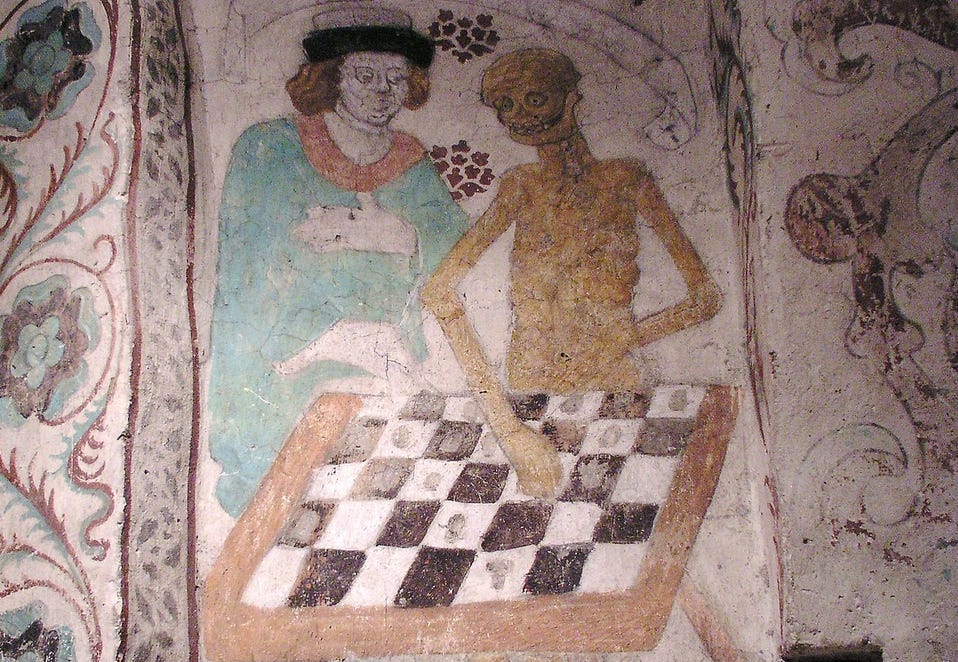
- تسبق المقالَ كلمةٌ قصيرة من النشرة موقّعة بـROL، تقول إنها سعيدة بأن تنشر لأوّل مرّة لصديق عزيز هو الكاتب [¶1 – ¶3]. ويعرّفه آخر الصفحة بأنه كاتب ومحرّر يقيم في لندن [¶28]، وتُنسب الصورة إلى Albertus Pictor [¶29].
- نقلنا Zugzwang بالمعنى إلى مأزق النقلة.
المنهجية. أُعدّ هذا الملخّص في 15 سبتمبر 2026 من نصّ مقال My Personal Zugzwang للكاتب ماردين إسحاق (Mardean Isaac)، كما نُشر على صفحته في نشرة The Republic of Letters على منصّة Substack في 13 سبتمبر 2026 بعنوان فرعي A Love Affair With Chess. حُمّلت صفحة المقال واستُخرج نصّها كاملاً (نحو 2,900 كلمة)، ثم رُقّمت فقراتها، فالمراجع [¶N] أرقام فقرات من وضعنا بترتيب ورودها في الصفحة، وتشمل كلمة النشرة التمهيدية وسطر التعريف بالكاتب وسطر نسبة الصورة. كلّ رقم أو تاريخ في الملخّص قولُ المقال لا قياسٌ منّا. في الصفحة اقتباسان مباشران فقط، وما عداهما صياغة بتصرّف منسوبة إلى الكاتب. الترجمة بالمعنى في عربية سلسة وفق المادة 3.4، بلا أيّ إضافة من خارج المقال، واختُصر المتن إلى نحو 950 كلمة، أي قرابة نصف طول المقال الأصلي، حذفاً لا تحويراً وفق المادة 5.8. النشر: رُفعت هذه الصفحة على shortitfor.me/zugzwang بتاريخ 15 سبتمبر 2026، بأمر المالك النصّي الصريح («انشر») بعد أن عُرض عليه رابط معاينتها، وفق المادة 6 من دستور الملخصات، والصفحة موسومة noindex كما توجب المادة نفسها.
A summary of “My Personal Zugzwang” by Mardean Isaac in the newsletter The Republic of Letters: how he inherited chess from his father and his great-grandfather, why he still refuses to study it after more than a thousand games, and how zugzwang came to mirror his own predicament.
↗ Read the original article
Numbers in brackets such as [¶7] are paragraph numbers in the original article, for anyone who wants to check where a point comes from.
The one-minute summary
If you read only one paragraph, read this
The author learned chess from his father, who had learned it from his own grandfather, a man who escaped the Assyrian genocide, and for him the board is a place where taking on the world becomes a battle with the self. After more than a thousand games in which he has deliberately refused to learn, he admits that this refusal lets him dodge any reckoning with himself while cutting him off from higher pleasures. He then turns to zugzwang, the bind of being forced to move when every move open to you leaves you worse off, which strikes him as a rough image of our lives as biological creatures up against time. He ends by recognising that he is caught in one himself: going deeper into chess has its drawbacks, and so does giving it up.
1 · Fathers, sons and an inherited game
The author starts from a remark he heard years ago and traces how chess reached him through his father and his great-grandfather — [¶5 – ¶8]
The author recalls a remark made to him by someone the essay addresses but never names: that person’s happiest moments were those spent with his own father, following baseball over whiskey and discussing the Holocaust. The author read the remark as a map of the bond between fathers and sons, who comfort one another [¶5].
The author’s own father learned chess as a boy from his grandfather, who had escaped the Assyrian genocide. The two played only a single game together, yet it laid down principles that eventually reached the author. He was moved that genocide should come up in that remark alongside this family inheritance. If nothing marks collapse more extremely than genocide, then speaking of it in the same breath as games and rules shows, in his view, how much it matters to teach people to play correctly and to play well, and the two do not always go together [¶6].
Of his first games with his father he remembers nothing but an intimate silence, broken now and then by his father’s voice. His urge to win was fierce at first, but in time victory lost some of its pull, because a win would show that he no longer had the shelter of being sure his father was the stronger player. Later he came to see that facing the world across the board is a struggle with oneself that has no end.
The board itself, ever present through his childhood, was a wordless summons that accused him of a possible shortcoming. Once he stepped back from chess in his teens, the summons grew faint, yet he kept a dormant vanity about his latent abilities [¶8].
2 · Broken pride, a laughing resignation and Carlsen’s advice
An easy defeat shatters the author’s vanity, and then Carlsen’s advice, relayed by a friend, opens the way into the game — [¶9 – ¶13]
That vanity was broken about 15 years ago, when the person behind that remark beat him without effort [¶9]. A few years later the author played at a friend’s flat in East London. There, drunk and facing his friend, he knocked over his own king in resignation before a single move had been played and held out his hand, and the two of them burst out laughing [¶11].
Then, in February, a different friend told him how remarks by Magnus Carlsen had spurred him to throw himself into chess. According to this friend, Carlsen’s message was that you can charge boldly into the game without excessive forethought or planning. For the author, that encouragement seemed to loosen a restraint within him, and in the months since he has played many more games than in all his earlier years put together [¶13].
3 · More than a thousand games and a dead end of his own making
The author admits that he deliberately refuses to learn, and so stays caught in a loop he uses to dodge facing himself — [¶14 – ¶18]
More than 1,000 games later, however, he has boxed himself into a dead end: he refuses to make any conscious effort to improve his play. He asks himself whether he could argue for an instinctive, expressive style of chess. His answer is “Probably not.” He is depriving himself of finer pleasures and gains, since deep analysis can remake the player himself with every game [¶15].
On chess.com his situation becomes an algorithmic see-saw: every climb matches him against tougher opponents who knock him down again, and every fall hands him easier ones who lift him back to his old level. Being caught in this circle lets him slip away from facing himself, but his wins do not truly come from getting better, and his losses do not come from a flaw that diligent effort could cure, so victory never gives him a real thrill and defeat never truly hurts.
Even so, small, childish gains give him a silly kind of pleasure. Yet he feels such pleasures are soiled by their cheapness, and he sees it as an insult to everything chess values to drift from move to move with no plan.
4 · The pieces as actors in an existential drama
Over time each piece became, in the author’s eyes, a character with its own temperament and role — [¶19 – ¶24]
The king exercises his authority as long as he is safe, but when defeat draws near and his guard is gone, he is reduced to mere flesh and blood. When all seems lost, though, he regains the bearing his rank demands: he walks a pawn up the board, and when they reach the far edge together they turn the pawn into a queen, and a renaissance becomes possible [¶19].
Bishops, slippery by nature, cannot be trusted, and rooks are their sturdy opposite: a rook keeps to its corner, too noble to be drawn into the early skirmishing, which makes it the hope we pin on the forces we are still holding back [¶21].
5 · What does chess teach?
The author doubts what the game has taught him and reflects on what it reveals about a person’s limits — [¶25]
As soon as the author threw himself into playing, he sensed his thinking quietly changing in ways that seemed to echo what chess teaches. Yet he wonders whether any of it is actually true. In his view, people project themselves onto whatever meaning they find in the game. The director Stanley Kubrick said in an interview with Playboy that chess trains you to think things through before making a capture. But The New Yorker’s 1966 portrait of Kubrick shows a less high-minded streak behind that wisdom: he feigned anguish to tempt a journalist into a move the journalist believed would crush Kubrick, and the move was in fact a trap. The stated rules bind every player, the author observes, but an advantage is often won through hidden rules.
Although the game’s logic, he argues, stands apart from us, each move cuts to the quick: few things expose our limits as painfully as a stupid blunder we make or a decisive move we miss. Failing to see things objectively, by closing off the paths to progress, often ends in a form of self-defeat.
6 · Zugzwang: no standing still, no way out
The author explains the term, extends it to life, and then realises he is living it — [¶26 – ¶27]
Here the author brings in zugzwang, whose German name means being compelled to move: a position in which every option available to you makes matters worse. You can escape it only by resigning, which amounts to no escape at all, and the author reads a bleak symbolism into that [¶26].
It seems to him that the concept reaches all the way to our biological existence in its contest with time. The burden always falls on you, there is no standing still, and every move either carries you forward or does you harm. The responsibility for pushing yourself onward is always yours, even into nothingness, indeed especially into nothingness. The grimmest point the concept makes is that the conditions driving you toward defeat are ones you are responsible for creating.
He closes by saying that he can no longer cling to this moment. One option is to accept that he must now push on deep within the endless forest of chess; the other is to walk away from the game completely, so that this essay stands as the lone record of his wanderings at its edges. Weighing the drawbacks of both, he writes:
“I realise I have already entered my own personal zugzwang.”
Notes on the source
- The essay is preceded by a short note from the newsletter, signed ROL, saying it is delighted to publish the author, a dear friend, for the first time [¶1 – ¶3]. At the end of the page he is introduced as a London-based writer and editor [¶28], and the image is credited to Albertus Pictor [¶29].
- In the Arabic text we rendered Zugzwang by its meaning, as ma’ziq al-naqla, literally the predicament of the move.
Methodology. This summary was prepared on 15 September 2026 from the text of the essay My Personal Zugzwang by Mardean Isaac, as published on his page in the newsletter The Republic of Letters on the Substack platform on 13 September 2026, under the subtitle A Love Affair With Chess. The article page was downloaded and its full text extracted (about 2,900 words), and its paragraphs were then numbered, so the [¶N] references are paragraph numbers we assigned in the order they appear on the page, including the newsletter’s introductory note, the author’s bio line and the image credit line. Every number or date in the summary is as stated in the article, not measured by us. The page contains only two direct quotations; everything else is paraphrase attributed to the author. Translation is by meaning, in fluent Arabic, under Article 3.4, with nothing added from outside the article, and the main text was trimmed to about 950 words in Arabic, roughly half the length of the original article, by cutting, not by rewording, under Article 5.8. Publication: this page was published at shortitfor.me/zugzwang on 15 September 2026, on the owner’s explicit written order (“Publish”), given after its preview link had been shared, under Article 6 of the Summaries Constitution, and the page is tagged noindex as that article requires.