أربع عادات في تلقين Fable 5.1 — خلاصة فيديو Nate Herk
تلخيص حرفي لفيديو «How Anthropic ACTUALLY Prompts Fable 5.1» لقناة Nate Herk | AI Automation. يستعرض فيه أربع عادات يقول إنه استخرجها من وثائق منصّة Claude، ويعرض على الشاشة الفقرات التي بنى عليها كل واحدة. اللقطات في هذه الصفحة مأخوذة من الفيديو نفسه بطوابعها الزمنية.
 ▶ شاهد الفيديو الأصلي
ما الذي يعِد به الفيديو، ومن أين أخذه
يفتتح بقوله: «اليوم لديّ أربع حيل من Anthropic أنفسهم عن كيفية الحصول على مزيد من Fable 5.1، وكيفية استخدامه بكفاءة أكبر، وكيفية إطالة حدّ الاستخدام الأسبوعي قدر ما يمكن» [0:00].
وموقعه الشخصي من النموذج: «سأكون صادقاً، في الآونة الأخيرة كنت أستخدم Codex أكثر بكثير من Claude Code، لكن Fable 5.1 يبدو لطيفاً حقاً. يبدو سريعاً وكفؤاً إن تعلّمت استخدامه بشكل صحيح — لأني رأيت أعداداً هائلة من الناس يشتكون من أنهم يستنزفون حدود جلساتهم» [0:00].
ومصدره: «كل ما أتحدث عنه اليوم وجدتُه مباشرةً من وثائق منصّة Claude عن كيفية تلقين Claude Fable 5.1. هناك ذهب كثير هنا، والوثيقة تتحدث عن كل نموذج على حدة، لأن هذه نماذج مختلفة، لها خصائص مختلفة، وتتلقّى المعلومات بطريقة مختلفة قليلاً» [0:21]. ويصفها بأنها «وثيقة طويلة طويلة فيها سيناريوهات كثيرة»، وأنه «نبش فيها وانتقى ما يظن أن المشاهدين يحتاجون معرفته فعلاً» [0:21].
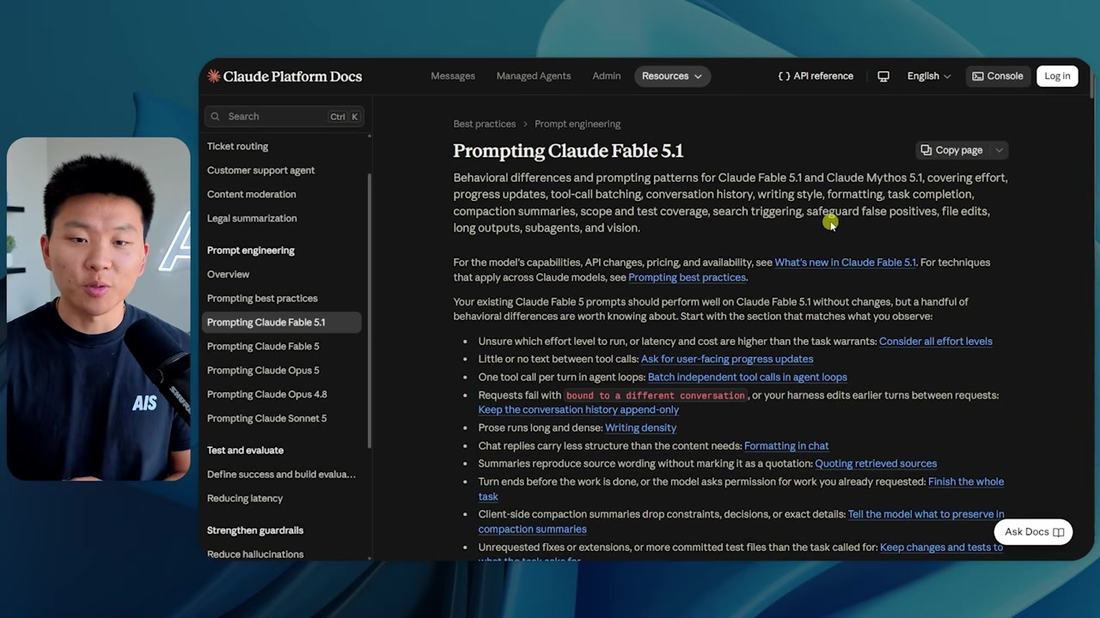
تنبيه أورده بنفسه قبل عرض الأدلة: «بعض هذه ستأتي من وثائق Claude Fable 5» لا 5.1، وعرض على الشاشة هذه الفقرة تبريراً:
«ينبغي أن تعمل تلقيناتك الحالية الخاصة بـ Claude Fable 5 جيداً على Claude Fable 5.1 دون تغييرات، لكن هناك حفنة من الاختلافات السلوكية تستحق المعرفة.»
"Your existing Claude Fable 5 prompts should perform well on Claude Fable 5.1 without changes, but a handful of behavioral differences are worth knowing about."
ثم علّق: «فوثيقة تلقين Claude Fable 5.1 هذه، كثير منها هو إضافة على طريقة تلقين Claude Fable التي تجدها في تلك الوثيقة الأخرى» [1:51].
| # | العادة | جوهرها في جملة | الموضع |
|---|---|---|---|
| 1 | قل لها كيف يبدو «المنجَز» | لا تعطها مهامّ، أعطها خطّ النهاية ودعها تستنبط المهامّ. | 0:56 |
| 2 | طابِق الجهد بالمهمة | لا تُبقِ كل شيء على مستوى الجهد الأعلى — ابدأ من high ثم اختبر ما دونه. | 3:41 |
| 3 | اجعلها تُثبت عملها | لا تقبل مسوّدة أولى؛ اطلب نسخة مُراجَعة ومُتحقَّقاً منها. | 6:42 |
| 4 | وازِ وفوّض | قسّم المهمة الكبيرة إلى مهامّ مستقلة ووزّعها على وكلاء فرعيين. | 8:47 |
العادة ١ · قل لها كيف يبدو «المنجَز»
Tell it what "done" looks like [0:56 – 3:41]
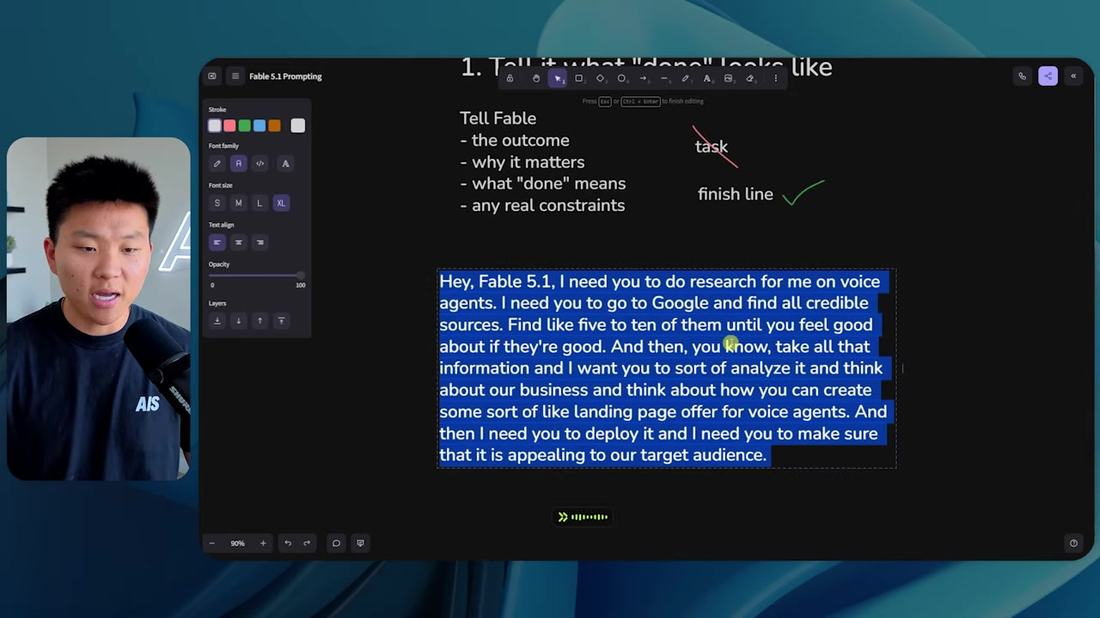
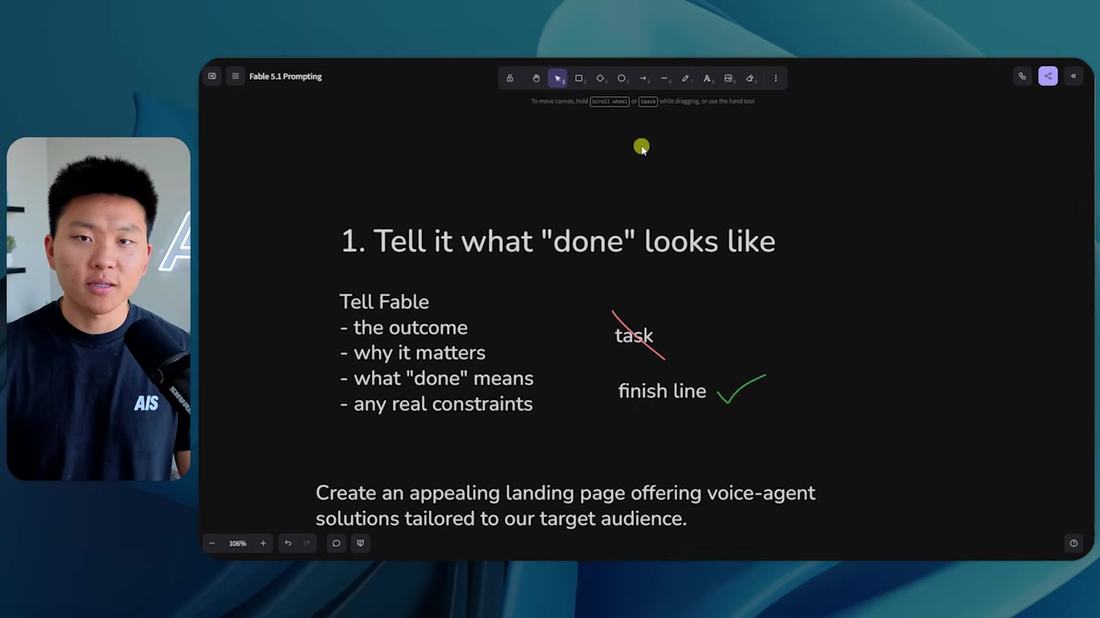
«هذا يعني أنك لا تعطيها مهامّ، بل تعطيها خطّ النهاية، وتدع Fable 5.1 يكتشف المهامّ التي يجب أن تجتمع لصنع النتيجة النهائية» [0:45].
ويسند ذلك إلى شخص ثالث: «سمعتُ بوريس تشيرني (Boris Cherny)، صانع Claude Code، يقول مراراً وتكراراً: أعطِ هذه النماذج هدفاً طموحاً، وابتعد عن طريقها» [1:08].
والصيغة العملية التي يقترحها: «أخبِر Fable بـالنتيجة، وأخبره لماذا تهمّ، وأخبره ما معنى المنجَز، وأخبره إن كانت هناك قيود حقيقية» [1:08].
الأدلة التي عرضها من التوثيق
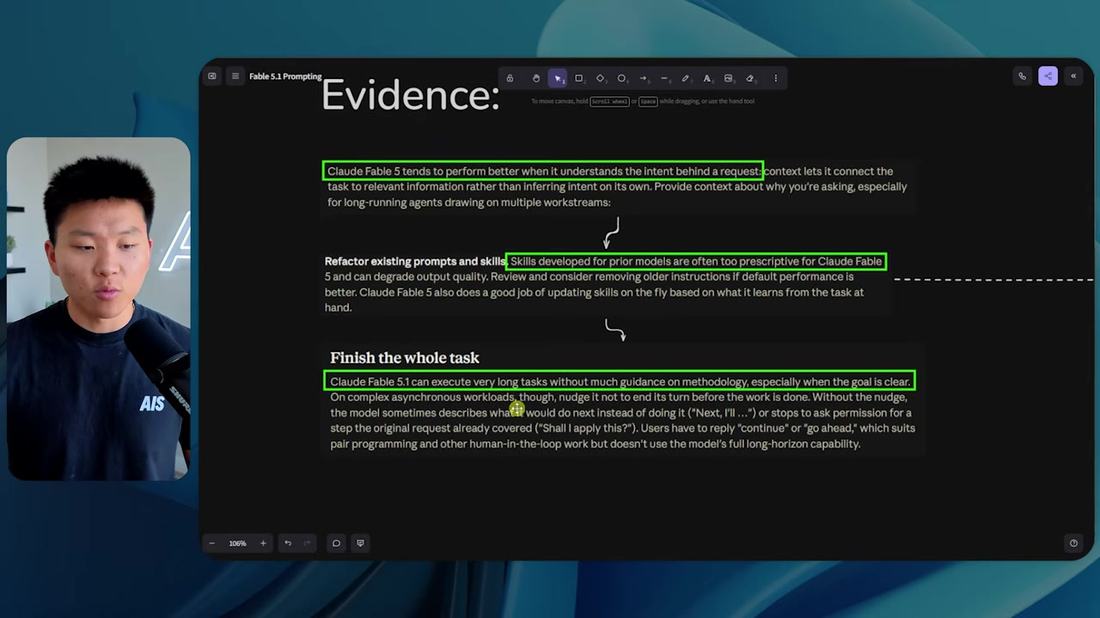
«يميل Claude Fable 5 إلى الأداء الأفضل حين يفهم النيّة وراء الطلب. السياق يتيح له ربط المهمة بالمعلومات ذات الصلة بدل استنباط النيّة بنفسه. فقدِّم سياقاً عن لماذا تسأل، خصوصاً للوكلاء طويلي التشغيل الذين يعتمدون على مسارات عمل متعددة.»
"Claude Fable 5 tends to perform better when it understands the intent behind a request. Context lets it connect the task to relevant information rather than inferring intent on its own. So provide context about why you're asking, especially for long-running agents drawing on multiple work streams."
وتعليقه عليها: «ولهذا فإن بناء نظام تشغيل معرفي خاص بك (AIOS) يحمل معلومات عن سياقك وأهدافك وخلفيتك مفيد جداً جداً في قيادة نماذج قوية كهذه» [2:12].
Refactor existing prompts and skills
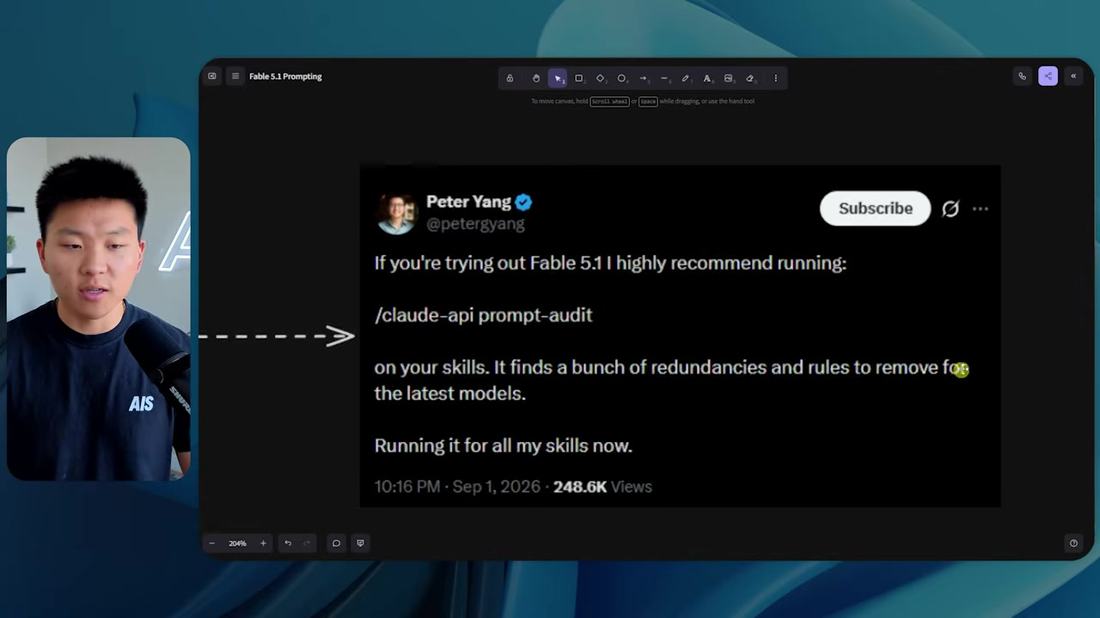
«المهارات (skills) المطوَّرة لنماذج سابقة كثيراً ما تكون شديدة الإملائية بالنسبة إلى Claude Fable 5 و Fable 5.1.»
"Skills developed for prior models are often too prescriptive for Claude Fable 5 and Fable 5.1."
وشرحه: «يعني إن كانت لديك مهارات حرفياً من نوع: افعل هذا، ثم هذا، ثم هذا، بهذا التحديد الشديد — وهي الطريقة التي عُلّمنا بها بناء المهارات — فقد يكون ذلك في الواقع يعترض طريق Fable 5.1، فيجعله أقل كفاءة، ويضع عليه حواجز» [2:40]. ويضيف: «فكرة إعادة تشغيل مهاراتك من أجل نماذج مختلفة حقيقية جداً» [3:03].
Finish the whole task
«يستطيع Claude Fable 5.1 تنفيذ مهامّ طويلة جداً دون توجيه كثير في المنهجية، خصوصاً حين يكون الهدف واضحاً.»
"Claude Fable 5.1 can execute very long tasks without much guidance on methodology, especially when the goal is clear."
وربطها بالعادة: «لكن ذلك هو المفتاح هناك: الهدف يجب أن يكون واضحاً جداً. ولهذا كانت النصيحة رقم واحد هي أن تقول لها كيف يبدو المنجَز — بطريقة لا تعطيها فيها مهمّة تلو مهمّة تلو مهمّة» [3:24].
العادة ٢ · طابِق الجهد بالمهمة
Match effort to the task [3:41 – 6:42]
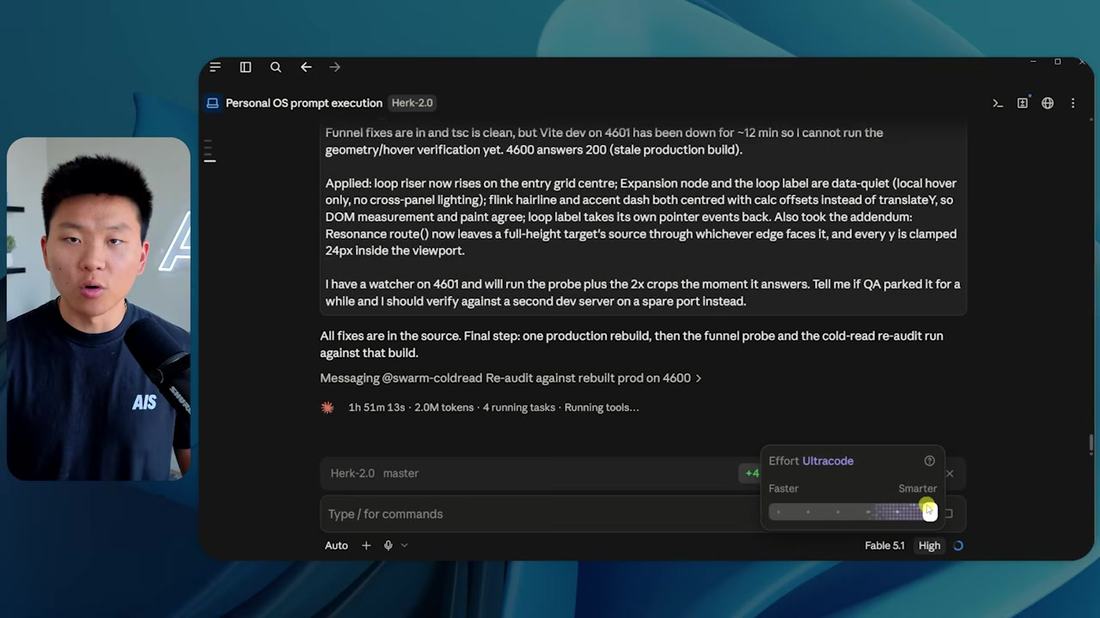
يفتتحها بسؤال: «كم منّا يدخل على Claude ولا يحرّك مؤشّر الجهد أصلاً، فيبقى على high؟» [3:24]. ويصف الواجهة كما رآها: «حين تضغط على النموذج تختاره هناك. وحين تضغط على مستوى الجهد، تستطيع تغييره من high إلى medium إلى low إلى extra إلى max أو إلى ultra code. وبشكل افتراضي، Claude Fable 5.1 يجلس على high» [3:50].
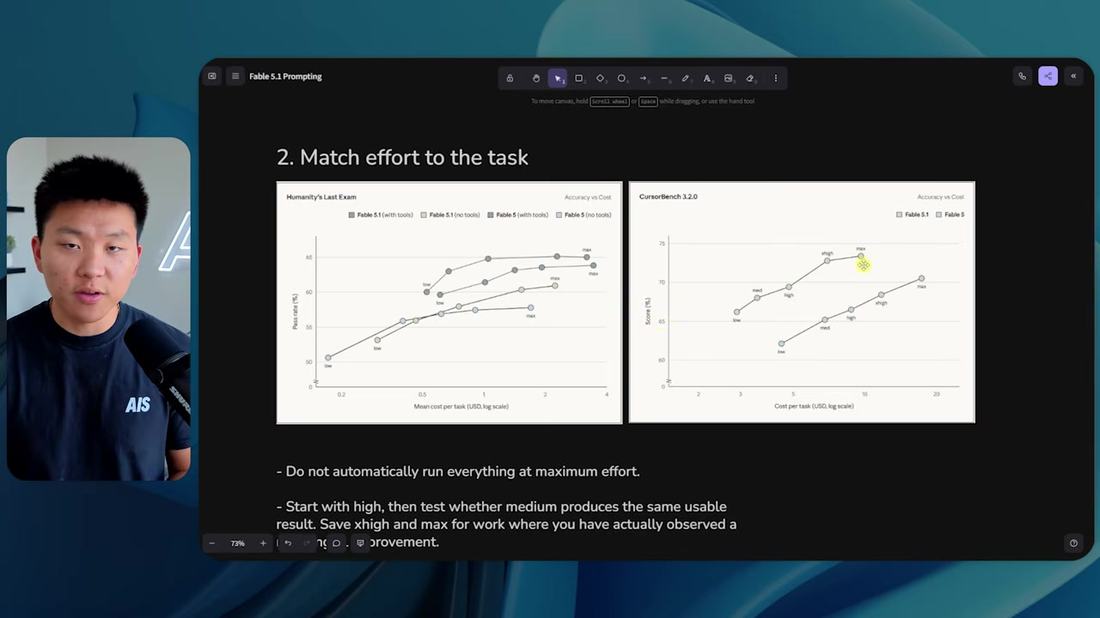
قراءته للرسمين البيانيين — وهو يصرّح بما لا يقصده: «النقطة التي أحاول إيصالها الآن ليست أن 5.1 أكفأ أو أفضل بكثير من 5. النقطة هي أن الفرق كبير جداً بين مستويات الجهد نفسها. Fable 5.1 على low مختلف تماماً عن Fable 5.1 على max. Fable 5.1 على low قريب تقريباً من Fable 5 على medium أو high، لكنه أيضاً أرخص» [4:11].
ويُتبعها بما سمعه من غيره، ويصفه بذلك صراحةً: «سمعتُ أيضاً أناساً يقارنون Fable 5.1 على low بأشياء مثل Opus أو أحياناً بـ Sonnet جيد جداً جداً» [4:11].
«الأغلبية العظمى من العمل الذي تقوم به على الأرجح مع Fable 5.1 — Fable 5.1 على high مبالغة فيه. أرى هذا الميم على تويتر: رجل يشعل سيجارة بمشعل لحام، ومكتوب: استخدام Fable 5.1 لإعادة ترتيب مجلد التنزيلات.»
ويضيف عن النماذج الأقدم: «النماذج العادية اليوم — Sonnet، وGPT 5.5 — هذه النماذج الأقدم لا تزال جيدة جداً جداً. تذكّر حين كان Sonnet 3.7 أفضل ما هو موجود؟ لا يزال نموذجاً جيداً جداً. الأمر فقط أن لدينا أشياء أفضل بكثير الآن، فلم يعد ذلك مضطراً لأن يكون الافتراضي دائماً» [4:33].
والقاعدة التي يخلص إليها: «لا تشغّل كل شيء تلقائياً على أقصى جهد، ولا حتى على high فقط. ابدأ بـ high، ثم اختبر هل يستطيع medium أداء المهمة نفسها بالجودة نفسها. وإن استطاع، جرّبها على low. ولا تحتاج x-high و max إلا حين تقوم بعمل ضخم ضخم أو شيء يحتاج تفكيراً عميقاً عميقاً» [4:54]. ويضيف: «وذلك النوع من العمل سيكلّفك أكثر قليلاً كذلك» [5:19].
الأدلة التي عرضها من التوثيق
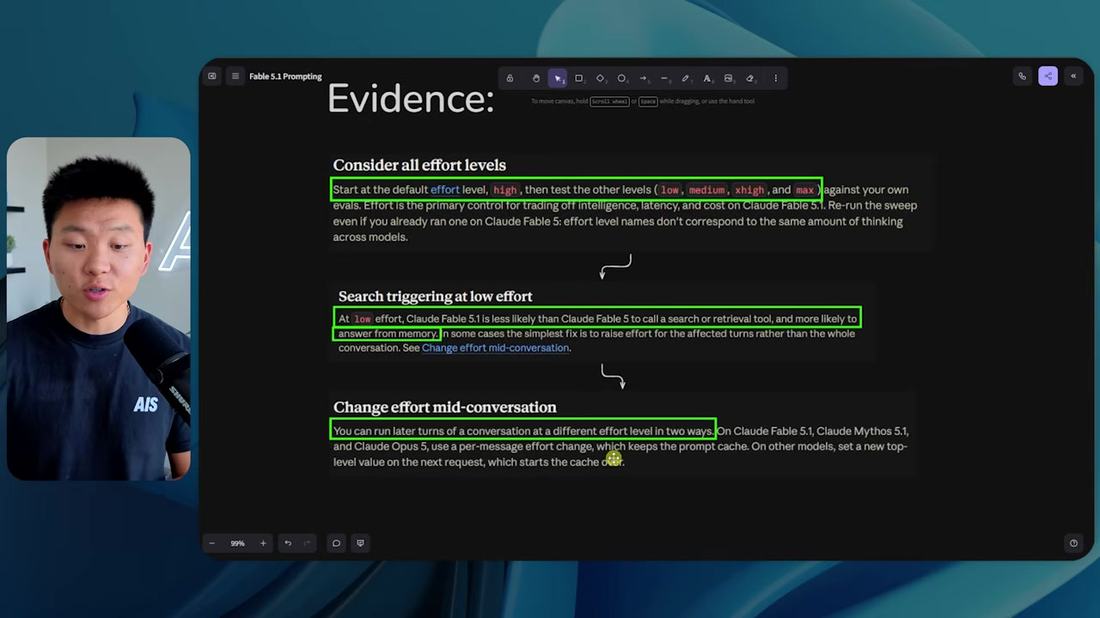
Consider all effort levels
«ابدأ بالافتراضي عند high، ثم اختبر على مستويات أخرى مثل low، medium، x-high، max مقابل تقييماتك أنت (evals).»
"Start with the default at high, then test on other levels like low, medium, x-high, and max against your own evals."
وتعليقه: «هذا هو ما أراه واضحاً جداً — مقابل تقييماتك أنت. لأن بعض الناس يقولون: أنا أعمل دائماً على x-high وهو مثالي لي، وأي شيء أقلّ لا يكون بالجودة نفسها. حسناً، ربما يقومون بهندسة برمجيات عميقة ويدمجون 15 طلب سحب كل ثانية — ذلك على الأرجح شيء يحتاج x-high فعلاً. لكن ربما أنت تُنشئ مستندات وجداول بيانات، وذلك على الأرجح لا يحتاج x-high ولا high. فالأمر يعتمد على تقييماتك أنت وحالات استخدامك أنت» [5:19].
Search triggering at low effort
«عند الجهد المنخفض (low)، يكون Claude Fable 5.1 أقلّ ميلاً من Claude Fable 5 إلى استدعاء أداة بحث أو استرجاع، وأكثر ميلاً إلى الإجابة من الذاكرة.»
"At low effort, Claude Fable 5.1 is less likely than Claude Fable 5 to call a search or retrieval tool and more likely to answer from memory."
وقراءته لها كفرصة لا كعيب: «هناك حالات استخدام لا بأس بها كثيرة لتحويل Claude Fable 5.1 إلى low حين لا تزال تريد إحساس Fable 5.1، لكن ربما لا تحتاج كل هذا الاستدعاء للأدوات — وأنت ربما تولّد أفكاراً أو تعصف ذهنياً أو تبحث عن أشياء» [5:45].
Change effort mid-conversation
«تستطيع تشغيل أدوار لاحقة من المحادثة بمستوى جهد مختلف بطريقتين. على Claude Fable 5.1 تستطيع استخدام تغيير الجهد لكل رسالة، وهو ما يُبقي ذاكرة التلقين المؤقتة (prompt cache). أما على النماذج الأخرى فعليك ضبط قيمة عليا جديدة على الطلب الجديد.»
"You can run later turns of a conversation at a different effort level in two ways. Now on Claude Fable 5.1, you can use a per-message effort change which keeps the prompt cache. But on other models, you have to set a new top level on the new request."
وتلخيصه: «فـ Fable 5.1 يتيح لك تبديل الجهد بين الأسئلة، بين النصوص، بين الأدوار — وهو أمر رائع» [6:07].
العادة ٣ · اجعلها تُثبت عملها
Make it prove its work [6:42 – 8:47] — ووصفها بأنها «المفضّلة لديّ على الإطلاق، ليس فقط لـ Fable 5.1 بل في العمل مع الذكاء الاصطناعي عموماً».
السؤال الذي يقترح البدء منه: «فكّر: كيف كنت ستتحقّق من هذا المخرَج لو أن إنساناً جاءك به وأعطاك إياه؟ ماذا كنت ستفعل؟» — «هل كنت ستنظر إليه كموقع؟ هل كنت ستشاهد الفيديو؟ هل كنت ستحاول البحث عن المصادر والتحقّق من الوقائع؟ هل كنت ستختبر الواجهة بالنقر؟ أياً كان ما كنت ستفعله هنا — طبِّق ذوقك أنت، طبِّق حكمك أنت. ودَع نماذج الذكاء الاصطناعي تفعله أولاً» [6:32].
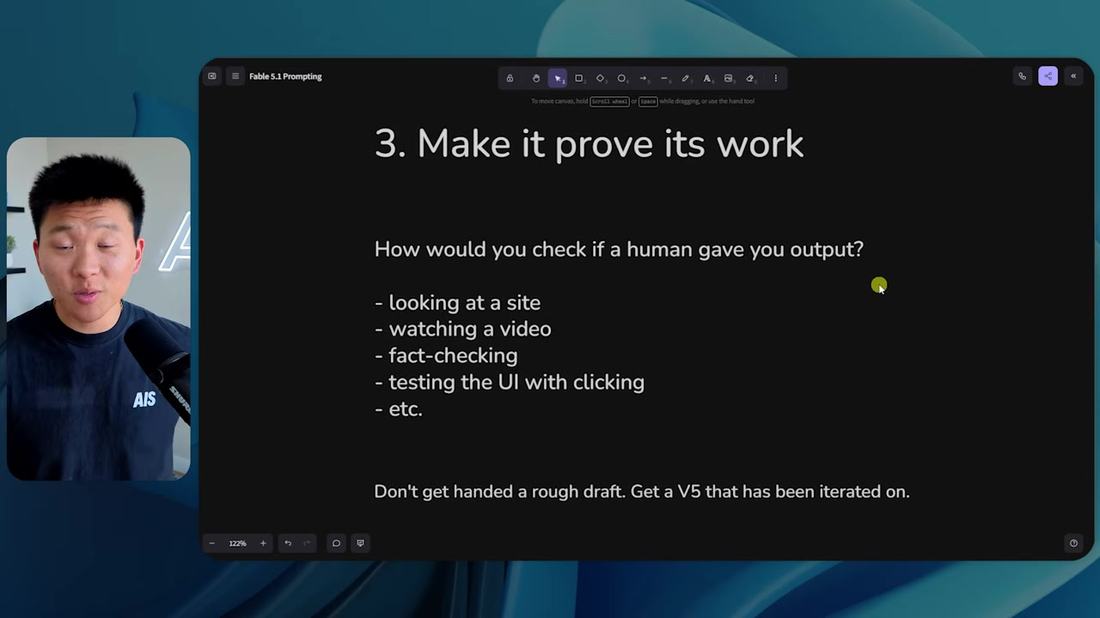
«الفكرة كلها أنك لا تريد أن تُسلَّم مسوّدة أولى. تريد أن تُسلَّم النسخة الخامسة أو العاشرة التي سبق أن راجعها واعتمدها كثير من الوكلاء الفرعيين الصغار الذين يقومون بالتحقّق، ثم جرى تكرارها خمس أو ست مرات أو ربما عشراً — لأنهم في كل مرة يراجعون فيها يجدون خطأً فيصلحونه، ثم يراجعون فيجدون خطأً فيصلحونه.»
القيد الذي أورده بنفسه: «الجزء الصعب أن ليس كل مخرَج يمكن أن يكون له فحص موضوعي. لو كنت حرفياً تحاول تحسين أداء شيء ما بحيث يصير س = 10، فذلك شيء يمكن إثباته موضوعياً. لكن كثيراً من هذه المخرجات يحتاج تحقّقاً من مستوى ذاتي أكثر — وهو في الحقيقة أن تصنع نموذجاً لغوياً بوصفه حَكَماً (LLM as a judge)، ما يعني أن عليك أنت أن تُدخل مدخلاتك: هذا هو ما يبدو عليه الجيّد» [7:27].
ومنه يستخرج قاعدة مزدوجة: «فأنت تُعرّف الهدف، لكن عليك أيضاً أن تُعرّف بحزم شديد: ما الذي يبدو عليه الجيّد؟ وكيف تختبر إن كان س جيداً؟» — ثم يضع سقفاً واقعياً: «لن يوصلك ذلك 100٪ من الطريق، لكنك تفضّل أن تصل 97٪ على أن تصل 70٪ فقط» [7:49].
الأدلة التي عرضها من التوثيق
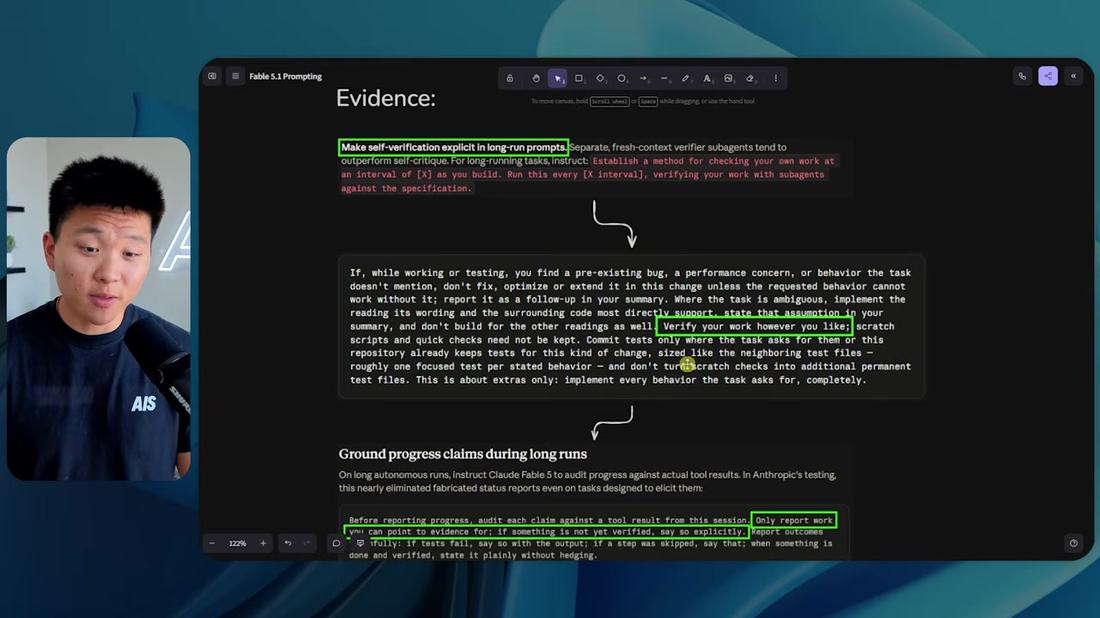
Make self-verification explicit in long-run prompts
«تحقّق من عملك بوكلاء فرعيين مقابل المواصفة.» — وفي موضع آخر من التلقين نفسه: «تحقّق من عملك بأي طريقة تشاء.»
"Verify your work with subagents against the specification." · "Verify your work however you like."
Ground progress claims during long runs
«قبل الإبلاغ عن التقدّم، دقّق كل ادّعاء مقابل نتيجة أداة من الجلسة. لا تُبلّغ إلا عن عمل تستطيع أن تشير إلى دليل عليه. وإن كان شيء لم يُتحقَّق منه بعد، فقُل ذلك صراحةً.»
"Before reporting progress, audit each claim against a tool result from the session. Only report work you can point to evidence for. If something is not yet verified, say so explicitly."
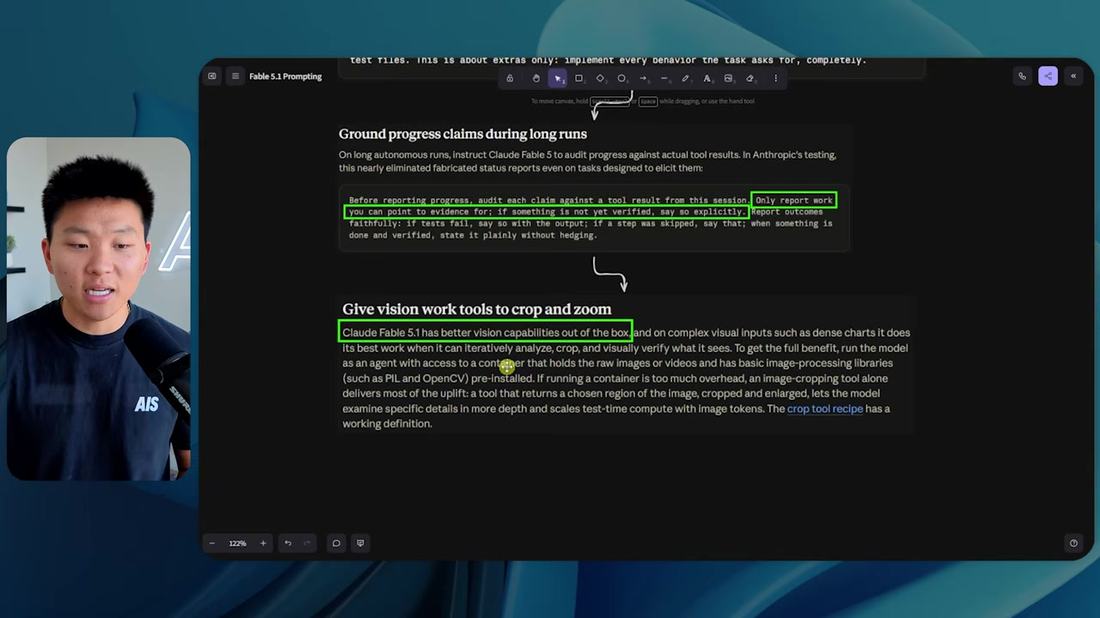
Give vision work tools to crop and zoom
«لدى Claude Fable 5.1 قدرات رؤية أفضل جاهزة، وعلى المدخلات البصرية المعقّدة مثل الرسوم البيانية الكثيفة. يؤدّي أفضل عمل له حين يستطيع أن يحلّل ويقصّ ويتحقّق بصرياً ممّا يراه، تكراراً، وهو يمضي.»
"Claude Fable 5.1 has better vision capabilities out of the box and on complex visual inputs such as dense charts. It does its best work when it can iteratively analyze, crop, and visually verify what it sees as it goes."
وسياق إيراده لها: «وهذا على جانب الرؤية، لأني أعرف أن كثيرين منّا يبنون مواقع أو عروضاً تقديمية أو أياً كان ممّا يحتاج تحقّقاً بصرياً» [8:13].
العادة ٤ · وازِ وفوّض
Parallelize and delegate [8:47 – 10:59]
«تقسيم مهمة كبيرة إلى مهامّ مستقلة. مجرّد أن لديك عمليةً واحدة لا يعني أن وكيلاً واحداً يجب أن يعمل عليها. تستطيع أن تكون لديك عملية واحدة فيها 80 وكيلاً، كلٌّ منهم يدخل ويلتقط قطعة منها — كخطّ تجميع — فيسلّمون الأشياء لبعضهم، أو يقوم كلٌّ منهم بقطعته في الوقت نفسه، ثم يجتمع كل شيء في النهاية» [8:40].
مع تحفّظ أورده مباشرةً: «ليست كل مهمة قابلة لأن تكون عملاً موازياً، لكن كثيراً منها كذلك» [9:09].
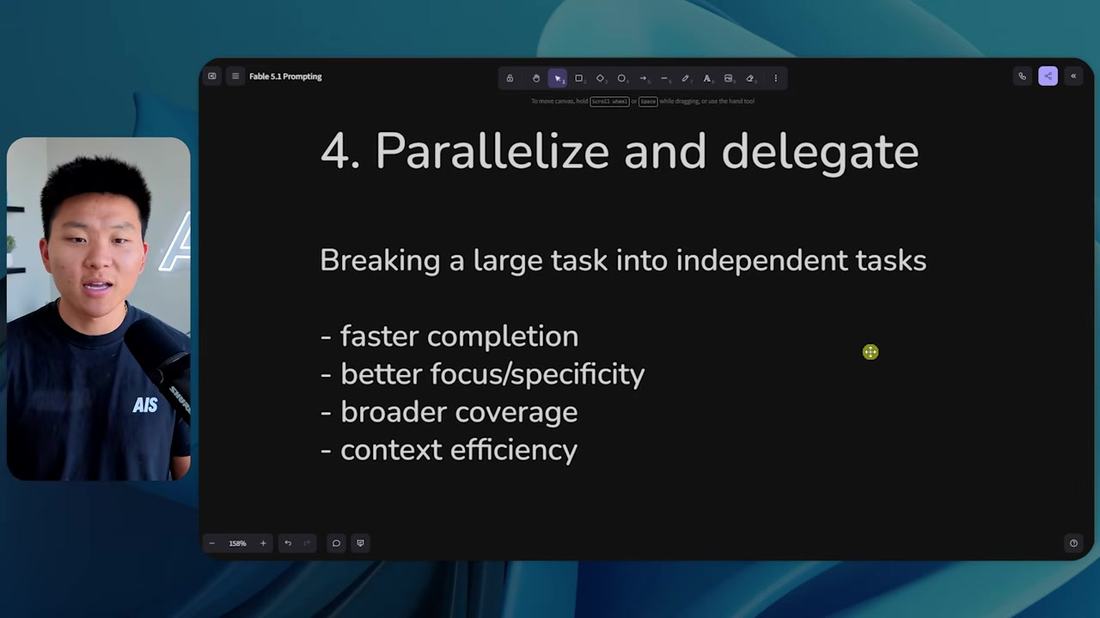
وشرحه للفوائد الأربع: «إنجاز أسرع، وتركيز وتخصيص أفضل لأن كل وكيل صار له عمل واحد محدّد جداً، وتغطية أوسع، وكفاءة في السياق — لأنك الآن تستطيع إبقاء الجلسة الرئيسية أنظف وتتحاور معها بينما تجعلها تفوّض إلى مجموعة من الوكلاء المختلفين» [9:09].
«وهذا أهمّ شيء استطعتُ فعله للحصول على استخدام أكبر بكثير من Fable 5.1. معظم الوقت الآن حين أعمل معه أقول له: لا أريدك أن تبني شيئاً. لا أريدك أن تبرمج شيئاً. لا أريدك أن تبحث في شيء. أريدك فقط أن تُنشئ وكلاء فرعيين، وتقود الاستراتيجية، وتفسّر ما يعطونك إياه، ثم تُنشئ مزيداً من الوكلاء الفرعيين — لأننا بذلك نستخدم ذكاء Fable في ذلك، ونوفّر كمّاً هائلاً من الرموز (tokens).»
ويعِد بأثر محسوس: «ثِق بي، جرّب فقط استخدام تلقينات كهذه، وستشعر بالفرق فوراً» [9:55].
الحدّ الذي وضعه على هذه العادة: «لكن ذلك لا يعني أن Fable ليس مسؤولاً عن النتيجة. إن كان المخرَج سيئاً، فهو خطأ Fable 5.1 لا خطأ كل الوكلاء الفرعيين. فعليه أن يبقي في ذهنه أن عليه أيضاً أشياء مثل إنشاء وكلاء متحقِّقين، أو ربما في التمريرة الأخيرة جداً قبل تسليمها لك أنت الإنسان — ربما عندها يتدخّل Fable 5.1 نفسه ويوسّخ يديه قليلاً في النهاية» [9:55].
الأدلة التي عرضها من التوثيق
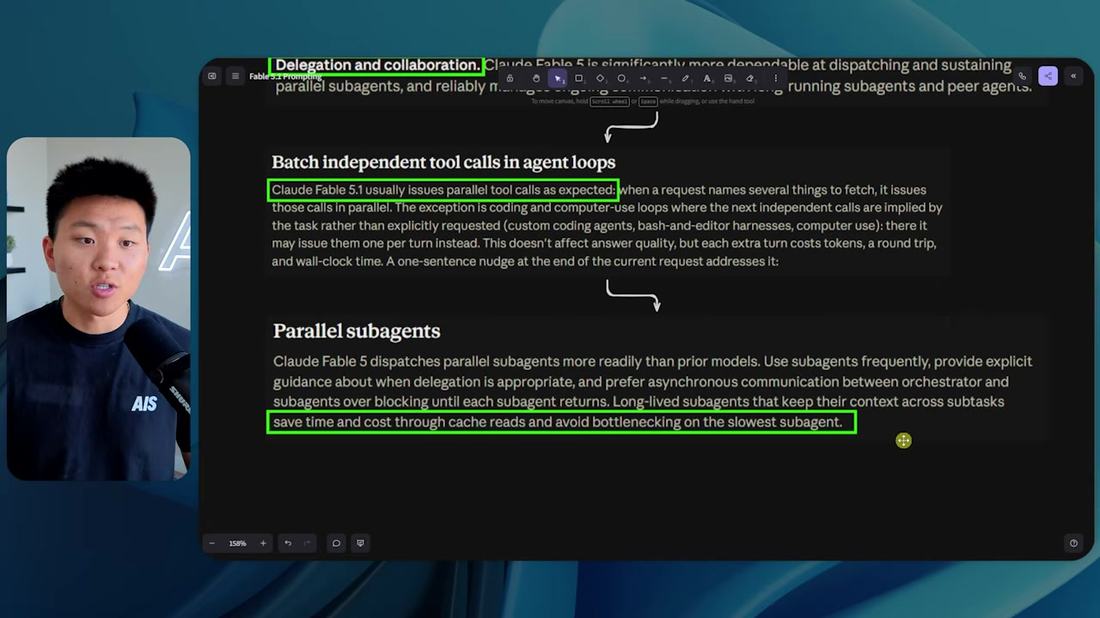
Delegation and collaboration
«Claude Fable 5 أكثر اعتمادية بدرجة ملحوظة في إرسال الوكلاء المتوازين وإدامتهم، ويدير بموثوقية التواصل المستمرّ مع الوكلاء الفرعيين طويلي التشغيل والوكلاء النظراء.»
"Claude Fable 5 is significantly more dependable at dispatching and sustaining parallel agents and reliably manages ongoing communication with long-running subagents and peer agents."
Batch independent tool calls in agent loops
«عادةً ما يُصدِر Claude Fable 5.1 استدعاءات أدوات متوازية كما هو متوقَّع. فحين يسمّي الطلب عدة أشياء لجلبها، يُصدِر تلك الاستدعاءات كلها على التوازي.»
"Fable 5.1 usually issues parallel tool calls as expected. When a request names several things to fetch, it issues those calls all in parallel."
وتعليقه: «فتعمل كلها في الوقت نفسه، ولا تجلس أنت منتظراً تُهدر الوقت» [10:17].
Parallel subagents
«الوكلاء الفرعيون المتوازون يوفّرون الوقت والتكلفة عبر قراءات الذاكرة المؤقتة (cache reads)، ويتجنّبون الاختناق عند أبطأ وكيل فرعي.»
"Parallel subagents save time and cost through cache reads and avoid bottlenecking on the slowest subagent."
وشرحه للاختناق: «إن كان لديك خطّ تجميع والوكيل رقم ثلاثة يستغرق دهراً، فإن 4 و5 و6 و7 و8 و9 و10، كلهم يجلسون وينتظرون. فإن استطعت أن توازيهم، فوازِهم» [10:42].
الخاتمة
ينهي بعرض مورد مجاني: «وضعتُ كل هذه المعلومات مع كل هذه الأدلة في دليل موارد بسيط جداً تستطيع الوصول إليه مجاناً تماماً. كل ما عليك هو الذهاب إلى مجتمعي المجاني على Skool — الرابط في الوصف — ثم تضغط classroom، وتذهب إلى all YouTube resources» [10:42]. ويصف ما بداخله: «كل مستند أو مهارة أو مستودع أو دليل مجاني، دائماً ما أعطيتها مجاناً هناك» [11:07].
ملاحظات على المصدر
مواضع ورد فيها المصدر ملتبساً أو مضطرباً. أُثبتت كما هي ولم تُحسم.
- نصوص التوثيق منقولة عن التفريغ الآلي واللقطات، لا عن الوثيقة الأصلية. ما بين علامات الاقتباس في هذه الصفحة هو ما نطقه المُقدِّم وما ظهر على شاشته — ولم نفتح وثائق Anthropic للمقابلة، لأن ذلك يخرج عن نطاق التلخيص الحرفي للمصدر.
- فرق في الإلزام بين التوثيق والمُقدِّم: نصّ التوثيق يقول «خصوصاً حين يكون الهدف واضحاً» — وهو تفضيل. أما المُقدِّم فيُتبعها فوراً بـ«لكن ذلك هو المفتاح هناك: الهدف يجب أن يكون واضحاً جداً» [3:24] — وهي صياغة إلزام. الجملتان مفصولتان في هذه الصفحة عمداً لئلا تُنسب الصياغة الأشدّ إلى التوثيق.
- فقرة «التفويض والتعاون» عن Fable 5 لا 5.1: نصّها المعروض يقول «Claude Fable 5 is significantly more dependable…» [10:17]، مع أن سياق الفصل كلّه عن 5.1. نُقلت باسمها الوارد.
- الفوائد الأربع للتوازي شريحة المُقدِّم لا التوثيق: عدّها في [9:09] دون أن يُحيل إلى الوثيقة كما يفعل في المواضع الأخرى («لننظر إلى بعض الأدلة هنا»)، وتظهر على شريحته هو لا على لقطة توثيق. أُثبتت في هذه الصفحة بوصفها كلامه.
- توتر في نسبة المحتوى: يقول في المقدمة إن هذه «أربع حيل من Anthropic أنفسهم» [0:00]، ثم يقول بعد قليل إنه «نبش في الوثيقة واستخرج ما يظنّ أنكم تحتاجون معرفته» [0:45] — أي أنّ الانتقاء والترتيب والصياغة له هو، وإن كان أصل الفقرات من التوثيق.
- وحدة الحدّ المستهلَك: يقول في المقدمة «حدّ الاستخدام الأسبوعي» [0:00]، ثم يقول بعدها «حدود جلساتهم» [0:21]. لم يوحّد المصدر بينهما.
- خلط بين اسمَي النموذجين في نصوص التوثيق: بعض الفقرات المعروضة تقول Claude Fable 5 وبعضها Claude Fable 5.1، وقد نبّه المُقدِّم إلى ذلك بنفسه وعرض فقرة تبرّره [1:51]. أُبقي كل اقتباس على الاسم الوارد فيه.
- ترتيب مستويات الجهد كما نطقها: «من high إلى medium إلى low إلى extra إلى max أو إلى ultra code» [3:50] — بينما الفقرة الموثّقة التي عرضها تسمّيها «low، medium، x-high، max» [5:19]. لم يوفّق المصدر بين التسميتين، ولا بين ما إذا كان «extra» و«x-high» الشيء نفسه.
- الرسمان البيانيان لم يُقرأ منهما رقم واحد بصوته. كل ما قاله عنهما مقارنات نوعية («مختلف تماماً»، «قريب تقريباً»، «أرخص»)، ولم يذكر قيمة عددية واحدة، فلم نستخرج أي رقم منهما.
- مقارنة low بـ Opus وSonnet منسوبة إلى غيره: صاغها بـ«سمعتُ أيضاً أناساً يقارنون» [4:11] — فهي نقل عن مجهولين لا ادّعاء منه ولا من التوثيق.
- اسم صانع Claude Code: ورد في التفريغ الآلي «Boris Churnney» [1:08]؛ واعتُمد هنا الهجاء المتعارف عليه Boris Cherny.
- أمر التدقيق في التغريدة: ورد في التفريغ الآلي مشوّشاً هكذا «/claw- API prompt- audit» [3:03]، بينما يظهر في لقطة التغريدة نفسها /claude-api prompt-audit — واعتُمد ما في اللقطة لأنه المصدر البصري نفسه.
- تطبيع مُعلَن: الأسطر الإنجليزية داخل صناديق التوثيق منقولة بصياغتها كما نُطقت في التفريغ الآلي، ولم تُعَد كتابتها. الاستثناء الوحيد أنّ أسماء المنتجات والمصطلحات التي شوّهها التفريغ رُدّت إلى هجائها المعروف (Anthropic · Claude Fable · GPT · evals · subagent · x-high)، وذلك إفصاحاً لا تصحيحاً صامتاً. ولم يُغيَّر أي لفظ آخر.
- أسماء وردت بصيغ مضطربة في التفريغ الآلي: «Enthropic» بدل Anthropic · «Codeex» بدل Codex · «CloudFable / Cloud Fable» بدل Claude Fable · «GBT 5.5» بدل GPT-5.5 · «EV valves» بدل evals · «sub aent» بدل subagent · «ideulating» بدل ideating.
- ما استُبعد: فقرات ترويج الرعاة والروابط التسويقية في أول الفيديو، ونداء الإعجاب والاشتراك في آخره — ليست من مادة الشرح. وأُبقي ذكر الدليل المجاني لأنه جزء من خاتمة الفيديو نفسها.
المنهجية: أُعدّ هذا الملخص في 3 سبتمبر 2026 من مصدرين من الفيديو نفسه: (١) التفريغ النصي الآلي بلغته الأصلية (الإنجليزية)، مسحوباً بأداة yt-dlp بصيغة json3 — نحو 3,111 كلمة، وقُرئ كاملاً؛ (٢) 13 لقطة مستخرَجة من ملف الفيديو مباشرة بأداة ffmpeg عند الطوابع الزمنية المذكورة تحت كل لقطة، بدقة 1100 بكسل عرضاً، غير معدّلة ولا مقصوصة ولا ممدّدة — وكل تعليق تحت لقطة يصف ما يظهر فيها فقط. وقد فُصل في هذه الصفحة فصلاً صريحاً بين ما هو نصّ من التوثيق (في الصناديق ذات الحدّ الأسود وشارة «📄 من وثائق منصّة Claude») وبين ما هو كلام المُقدِّم أو نقله عن غيره — لأن الخلط بينهما ينسب إلى Anthropic ما لم تقله. كل اقتباس قولُ المتحدّث أو نصُّ شاشته بطابعه الزمني كما ورد، ولم يُصحَّح شيء ممّا ورد في المصدر، بما في ذلك المواضع المضطربة المثبتة في «ملاحظات على المصدر». الترجمة حرفية بالمعنى الدقيق مع الحفاظ على التحفّظات كما نطقها («على الأرجح»، «ربما»، «سمعتُ»). لا توجد في هذه الصفحة أي إضافة أو استنتاج أو توصية من المُلخِّص — لم يُطلب ذلك، فلم يُكتب؛ وأي إضافة مأذونة مستقبلاً تُوضع في صندوق موسوم بحسب المادة 4 من دستور الملخصات. النشر: رُفعت هذه الصفحة أول مرة بتاريخ 6 سبتمبر 2026، بناءً على أمرك النصّي الصريح لهذا الملف بعينه — وهو استثناء موثَّق من المادة 6 من دستور الملخصات التي تجعل الملخصات ملفات محلية بشكل افتراضي. وتبقى الصفحة موسومة noindex بعد النشر كما توجب المادة نفسها. والنشر على «ملخصاتي»: رُفعت هذه الصفحة على shortitfor.me/prompting بتاريخ 13 سبتمبر 2026، بناءً على أمر المالك النصّي الصريح لهذا الملف بعينه («ارفعها على موقع ملخصاتي») — استثناءٌ موثَّق من المادة 6 من دستور الملخصات، والصفحة موسومة noindex كما توجب المادة نفسها.
A verbatim summary of the video "How Anthropic ACTUALLY Prompts Fable 5.1" from the Nate Herk | AI Automation channel. In it he presents four habits he says he extracted from the Claude Platform docs, and shows on screen the passages he built each one on. The frames on this page are taken from the video itself, with their timestamps.
▶ Watch the original video
What the video promises, and where he got it
He opens by saying: "Today I've got four tricks from Anthropic themselves on how to get more out of Fable 5.1, how to use it more efficiently, and how to stretch that weekly usage limit as long as it can go" [0:00].
His own position on the model: "I will be honest, as of lately, I've been using Codex a lot more than Claude Code, but Fable 5.1, it's feeling really nice. It's feeling pretty quick and it's feeling pretty efficient if you learn to use it right — because I have seen tons of people complaining that they are just killing their session limits" [0:00].
His source: "Everything that I'm talking about today, I found straight from the Claude Platform docs on how to prompt Claude Fable 5.1. There's a ton of gold in here and it talks about every individual model because these are different models. They have different characteristics and they perceive information a little bit differently" [0:21]. He describes it as "a long long doc with lots of scenarios" and says, "I dug through here and I just pulled out what I think you guys actually need to know" [0:21].
A caveat he raised himself before presenting the evidence: "Some of these will be coming from the Claude Fable 5 docs" — not 5.1 — and he put this passage on screen as justification:
"Your existing Claude Fable 5 prompts should perform well on Claude Fable 5.1 without changes, but a handful of behavioral differences are worth knowing about."
"Your existing Claude Fable 5 prompts should perform well on Claude Fable 5.1 without changes, but a handful of behavioral differences are worth knowing about."
He then commented: "So this document, prompting Claude Fable 5.1. A lot of this is just like in addition to the way that you prompt Claude Fable that you can find in this doc" [1:51].
| # | Habit | In one sentence | Timestamp |
|---|---|---|---|
| 1 | Tell it what "done" looks like | Do not give it tasks; give it the finish line and let it work out the tasks. | 0:56 |
| 2 | Match the effort to the task | Do not keep everything at the highest effort level — start at high, then test the levels below it. | 3:41 |
| 3 | Make it prove its work | Do not accept a rough draft; ask for a version that has been reviewed and verified. | 6:42 |
| 4 | Parallelize and delegate | Break the large task into independent tasks and distribute them across subagents. | 8:47 |
Habit 1 · Tell it what "done" looks like
Tell it what "done" looks like [0:56 – 3:41]
"This means you're not giving it tasks, you're giving it the finish line, and you're letting Fable 5.1 figure out the tasks that need to come together to create the end result" [0:45].
He attributes this to a third party: "I've heard Boris Cherny, the creator of Claude Code, say so many times to give these models an ambitious goal, and get out of their way" [1:08].
The practical formula he proposes: "Tell Fable the outcome, tell it why it matters, tell it what done means, and tell it if there are any real constraints" [1:08].
The evidence he showed from the docs
"Claude Fable 5 tends to perform better when it understands the intent behind a request. Context lets it connect the task to relevant information rather than inferring intent on its own. So provide context about why you're asking, especially for long-running agents drawing on multiple work streams."
"Claude Fable 5 tends to perform better when it understands the intent behind a request. Context lets it connect the task to relevant information rather than inferring intent on its own. So provide context about why you're asking, especially for long-running agents drawing on multiple work streams."
His comment on it: "Which is why building out your own knowledge operating system (AIOS) that has information about your context, your goals, your background, that is very, very helpful in driving powerful models like this" [2:12].
Refactor existing prompts and skills
"Skills developed for prior models are often too prescriptive for Claude Fable 5 and Fable 5.1."
"Skills developed for prior models are often too prescriptive for Claude Fable 5 and Fable 5.1."
His explanation: "Meaning, if you have some skills that are literally like, do this, this, this, this, this, like so, so specifically — that is kind of the way we were taught to build skills — but that might actually be getting in Fable 5.1's way where it's making it less efficient and it's kind of just like putting guard rails on it" [2:40]. He adds: "The whole idea of like rerunning your skills for different models is really real" [3:03].
Finish the whole task
"Claude Fable 5.1 can execute very long tasks without much guidance on methodology, especially when the goal is clear."
"Claude Fable 5.1 can execute very long tasks without much guidance on methodology, especially when the goal is clear."
He ties it to the habit: "But that's the key there. The goal has to be very clear. So, that is why tip number one was to tell it what done looks like — do it in a way where you're not giving it task after task after task" [3:24].
Habit 2 · Match the effort to the task
Match effort to the task [3:41 – 6:42]
He opens it with a question: "How many of us just hop on Claude and we don't actually drag the effort slider around and we just stay at high?" [3:24]. He describes the interface as he saw it: "When you click on the model, you obviously choose that there. And when you click on the effort level, you can change this from high to medium to low to extra to max or to ultra code. And by default, Claude Fable 5.1 just sits on high" [3:50].
His reading of the two charts — stating outright what he does not mean: "The point I'm trying to make right now isn't that 5.1 is much more efficient or better than 5. The point is that the difference between the effort levels themselves is very large. Fable 5.1 on low is so much different than Fable 5.1 on max. Fable 5.1 on low is about comparable to Fable 5 on medium or high, but it's also cheaper" [4:11].
He follows it with something he heard from others, and says so explicitly: "I've also heard people compare Fable 5.1 on low to things like Opus or sometimes a really, really good Sonnet" [4:11].
"The vast majority of work that you're probably doing with Fable 5.1 — Fable 5.1 on high is overkill. I see this meme on Twitter where it's like this guy is lighting a cigarette with a blowtorch and it's like using Fable 5.1 to reorganize my downloads folder."
He adds, on the older models: "The normal model nowadays — Sonnet, you know, GPT-5.5 — like these older models are still really, really good. Like remember when Sonnet 3.7 was like the best thing out there? It's still a really good model. It's just that we have things that are so much better now that that doesn't always have to be the default" [4:33].
The rule he arrives at: "Do not automatically run everything at maximum effort or even just high. Start with high, then test whether medium can do that same task just as well. And if it can, try it on low. And you only need x-high and max when you're doing like massive massive work or something that needs like deep deep thought" [4:54]. He adds: "And obviously, that kind of stuff is going to cost you a little bit more as well" [5:19].
The evidence he showed from the docs
Consider all effort levels
"Start with the default at high, then test on other levels like low, medium, x-high, and max against your own evals."
"Start with the default at high, then test on other levels like low, medium, x-high, and max against your own evals."
His comment: "Against your own evals is what I think is really clear. Because some people are like, 'Oh yeah, I drive all the time with x-high and it's perfect for me. Anything lower and it's not as good.' Well, maybe they're doing like deep software engineering and, you know, merging 15 PRs every second. That's probably something that does need x-high. But maybe you're creating documents and creating spreadsheets that probably doesn't need x-high or high. So, it has to be on your own evals and your own use cases" [5:19].
Search triggering at low effort
"At low effort, Claude Fable 5.1 is less likely than Claude Fable 5 to call a search or retrieval tool and more likely to answer from memory."
"At low effort, Claude Fable 5.1 is less likely than Claude Fable 5 to call a search or retrieval tool and more likely to answer from memory."
His reading of it as an opportunity rather than a flaw: "There are lots of decent use cases for switching Claude Fable 5.1 to low when you still want that Fable 5.1 feel, but maybe you don't need to be doing all of this tool calling as much and you're maybe ideating, brainstorming, searching for things" [5:45].
Change effort mid-conversation
"You can run later turns of a conversation at a different effort level in two ways. Now on Claude Fable 5.1, you can use a per-message effort change, which keeps the prompt cache. But on other models, you have to set a new top level on the new request."
"You can run later turns of a conversation at a different effort level in two ways. Now on Claude Fable 5.1, you can use a per-message effort change which keeps the prompt cache. But on other models, you have to set a new top level on the new request."
His summary: "So Fable 5.1 lets you switch effort in between questions, in between texts, which is pretty cool, in between turns" [6:07].
Habit 3 · Make it prove its work
Make it prove its work [6:42 – 8:47] — which he described as "my favorite one of all time, not just for Fable 5.1, but just in general working with AI".
The question he suggests starting from: "Think about how would you check this output if a human came to you and gave it to you? What would you do?" — "Would you just look at it like a website? Would you watch the video? Would you try to like look up the sources and fact check? Would you test the UI by clicking? Whatever you would do here, apply your own taste, apply your own judgment. Let the AI models do it first" [6:32].
"The whole idea is you don't want to get handed a rough draft. You want to get handed a version five or a version 10 that's already been approved and reviewed by lots of little subagents that do verification and then it's been iterated on like five or six times or maybe even 10 times because every single time they review it, they find a mistake, they fix it, they review it again, they find a mistake, they fix it."
The limitation he raised himself: "The tough part is not every single piece of output can have an objective check. Like if you were literally trying to optimize the performance of something so that X equals 10, that's something that objectively can be proven. A lot of these sorts of outputs need to be verified from more of a subjective level, which is really you creating your own sort of like LLM as a judge, which means that you do have to put your, you know, input in there as far as this is what good looks like" [7:27].
From this he extracts a two-part rule: "So, you define the goal, but you also need to very firmly define what does good look like and how do you test if X is good" — then sets a realistic ceiling: "it's not going to get you 100% of the way there, but you'd rather get 97% of the way there than getting like 70% of the way there" [7:49].
The evidence he showed from the docs
Make self-verification explicit in long-run prompts
"Verify your work with subagents against the specification." — and elsewhere in the same prompt: "Verify your work however you like."
"Verify your work with subagents against the specification." · "Verify your work however you like."
Ground progress claims during long runs
"Before reporting progress, audit each claim against a tool result from the session. Only report work you can point to evidence for. If something is not yet verified, say so explicitly."
"Before reporting progress, audit each claim against a tool result from the session. Only report work you can point to evidence for. If something is not yet verified, say so explicitly."
Give vision work tools to crop and zoom
"Claude Fable 5.1 has better vision capabilities out of the box and on complex visual inputs such as dense charts. It does its best work when it can iteratively analyze, crop, and visually verify what it sees as it goes."
"Claude Fable 5.1 has better vision capabilities out of the box and on complex visual inputs such as dense charts. It does its best work when it can iteratively analyze, crop, and visually verify what it sees as it goes."
The context in which he cited it: "And then just on the vision piece, because I know a lot of us are building websites or slide decks or whatever it might be where you need some vision verification" [8:13].
Habit 4 · Parallelize and delegate
Parallelize and delegate [8:47 – 10:59]
"Breaking a large task into independent tasks. Just because you have one process doesn't mean one agent needs to be working on it. You can have one process where you actually have 80 agents each go in there, pick one piece of it, like an assembly line, and they hand stuff off to each other, or they all do their own piece at the same time, and then it all comes together in the end" [8:40].
With a reservation he added immediately: "Not every task is available to be like parallel work, but a lot of them are" [9:09].
His explanation of the four benefits: "faster completion, better focus and specificity because each agent has one very specific job now, broader coverage, and context efficiency — because now you can keep that main session cleaner and converse with it while you have it delegate out to a bunch of different agents" [9:09].
"And this is like the most important thing that I've been able to do to get way more usage out of my Fable 5.1. Most of the time now when I'm working with Fable 5.1, I tell it, I don't want you to build anything. I don't want you to code anything. I don't want you to research anything. I just want you to spin up subagents, drive strategy, interpret what they give you, and then spin up more subagents because now we're getting Fable's intelligence to do that, and we're saving so many tokens."
And he promises a tangible effect: "Trust me, just try out using some prompts like that, and you will feel the difference immediately" [9:55].
The limit he put on this habit: "But that doesn't mean that Fable isn't responsible for the outcome. Like, if it's a bad output, then it was Fable 5.1's fault, not all the subagents' faults. So, it needs to keep in mind that it still has to do things like spinning up verifier agents or maybe at the very very end on the final pass before it gives it to you the human. Maybe that's when Fable 5.1 actually steps in there and it gets its hands dirty a little bit at the very end" [9:55].
The evidence he showed from the docs
Delegation and collaboration
"Claude Fable 5 is significantly more dependable at dispatching and sustaining parallel agents and reliably manages ongoing communication with long-running subagents and peer agents."
"Claude Fable 5 is significantly more dependable at dispatching and sustaining parallel agents and reliably manages ongoing communication with long-running subagents and peer agents."
Batch independent tool calls in agent loops
"Fable 5.1 usually issues parallel tool calls as expected. When a request names several things to fetch, it issues those calls all in parallel."
"Fable 5.1 usually issues parallel tool calls as expected. When a request names several things to fetch, it issues those calls all in parallel."
His comment on it: "So they can all work at the same time, and you're not just sitting there wasting time" [10:17].
Parallel subagents
"Parallel subagents save time and cost through cache reads and avoid bottlenecking on the slowest subagent."
"Parallel subagents save time and cost through cache reads and avoid bottlenecking on the slowest subagent."
His explanation of the bottleneck: "If you got an assembly line and agent number three is just taking forever, then 4, 5, 6, 7, 8, 9, 10, all of those other agents are just sitting there and waiting. So if you can parallelize them, parallelize them" [10:42].
Closing
He ends by offering a free resource: "I put all of this information with all of this evidence into just a super simple resource guide that you can access for completely free. All you have to do is go to my free Skool community. The link is down in the description. You'll come into here, you'll click on classroom, you'll go to all YouTube resources" [10:42]. And he describes what is inside it: "Every free doc or skill or repo or guide, whatever it is, I've always given them away for free right inside of here" [11:07].
Notes on the source
Places where the source is ambiguous or inconsistent. Recorded as they are and left unresolved.
- The docs quotes are taken from the auto-generated transcript and the frames, not from the original document. What stands between quotation marks on this page is what the presenter said and what appeared on his screen — we did not open Anthropic's docs to cross-check, because that falls outside the scope of a verbatim summary of the source.
- A difference in force between the docs and the presenter: the docs' wording says "especially when the goal is clear" — a preference. The presenter follows it immediately with "But that's the key there. The goal has to be very clear." [3:24] — a formulation of obligation. The two sentences are deliberately kept apart on this page so that the stronger wording is not attributed to the docs.
- The "Delegation and collaboration" passage is about Fable 5, not 5.1: its text as shown says "Claude Fable 5 is significantly more dependable…" [10:17], even though the whole section's context is 5.1. It is reproduced under the name it carries.
- The four benefits of parallelizing are the presenter's slide, not the docs: he lists them at [9:09] without referring to the document as he does elsewhere ("let's take a look at some evidence here"), and they appear on his own slide, not on a docs frame. They are recorded on this page as his words.
- A tension in attribution: in the intro he says these are "four tricks from Anthropic themselves" [0:00], and a little later says, "I dug through here and I just pulled out what I think you guys actually need to know" [0:45] — that is, the selection, ordering, and wording are his own, even though the passages originate in the docs.
- Which limit is being used up: in the intro he says "weekly usage limit" [0:00], and then afterward "their session limits" [0:21]. The source does not reconcile the two.
- The two model names mixed in the docs quotes: some of the passages shown say Claude Fable 5 and others Claude Fable 5.1; the presenter flagged this himself and showed a passage justifying it [1:51]. Each quote keeps the name that appears in it.
- The effort levels in the order he spoke them: "from high to medium to low to extra to max or to ultra code" [3:50] — whereas the docs passage he showed names them "low, medium, x-high, and max" [5:19]. The source does not reconcile the two lists, nor whether "extra" and "x-high" are the same thing.
- Not one number from the two charts was read aloud. Everything he said about them was qualitative comparison ("so much different," "about comparable," "cheaper"), and he did not mention a single numeric value, so we extracted no figure from them.
- The comparison of low to Opus and Sonnet is attributed to others: he framed it as "I've also heard people compare" [4:11] — so it is secondhand from unnamed people, not a claim of his own or of the docs.
- The name of Claude Code's creator: the auto-generated transcript has "Boris Churnney" [1:08]; the customary spelling Boris Cherny is adopted here.
- The audit command in the tweet: the auto-generated transcript garbles it as "/claw- API prompt- audit" [3:03], whereas the frame of the tweet itself shows /claude-api prompt-audit — the frame's version is adopted, since it is the visual source itself.
- Declared normalization: the English lines inside the docs boxes are transcribed in the wording as spoken in the auto-generated transcript and were not rewritten. The sole exception is that product names and terms the transcript mangled were restored to their known spelling (Anthropic · Claude Fable · GPT · evals · subagent · x-high), and this is stated here as disclosure, not as silent correction. No other word was changed.
- Names that appear in garbled form in the auto-generated transcript: "Enthropic" for Anthropic · "Codeex" for Codex · "CloudFable / Cloud Fable" for Claude Fable · "GBT 5.5" for GPT-5.5 · "EV valves" for evals · "sub aent" for subagent · "ideulating" for ideating.
- What was left out: the sponsor promotions and marketing links at the start of the video, and the like-and-subscribe appeal at its end — they are not part of the explanatory material. The mention of the free guide was kept because it is part of the video's own closing.
Methodology: This summary was prepared on 3 September 2026 from two sources from the video itself: (1) the auto-generated transcript in its original language (English), pulled with yt-dlp in json3 format — about 3,111 words, read in full; (2) 13 frames extracted directly from the video file with ffmpeg at the timestamps noted under each frame, at 1100 px wide, unedited, uncropped, and unstretched — and every caption under a frame describes only what appears in it. This page explicitly separates what is text from the docs (in the black-bordered boxes with the "📄 From the Claude Platform docs" label) from what is the presenter's own words or what he relayed from others — because conflating the two attributes to Anthropic what it did not say. Every quotation is the speaker's words or the text on his screen, with its timestamp, as it appeared, and nothing in the source has been corrected, including the inconsistent places recorded in "Notes on the source". The translation is literal in the strict sense, with the hedges preserved as he spoke them ("probably", "maybe", "I've also heard"). This page contains no addition, inference, or recommendation from the summarizer — none was requested, so none was written; any addition authorized in the future goes in a labeled box under Article 4 of the Summaries Constitution. Publication: This page was first published on 6 September 2026, on your explicit written instruction for this very file — a documented exception to Article 6 of the Summaries Constitution, which makes summaries local files by default. The page remains tagged noindex after publication, as the same Article requires. Publication on "My Summaries": This page was uploaded to shortitfor.me/prompting on 13 September 2026, on the owner's explicit written instruction for this very file ("upload it to the My Summaries site") — a documented exception to Article 6 of the Summaries Constitution, and the page is tagged noindex, as the same Article requires.