ستّة أطر سردية تبيع — خلاصة فيديو Kallaway
هذه خلاصة فيديو «How to Become A Master Storyteller» لـKallaway، يعرض فيه ستّة أطر لكتابة قصص غايتها التحويل لا الترفيه، أوّلها تأطير الجمهور وآخرها سيكولوجية الشراء. والشرائح المعروضة في الصفحة مأخوذة من الفيديو نفسه بطوابعها الزمنية.
 ▶ شاهد الفيديو الأصلي
الفكرة التي يقوم عليها الفيديو كلّه
يفرّق في مطلع الفيديو بين نوعين من القصص: قصة تُسلّي، وقصة تدفع الناس إلى الشراء. ويخصّص حديثه للنوع الثاني وحده، فيعرض أطره الستّة المفضّلة «المصمَّمة خصّيصاً للتحويل»، أي لتحويل المشاهد إلى عميل محتمل ثم إلى مشترٍ [0:00].
«أضمن لك أنك بعد هذا الفيديو ستنظر نظرةً مختلفة إلى طريقتك في كتابة السكربت وصناعة المحتوى.»
ثم يعرّف بنفسه سريعاً: «اسمي Kallaway، عندي مليونا متابع، وحقّقتُ مليارات المشاهدات، ولا أفعل طوال يومي شيئاً غير المحتوى» [0:28].
الإطار الأول · التأطير على مقاس العميل
يمتدّ هذا الإطار، واسمه بالإنجليزية Avatar Framing، على المقطع [0:35 – 5:23]، ويصفه بأنه «بالغ الأهمية».
ينطلق من ملاحظة أن معظم المحتوى يُصنع للانتشار العريض، فتأتي قصص هذا المحتوى مثيرة، موجَّهة إلى أوسع جمهور ممكن، ومضغوطة إلى أقصى حدّ، أي «صدمة قصوى، وانتشار أقصى، وطول أدنى». وهذا يجلب مشاهدات هائلة فعلاً، لكنه ليس ما تريده إن كان هدفك البيع [0:28] [0:55].
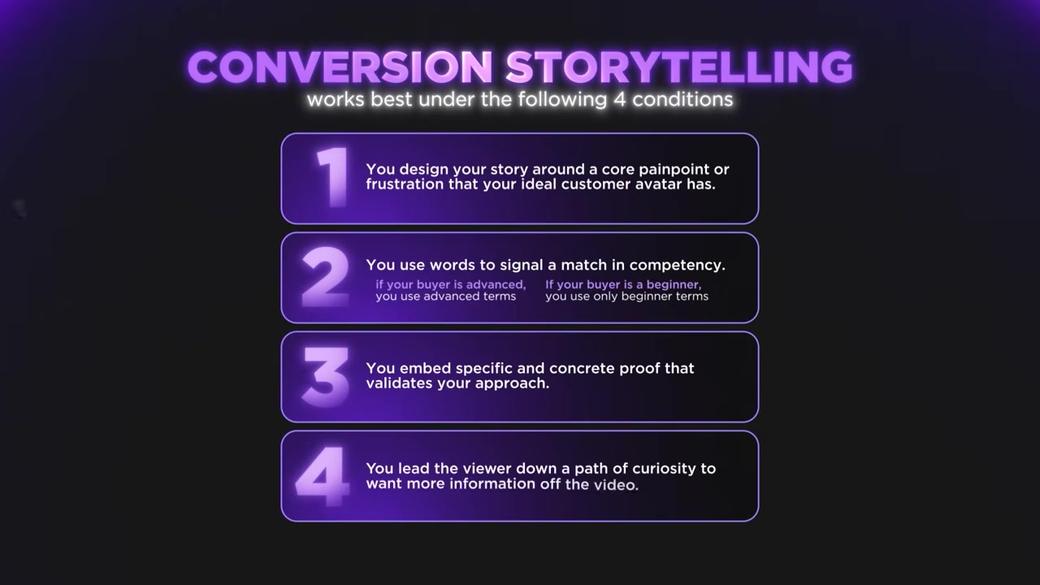
الشروط الأربعة التي ينجح في ظلّها السرد البيعي
- ابنِ القصة على وجعٍ محدّد يعانيه عميلك المثالي، ألماً كان أو إحباطاً.
- اختر كلماتك لتوحي بأنك من مستواه. إن كان مشتريك متقدّماً فاستخدم المصطلحات المتقدّمة التي يفهمها فوراً، وإن كان مبتدئاً فلا تتجاوز مفردات المبتدئين.
- ضمّن دليلاً ملموساً ومحدّداً يثبت أن طريقتك تعمل.
- قُد المشاهد في طريقٍ من الفضول يجعله يريد أن يعرف المزيد بعد الفيديو [0:55] [1:22].
ثم يختصرها في أربع عبارات: «مدفوع بالوجع، ورسالة متوائمة، ودليل في المقدّمة، وطريق إلى المزيد». والغاية أن تبدو القصة لعميلك «إصابةً في قلب الهدف»، وأن تستبعد كل من ليس عميلك [1:22].
ويوضّح ذلك بتشبيه الدائرة. تخيّل دائرة فيها مئة مليون حساب على إنستغرام أو يوتيوب. إن كنت صاحب عمل، فعملاؤك الحقيقيون في هذه الدائرة على الأرجح لا يتجاوزون بضع مئات الآلاف، وربما بضعة ملايين، أي «شريحة صغيرة جداً من الكعكة». وتأطير الجمهور يتيح لك أن تلتقط أكبر قدر ممكن من شريحتك دون أن تفيض إلى الشرائح الأخرى [1:49].
كيف يطبّقه على نفسه — مثال كامل
يعرّف عميله المثالي بأنه صاحب عمل يريد توسيع محتواه ليُنمّي عمله أسرع. فلو كتب سكربتاً عن النمو في السوشال ميديا ليدفع هذا العميل نحو أحد برامجه المدفوعة، لكان أول ما يفعله أن يسأل: ما الوجع الذي يعانيه صاحب العمل تحديداً في هذا الموضوع، ولا يعانيه معظم الناس؟ [2:17] [2:43]. ومن الأوجاع التي يذكرها هنا:
- لا يملك وقتاً كثيراً لصناعة المحتوى كل أسبوع.
- لا يعرف المزيج الصحيح لاستراتيجية محتواه حتى يبيع أكثر.
- لا يعرف من يوظّف ولا كيف يدير فريق محتوى.
- لا يعرف أي حسابات تجارية يقتدي بها.
- يشعر بحدسه أن الانتشار الفيروسي ليس الخيار المناسب له، لكنه لا يعرف لماذا، ولا ماذا يفعل بدلاً منه [2:43].
هذه أوجاع تخصّ صاحب العمل، ولا تخصّ صانع محتوى يعمل وحده. لذلك يختار واحدة منها ويطرقها بقوة في أول جملتين [3:13]، فيقترح لافتتاح الفيديو خطّافاً كهذا:
«أسرع طريق لتنمية عملك على السوشال ميديا ليس الانتشار الفيروسي، بل أن تطبّق استراتيجية التحويل 3-2-1. بها انتقلتُ من الصفر إلى مئة ألف متابع على قناتي، وحقّقتُ في الوقت نفسه مئة ألف دولار ربحاً في أول ثلاثة أشهر. وهكذا تحصد تحويلاً كثيراً دون أن تضحّي بالنمو. وإليك طريقة عملها.»
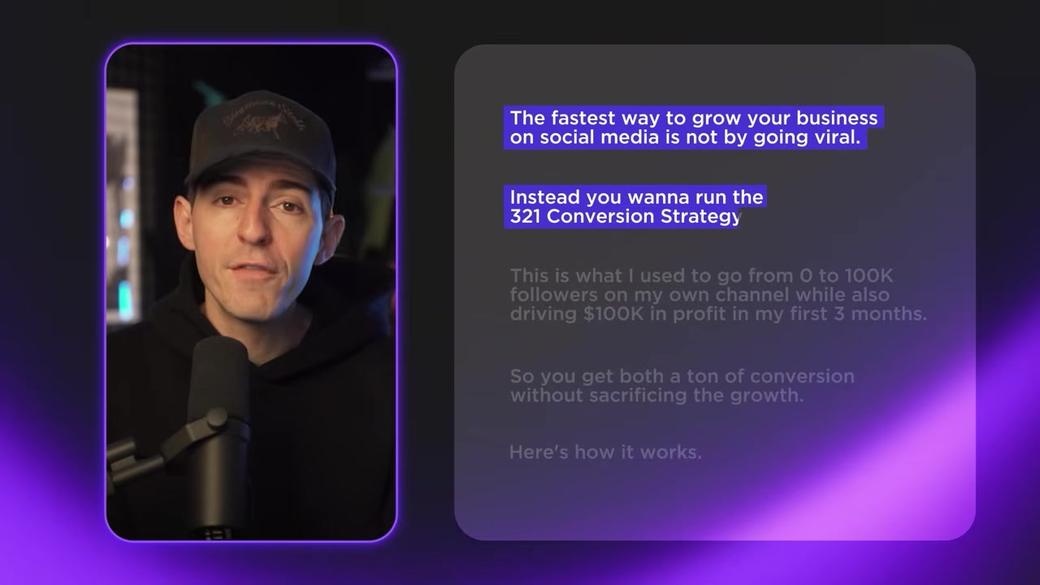
ثم يشرّح بنفسه ما فعله في هذه الجمل [3:43] [4:12]:
- نادى صاحب العمل باسمه حين قال «تنمية عملك على السوشال ميديا»، فمن كان صاحب عمل انجذب، ومن لم يكن مرّر ومضى.
- قدّم رأياً مخالفاً لما يظنّه الناس عادةً من أنهم يحتاجون إلى الانتشار، ثم عرض بديلاً سمّاه استراتيجية 3-2-1.
- أعطى دليلاً ملموساً من النتائج التي حقّقها بنفسه بهذا البديل.
- استخدم مصطلحات تجارية متوسطة المستوى يفهمها صاحب العمل فوراً وقد لا يفهمها غيره: تحويل، استراتيجية تحويل، ربح، التضحية بالنمو.
- حاول أن يجعلها مغرية بما يكفي ليرغب المشاهد في سماع بقية القصة.
«ينجح هذا نجاحاً كبيراً في جذب المشاهد القابل للتحويل، لأنه يشعر كأني أقول الشيء نفسه الذي ظلّ يدور في رأسه ويُحبطه منذ أسابيع. فما إن يسمعه حتى يكاد يهزّ رأسه موافقاً وهو يشاهد، دون وعي منه.»
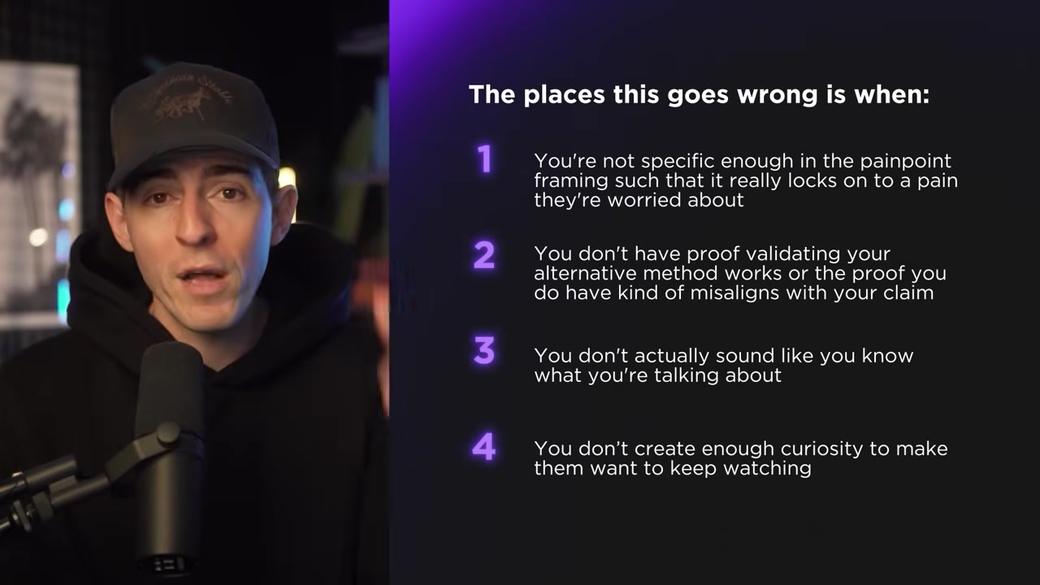
أين يفشل الناس في تطبيقه
- الوجع الذي تؤطّره ليس محدّداً بما يكفي ليمسك بقلقٍ حقيقي يشغلهم.
- لا تملك دليلاً يثبت أن بديلك يعمل، أو تملك دليلاً لا يتّسق تماماً مع ادّعائك.
- لا تبدو كمن يعرف ما يتحدّث عنه، ولا تستخدم الكلمات الصحيحة في مواضعها الصحيحة.
- ببساطة، لا تثير فضولاً كافياً يجعلهم يرغبون في مواصلة المشاهدة [4:46] [5:13].
الإطار الثاني · من العريض إلى الضيّق
يمتدّ هذا الإطار، واسمه بالإنجليزية Broad To Narrow، على المقطع [5:23 – 10:00]، ويفتتحه بقوله: «لو أمكنك أن تأخذ من هذا الفيديو شيئاً واحداً وتحاول تطبيقه الآن، فليكن هذا».
«يشتري الناس منك حين يفهمون بوضوحٍ تامّ ما تقوله بالضبط.»
يقول إن من أكبر أسباب إعجاب الناس بمحتواه أنه يحاول أن يجعل الخطوة التالية بعد الفيديو واضحة تماماً، وإنه يُمضي في ذلك «كلّ وقت الكتابة تقريباً». ويسمّي هذا تنقية الوضوح (clarity purification): «أظلّ أعيد الكتابة وأعيد وأعيد، محاولاً أن أنقّيها حتى يصير ما أقوله بالضبط واضحاً مئة بالمئة» [5:23] [5:44].
ويعلّل ذلك بقوله: «حين أكون واضحاً تكون أنت واضحاً، وحين تكون واضحاً تثق بي أكثر، وهذا ما يقود إلى الشراء» [5:44].
ومن أسرار هذا الوضوح إطارُ «من العريض إلى الضيّق»، ويقول إنه يصلح لبناء «أي نوع من المحتوى»: الفيديو القصير، وأقسام فيديوهات يوتيوب، والستوري، والكاروسيل، والإيميل [5:44].
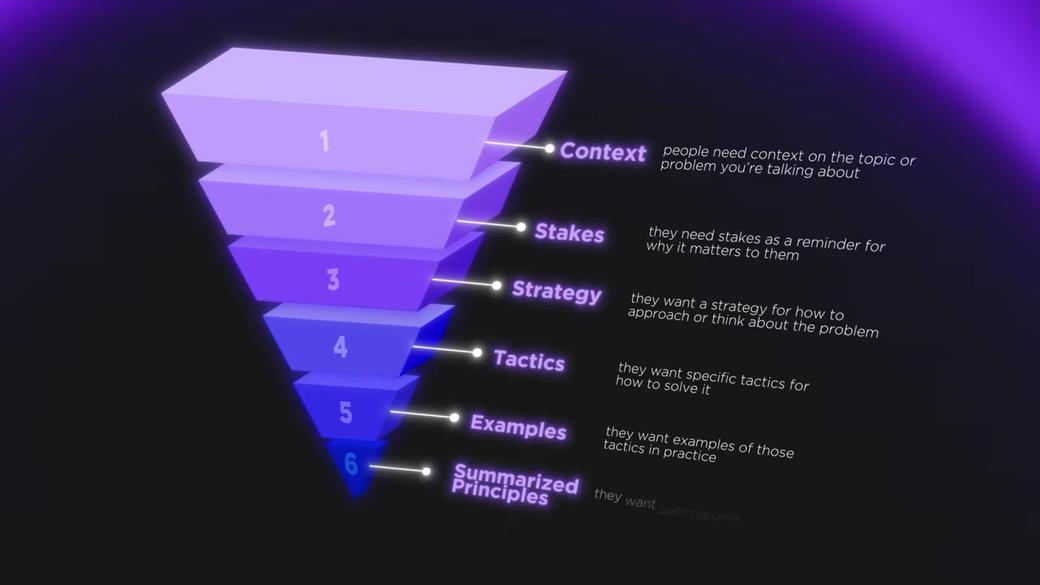
كيف يعمل
«يتلقّى الدماغ المعلومات من الأعلى إلى الأسفل، كالقُمع أو الهرم المقلوب، فيبدأ بالأعرض وينتهي بالأضيق» [6:12]. ثم يمرّ على المستويات الستّة بترتيبها:
| # | المستوى | ما يحتاجه المشاهد فيه |
|---|---|---|
| ١ | السياق Context | أن يفهم عمَّ تتحدّث، وهذا أعرض المستويات. |
| ٢ | الرهان Stakes | أن يدرك لماذا يهمّه هو هذا الأمر. |
| ٣ | الاستراتيجية Strategy | أن يسمع الخطّ العام لمقاربة المشكلة. |
| ٤ | التكتيكات Tactics | أن يدخل في تفاصيل تنفيذ تلك الاستراتيجية. |
| ٥ | الأمثلة Examples | أن يرى أمثلة تُظهر كيف تعمل تلك التكتيكات. |
| ٦ | المبادئ المختصَرة Principles | أن يحصل في النهاية على مبادئ مختصرة تُجمل العناصر الجوهرية في كل ما سبق، وهذا أضيق المستويات. |
ثم يذكر خطأين شائعين: الأول أن يبدأ الراوي من منتصف القُمع، كأن يفتتح بالاستراتيجية، فلا يستطيع المشاهد أن يتابع ولا أن يقتنع، لأنه لا يملك السياق ولا يعرف لماذا يهمّه الأمر. والثاني أن يبدأ بداية صحيحة بالسياق والرهان، لكنه لا ينزل أبداً إلى الأمثلة التي تُثبّت معنى التكتيكات. «وأيٌّ من الخطأين يترك المشاهد في غموض وارتباك، ولن يشتري» [6:39] [7:08].
الخدعة: يشرح الإطار بالإطار نفسه
هنا يعود بالفيديو إلى بداية هذا القسم ليُريك عملياً كيف بناه بالترتيب نفسه [7:08] [9:03]:
- بدأ بالسياق: «الإطار الثاني اسمه من العريض إلى الضيّق… لو أمكنك أن تأخذ شيئاً واحداً فليكن هذا. يشتري الناس حين يفهمون بوضوح تامّ»، ولم يُرد بذلك إلا أن يوجّهك إلى فكرة الإطار ويبيّن لماذا يهمّ الوضوح إلى هذا الحدّ.
- ثم أضاف الرهان: «حين أكون واضحاً تكون أنت واضحاً، وحين تكون واضحاً تثق بي أكثر، وهذا ما يقود إلى الشراء». ويقول إن هذه الجملة أشبه بخطّاف ثانٍ يُعيد انتباهك، فلو قلتَ في نفسك إن الوضوح لا يهمّ، شدّك ذكرُ البيع من جديد لأنك تريد التحويل.
- بعد ذلك عرض الاستراتيجية: «من أسرار ذلك الوضوح هذا الإطار، وتستطيع أن تستخدمه في أي نوع من المحتوى».
- ثم شرح التكتيكات، فمرّ على المستويات الستّة واحداً واحداً.
- بعدها ساق الأمثلة: مثالاً على ما لا ينبغي فعله، وهو البدء من المنتصف، ثم هذا الاستعراض نفسه مثالاً حيّاً.
- وأخيراً ختم بالمبادئ، وهي الخلاصة أدناه.
«إن أردتَ حقاً أن ترفع الوضوح وتجعل المعلومة تلتصق بالذهن حتى يشتري الناس، فاشرح أفكارك من العريض إلى الضيّق: ابدأ بالسياق، ثم انتقل إلى الرهان فالاستراتيجية فالتكتيكات فالأمثلة فالمبادئ، بهذا الترتيب. والسبب أنك حين ترفع الوضوح ترفع الفهم، والفهم يرفع الثقة، والثقة تجلب مبيعات أكثر.»
ويسمّي ما فعله «خدعة سحرية صغيرة» ليُريك بها «حيل الجيداي الذهنية في السرد والسيكولوجيا حين تُحسن استخدامها» [9:03]. ثم يقدّم عرضيه: شرحه المجاني لنظام محتواه كاملاً على shortformsystem.co، والعمل معه فردياً عبر رابط أسفل الفيديو [9:34].
الإطار الثالث · لحظتا إدراك
يمتدّ هذا الإطار، واسمه بالإنجليزية Double Aha، على المقطع [10:00 – 12:04]، ويقول في مطلعه: «لو أدّيتُ عملي كما ينبغي، فالمفترض أنك مررتَ بلحظتَي الإدراك قبل أن نصل إلى هنا».
يقصد بـلحظة الإدراك ذلك الإحساسَ بأن مصباحاً أُضيء في رأس المشاهد حين يسمع شيئاً يتجاوز عتبة القيمة عنده. ويحدث هذا عادةً حين تقول شيئاً لم يخطر له من قبل، لكنه ما إن يسمعه حتى يرى فوراً كيف سينفعه [10:01].
«لحظة إدراك واحدة قد تجلب لك حفظاً أو مشاركة أو إعجاباً. أما لحظتان في الفيديو نفسه فتراكمان ثقةً بعشرة أضعاف، وتضمنان لك المتابعة، وتقودان غالباً إلى الشراء.»
ولماذا يحدث ذلك؟ لأن المشتري المحتمل يشاهد المحتوى بحثاً عن جديدٍ يساعده على حلّ مشكلاته. وتقديم فكرة واحدة غير بديهية أمرٌ جيد، أما فكرتان فتُثبتان أنك منجم معلومات، وهذا نمط يلتقطه دماغه. فحين تأتيه لحظة الإدراك الثانية يتابعك ويشترك فوراً، خوفاً من أن يفوته صندوق الكنز التالي إن لم يفعل [10:28].
التطبيق
«هدفك أن تزرع لحظتَي إدراك في أبكر موضع ممكن من الفيديو، ثم تضع بعد الثانية مباشرةً دعوةً إلى إجراء متوائمة. فهذه النقطة من القصة تمنحك أقصى قدرة على التأثير، إذ يشعر المشاهد عندها، بحكم قانون الردّ بالمثل، أنه مدينٌ لك أكثر ما يكون» [10:56]. ويختصر ذلك في أن تنتقل من لحظتَي الإدراك مباشرةً إلى دعوة متوائمة.
ويضرب مثلاً من هذا الفيديو نفسه، فقد كان شبه متأكّد أن لحظة إدراك واحدة على الأقل ستقع في مكان ما من قسم تأطير الجمهور، وتوقّع الثانية في جزء «من العريض إلى الضيّق». وتحوّطاً لاحتمال ألّا يكون المفهوم نفسه كافياً، أضاف تلك «الخدعة» حين عاد بالفيديو وأراك كيف بناه، ثم وضع الدعوة إلى الإجراء بعدها مباشرةً [10:56] [11:24].
ثم يقول صراحةً: «إن كنتَ قد بلغتَ هذه النقطة من الفيديو ولا تزال تشاهد، فأغلب الظن أنك تلمس أني أعرف عن السرد الكثير ممّا لم تسمعه من قبل. وإن كان السرد مشكلة عندك، خصوصاً إن كنت صاحب عمل، فالأرجح أنك صرتَ تثق بي كثيراً، وهذا يعود في معظمه إلى أني صنعتُ لحظتَي الإدراك في أول ثماني إلى عشر دقائق. وصدّقني، هذا سحر أسود، لكنه يعمل فعلاً حين تتعلّم كيف تسخّر قوة السيكولوجيا وتعرف كيف تؤثّر في الثقة» [11:24] [11:53].
الإطار الرابع · استجابة التحوّل العاطفي
يمتدّ هذا الإطار، واسمه بالإنجليزية Emotional Transformation Response، على المقطع [12:04 – 14:39].
يبدأ بالتفريق بين المتفرّج والمشتري، فالمتفرّج يستمع إلى القصة لأنها ممتعة، أما المشتري فيستمع لأن عنده وجعاً محدّداً يريد حلّه. ولكي تحوّل المتفرّج إلى مشترٍ، عليك أن تُطلق بقصتك «استجابة تحوّل عاطفي»، وهي في جوهرها أن تُشعل رغبته في التحوّل الذي تبيعه [11:53] [12:20].
وكل منتج يبيع تحوّلاً في الخفاء، لا الكورسات والاستشارات وحدها. فبرنامجه Sandcastles يعرض عليك الانتقال من «بلا نظام محتوى» إلى «نظام محتوى»، وAG1 يعرض الانتقال من جسد غير صحي إلى جسد صحي، وعلامات الملابس التجارية تعد بأن تنقل ذوقك من سيئ إلى جيد. ويخلص إلى أن «كل المنتجات تعرض ضمنياً انتقالاً ما من أ إلى ب»، فعليك أن تجعل قصتك تُشعل الرغبة في هذا الانتقال [12:20] [12:50].
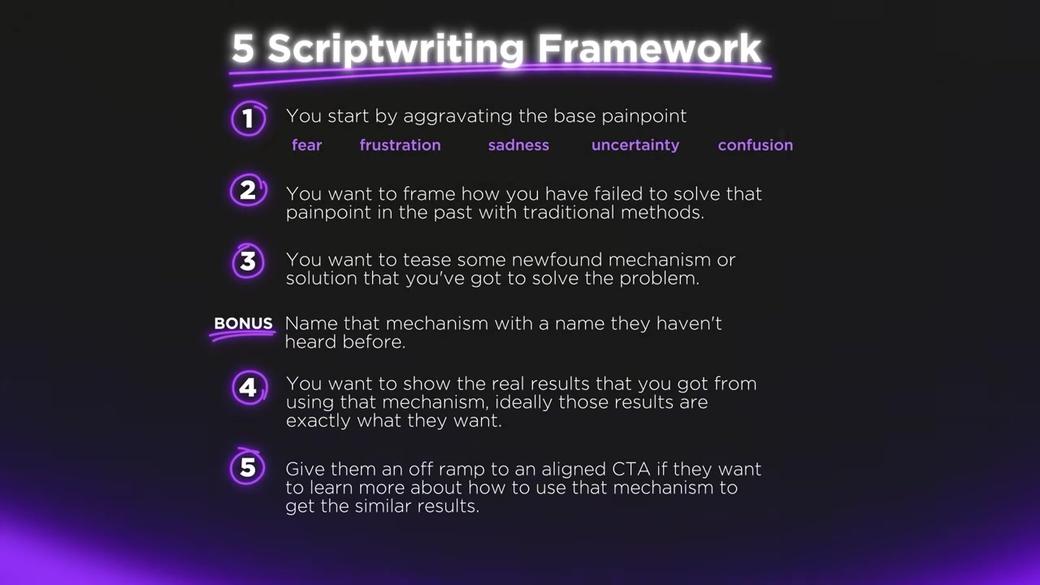
إطار السكربت الخماسي: قبل وبعد
يقول إنك تُطلق هذه الاستجابة بأن تؤطّر حالة ما قبل وحالة ما بعد، ويضع لذلك إطار سكربت من خمس خطوات [12:50] [13:17] [13:42]:
- أجّج الوجع الأساسي، وذلك بأن تذكره صراحةً في البداية، وتحاول ربطه بالشعور الذي يعيشه صاحبه على الأرجح: خوف، إحباط، حزن، حيرة، ارتباك.
- اروِ كيف فشلتَ في حلّه بالطرق التقليدية، وهي عادةً الطرق المعتادة التي ما زالوا عالقين فيها.
- لوّح بآلية جديدة وجدتَها لحلّ المشكلة. وإليك نصيحة إضافية: أعطِها اسماً لم يسمعوه من قبل.
- أرِهم النتائج الحقيقية التي حقّقتها بها، والأمثل أن تكون بالضبط ما يريدونه.
- افتح لهم مخرجاً إلى دعوة إجراء متوائمة، إن أرادوا أن يعرفوا أكثر كيف يستخدمون الآلية نفسها ليصلوا إلى نتائج مماثلة.
«من الصعب جداً على صاحب العمل أن يصنع محتوى يحقّق مشاهدات عالية ومبيعات عالية معاً. قضيتُ شهوراً أتعلّم كيف أنتشر، ومع أني بلغتُ 25 مليون مشاهدة، لم يتحوّل ذلك إلى مبيعات تُذكر. لكني قبل أسبوعين اكتشفتُ أخيراً صيغة فيديو جديدة نجحت فعلاً، فبعد محاولتين فقط حقّقتُ بها 55 ألف دولار ربحاً من 14 ألف مشاهدة لا غير. اسمها طريقة التحويل، وقد غيّرت تماماً أسلوبي في صناعة المحتوى. اكتب «طريقة» في التعليقات، وسأرسل لك دليلاً كاملاً يشرح بالضبط كيف تعمل، ولماذا تنجح إلى هذا الحدّ في جلب المبيعات.»
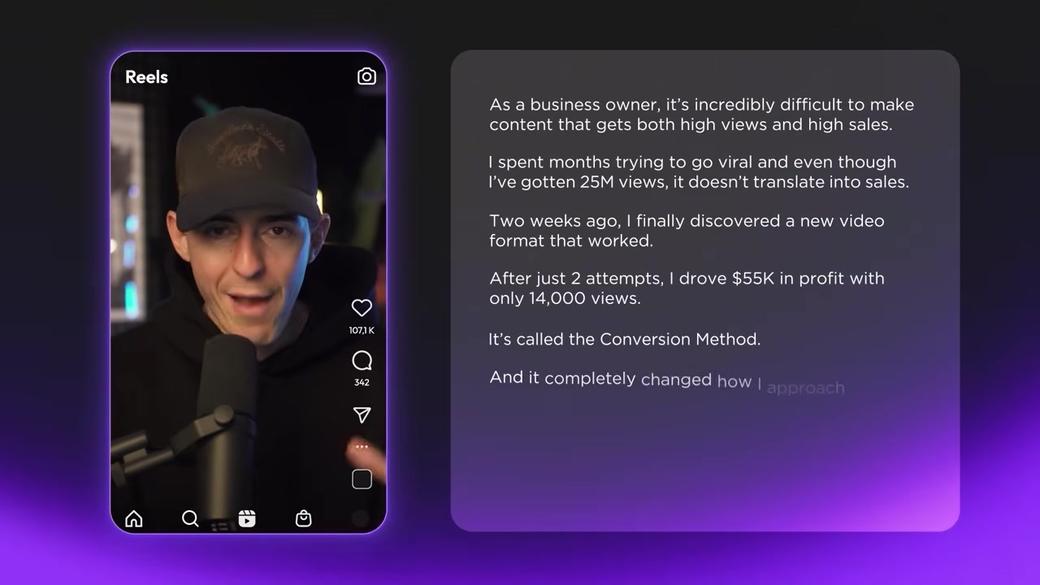
ويقول إن هذا الإطار «يعمل جيداً جداً في كل أنواع القصص: الفيديو القصير، ويوتيوب، والكاروسيل، والستوري، وسينجح في أي شيء تحتاجه» [14:13].
الإطار الخامس · التراجع خطوتين إلى الوراء
يمتدّ هذا الإطار، واسمه بالإنجليزية Double Zoom Out، على المقطع [14:39 – 18:04]. ويقول إنه «مختلف قليلاً عن الأربعة التي تناولناها»، ويرى أنه «على الأرجح أقلّ ما يمكن أن تأخذه من هذا الفيديو كله بداهةً، وأكثره نفعاً».
ينطلق هذا الإطار من أننا جميعاً نتأثّر طوال يومنا، دون أن نشعر، بما نستهلكه من محتوى. وأسرع طريق لتعرف كيف تعدّل سردك أنت أن تفهم كيف يؤثّر فيك سرد غيرك. وينصح بأن تطبّق هذه الطريقة «على كل محتوى تستهلكه» [14:40].
الخطوتان
- في الخطوة الأولى تتراجع تراجعاً صغيراً وأنت تشاهد، كأنك تنظر من فوق كتفك، وتسأل نفسك: هل يجعلني هذا المحتوى أثق بهذا الشخص أكثر، حتى إني أفكّر في شراء ما يبيعه؟
- وفي الخطوة الثانية، إن كان الجواب نعم، تتراجع أكثر حتى «عين الإله» وتسأل: ما الذي قاله أو أراه أو فعله تحديداً، فجعلني أبدأ أثق به وأرغب في معرفة المزيد؟ [15:10]
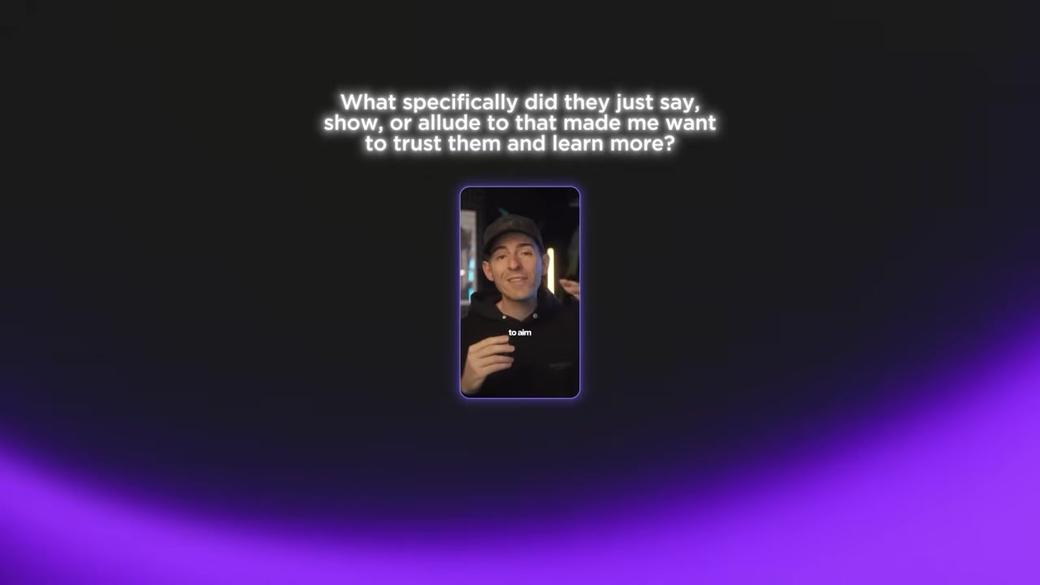
«يبدو الأمر مخالفاً للحدس، لكن هذا التراجع المزدوج وحده يكشف لك بالضبط الرسائل والكلمات والأفعال والمرئيات التي كانت أقدر من غيرها على دفعك إلى الثقة به، ثم تستطيع أن تحاكيها في محتواك أنت» [15:10] [15:37]. ومتى لاحظتَ أنك بدأت تثق بصانع محتوى، «توقّف، وتتبّع خطواتك إلى الوراء، وتراجع، واسأل: كيف وصلتُ إلى هنا؟». فإن كان قد كسب ثقتك، فعادةً يكون قد فعل واحداً من أشياء عدّة: عرض عليك مثالاً يلامس بعمق صراعاً تعيشه الآن، أو وصف حالة شعورية أنت فيها أو كنت فيها قريباً، أو روى تحوّله هو، بدءاً بوجعه، ثم محاولته الفاشلة لحلّه، ثم حلّه الجديد [15:37].
ولماذا هو مفيد إلى هذا الحدّ؟ لأن البشر يصعب عليهم أن يتأمّلوا عملهم هم، إذ «نرى أخطاء غيرنا بسهولة، لكن يصعب علينا كثيراً أن ننظر إلى داخلنا فنجد الأخطاء في عملنا». أما التراجع المزدوج فيجعلك تمسك بنفسك متلبّساً بالاقتناع في اللحظة نفسها، فلا تحتاج إلى أن تجلس بعدها وتخمّن ما الذي حدث [16:07].
مثال من تجربته مع جيريمي هاينز
كان يشاهد مؤخراً بضعة فيديوهات لـجيريمي هاينز (Jeremy Haynes)، الذي يصنع محتواه تحديداً لأصحاب أعمال يحقّقون ما يقارب بضع مئات الآلاف شهرياً ويسعون إلى بلوغ المليون شهرياً، «وهذا بالضبط موضعي في رحلتي مع ريادة الأعمال، وهذا هدفي». وفي أثناء مشاهدته أحد فيديوهاته، لاحظ أنه بدأ «يسقط في حفرة الثقة»، فتراجع مرتين وسأل نفسه: ما الذي يفعله هنا فيجعلني أثق به، وربما أرغب في شراء منتجاته؟ [16:36]. فوجد أربعة أشياء، وخامساً إضافياً:
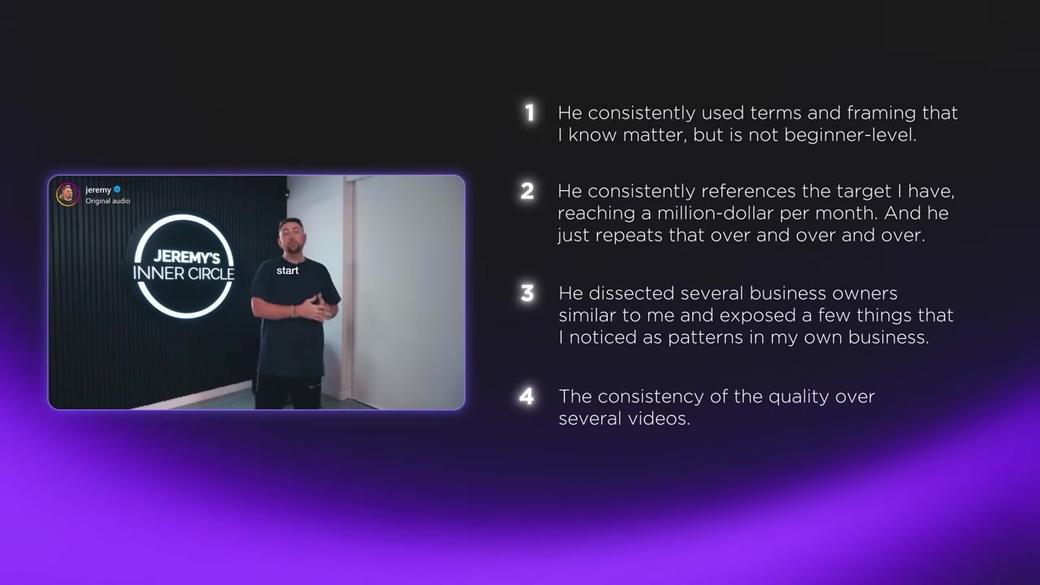
- يستخدم باستمرار مصطلحات أعرفها لكنها ليست من مستوى المبتدئين، فأوحى لي ذلك بأنه يخدم المتقدّمين أمثالي.
- يعود باستمرار إلى الهدف نفسه الذي أضعه لنفسي، «شهور المليون دولار»، فيكرّره مراراً وتكراراً، حتى لكأنه يحفر في رأسك أن هذا كل ما يفعله.
- شرّح عدة شركات تشبه شركتي إلى حدّ ما بطريقة جعلتني أتأمّل الأنماط أو العوائق في عملي أنا.
- ظلّت جودة هذه الأشياء الثلاثة ثابتة مرة بعد مرة في فيديوهات كثيرة.
- وخامساً، على سبيل الإضافة: «هو أيضاً ظريف نوعاً ما، وهذا يضيف فوق ذلك كله طبقة من الزينة» [17:03] [17:34].
«وبينما أنا جالس أشعر بالتأثير يجذبني كأنه مغناطيس، جعلني هذا التراجع المزدوج أدرك: آه، عليّ ببساطة أن أفعل هذه الأشياء نفسها في محتواي» [17:34]. ويقرّ بأن هذا الإطار «يميل قليلاً إلى السيكولوجيا، وليس تكتيكياً بالقدر نفسه»، لكنه يجده مفيداً للغاية «لأن معظم الناس ليسوا بارعين في ملاحظة الأنماط السيكولوجية» [17:34] [18:01].
الإطار السادس · سيكولوجية المشتري
يمتدّ هذا الإطار، واسمه بالإنجليزية Buyer Psychology، على المقطع [18:04 – 20:01].
«في أبسط مستوى، يشتري الناس لأنهم مستعدّون أن يخاطروا بدولاراتهم اليوم على أمل أن تعود عليهم أضعافاً في المستقبل. هذا كل ما في الأمر. فوظيفة قصتك أن تُزيل الخطر عن قرار الشراء، حتى يبدو لهم قول «نعم» بديهياً لا يحتاج إلى تفكير، وكأن حصولهم على العائد أمر مفروغ منه.»
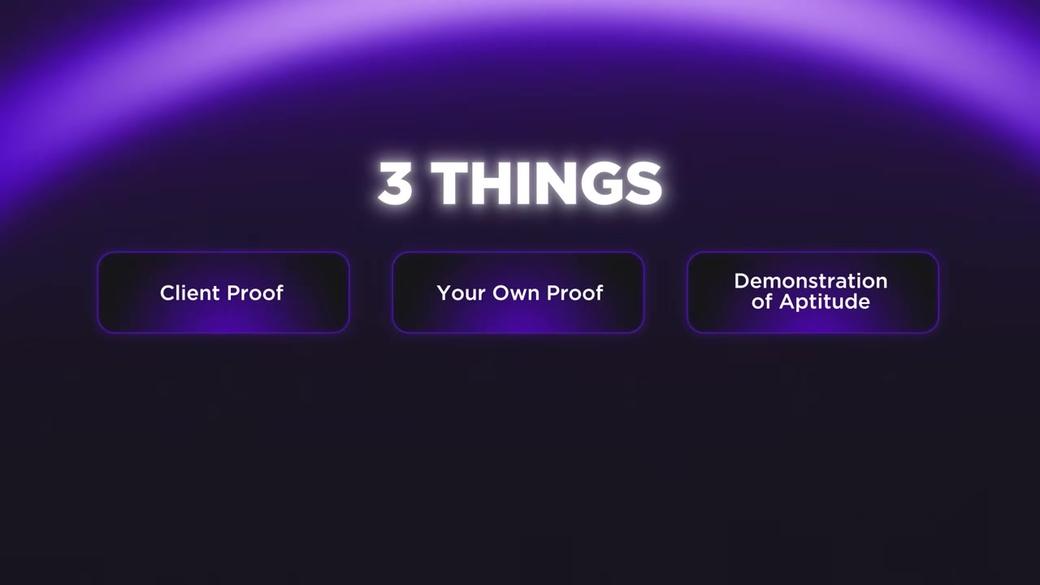
وتكون إزالة الخطر عادةً بثلاثة أشياء: دليل من عملائك، أو دليلك أنت، أو إظهار الكفاءة والقدرة داخل المحتوى نفسه [18:34].
وأيّ الثلاثة استخدم في هذا الفيديو؟ استخدم الثالث؛ فقد حاول جهده أن يُظهر «مستوى متقدّماً أو إتقاناً في السرد والسيكولوجيا» حتى لا يبقى عندك شكّ في أنك لو دفعتَ له لاستطاع أن يساعدك على النمو أسرع، وفعل ذلك عبر «سلسلة من الأطر البعيدة جداً عن البداهة، الجديدة، لكن المشروحة بوضوح، لأُريك أن جعبتي أعمق من جعبة غيري» [18:34]. ثم يصف الدورة كما يراها: بعد أن تشاهد الفيديو يمكنك أن تطبّق بنفسك بعض ما قاله، فإن رأيت التحويل يرتفع عدتَ فوراً راغباً في الشراء لتنال المزيد؛ «وهذه هي دورة المحتوى التي تصنع المرجعية والثقة والتحويل» [19:04].
لكن الأقوى من إظهار الكفاءة هو الدليل، سواء جاء من العملاء أو منه هو، بالبيانات الخام والشهادات. ويعترف: «تركتُ ذلك عمداً حتى تصل هذه النقطة أقوى»، ولو كان الأمر مثالياً لأضاف دليله أيضاً: مليونا المتابعين، ومليارات المشاهدات، والشركات الثلاث ذات الأرقام السبعة، وشهادات «عشرات وعشرات من أصحاب الأعمال» الذين ساعدهم على النمو من الصفر إلى الملايين [19:04] [19:33].
ثم يصارحك: «المعلومة وإظهار الكفاءة لا يبلغان بك إلا حدّاً معيّناً على مقياس إزالة الخطر. إن كنت تبيع عروضاً غالية، فستحتاج على الأرجح إلى أن تُدخل الدليل، من عملائك أو منك». وما دامت سيكولوجية المشتري تعمل هكذا، فحاول أن تضمّن محتواك من هذه الأشياء الثلاثة أكثر ما تسمح به مدته [19:33].
الأطر الستّة في جدول واحد
| # | الإطار | جوهره في سطر | الموضع |
|---|---|---|---|
| ١ | التأطير على مقاس العميل Avatar Framing | تبني القصة على وجع محدّد، وتخاطب عميلك بلغة من مستواه، وتضع الدليل في المقدّمة، وتفتح له طريقاً إلى المزيد، فتُصيب شريحتك وتُبعد غيرها. | [0:35] |
| ٢ | من العريض إلى الضيّق Broad To Narrow | تشرح بالترتيب: سياق ← رهان ← استراتيجية ← تكتيكات ← أمثلة ← مبادئ؛ فالوضوح يصنع الثقة، والثقة تبيع. | [5:23] |
| ٣ | لحظتا إدراك Double Aha | تزرع فكرتين غير بديهيتين في أبكر موضع ممكن، ثم تضع دعوة متوائمة بعد الثانية مباشرة. | [10:00] |
| ٤ | استجابة التحوّل العاطفي Emotional Transformation Response | أجّج الوجع ← فشل الطرق التقليدية ← آلية جديدة لها اسم ← النتائج ← مخرج إلى دعوة. | [12:04] |
| ٥ | التراجع خطوتين Double Zoom Out | تسأل: هل يجعلني أثق به؟ ثم تسأل: ما الذي فعله تحديداً؟ ثم تحاكيه. | [14:39] |
| ٦ | سيكولوجية المشتري Buyer Psychology | الشراء مخاطرةٌ طمعاً في عائد، فأزِل الخطر بدليل العملاء أو بدليلك أو بإظهار كفاءتك. | [18:04] |
ويختم بتكرار عرضيه، أي العمل معه فردياً، والأدوات ومغانط العملاء المجانية أسفل الفيديو، قائلاً: «أحاول حقاً أن أساعدك على النمو أسرع» [20:02] [20:30].
ملاحظات على المصدر
يجمع هذا القسم ما ورد في المصدر ملتبساً أو بلا سند، أو ما يستحق الانتباه إليه، ويُثبته دون أن يحسم فيه.
- الفيديو يطبّق أطره على المشاهد وهو يشرحها، ويقول ذلك صراحةً. فقد زرع «لحظتَي الإدراك» عمداً في أول عشر دقائق وأتبعهما بدعوة إلى إجراء [11:24]، واختار «إظهار الكفاءة» أداةً لهذا الفيديو بالذات [18:34]، فالفيديو نفسه قطعة بيعية مصمَّمة بالأطر التي يشرحها.
- الأرقام كلها يرويها عن نفسه بلا إحالة: مليونا متابع، ومليارات المشاهدات، وثلاث شركات بسبعة أرقام، و«عشرات وعشرات» من أصحاب الأعمال [0:28] [19:33]. أما «عشرة أضعاف الثقة» التي تجلبها لحظتا الإدراك [10:28] فصياغة قاطعة بلا مصدر.
- وثمة أرقام وردت داخل الأمثلة لا داخل الادّعاءات: «من الصفر إلى 100 ألف و100 ألف دولار ربحاً في ثلاثة أشهر» [3:13]، و«25 مليون مشاهدة» و«55 ألف دولار من 14 ألف مشاهدة» [14:13]؛ فقد جاءت كلها نصوصاً مقترحة للخطّافات لا وقائع يقرّرها، ولهذا السبب تحديداً أُبقيت في هذا الملخص داخل صناديق «المثال».
- «قانون الردّ بالمثل» و«عتبة القيمة» مصطلحان يستخدمهما دون أن يعرّفهما أو يحيل فيهما إلى مصدر [10:01] [10:56].
- في الشرح مصلحة تجارية معلَنة: فمنتجه Sandcastles يرد مثالاً على «التحوّل» [12:20]، وعرضاه (النظام المجاني والعمل الفردي) يُذكران ثلاث مرات [9:34] [11:53] [20:02].
- وقعت في التفريغ الآلي اضطرابات في كتابة الأسماء: «Callaway» بدل Kallaway · «SamCast» بدل Sandcastles · «shortformsytem.co» بدل shortformsystem.co. وقد اعتُمد الهجاء الصحيح لهذه الأسماء، إفصاحاً لا تصحيحاً صامتاً.
- استُبعدت من الملخص جمل الحشو والتكرار الشفهي (مثل «all right»)، وعبارات الترويج المتكرّرة بصيغتها الحرفية، وأُبقي منها ما كان جزءاً من حجّته أو من إفصاحه.
المنهجية: أُعدّ هذا الملخص في 9 سبتمبر 2026 من مصدرين من الفيديو نفسه: (١) التفريغ النصي الآلي بلغته الأصلية (الإنجليزية)، مسحوباً بأداة yt-dlp بصيغة json3 — نحو 5,171 كلمة، وقُرئ كاملاً؛ (٢) تسع شرائح استُخرجت من ملف الفيديو مباشرة بأداة ffmpeg عند الطوابع الزمنية المذكورة تحتها، بدقة 1040 بكسل عرضاً، غير معدّلة ولا مقصوصة — واختيرت وحدها لأنها تحمل بنية الأطر كما رسمها هو. هذا أول ملخص يُكتب بالمادة 3.4 المُعدَّلة من الدستور (9 سبتمبر 2026): الترجمة بالمعنى لا بالحرف. أي أن الجملة الإنجليزية كُسرت وأُعيد بناؤها عربيةً سلسة، مع بقاء الأمانة للمحتوى مطلقة: لا معنى أُضيف، ولا معنى حُذف، والتحفّظات والأرقام كما وردت، والاقتباسات تنقل معناه ونبرته لا ترتيب كلماته. وكل اقتباس منسوب لطابعه الزمني ليُقابَل بالأصل. لم يُصحَّح شيء ممّا ورد في المصدر عدا تشوّهات التفريغ المفصح عنها في «ملاحظات على المصدر». لا توجد في هذه الصفحة أي إضافة أو استنتاج أو توصية من المُلخِّص. وفي 14 سبتمبر 2026 أُعيدت صياغة النص العربي بأمر المالك («الصياغة هنا مفككة… اعد الصياغة حسب الدستور») ليصير عربيةً متصلة وفق المادة 3.4، وقوبل في أثناء ذلك بالتفريغ من جديد، فرُدّت بعض الاقتباسات والتحفّظات إلى معناها الدقيق في المصدر دون إضافة أي معنى من خارجه، وصُحّحت قائمة اضطرابات التفريغ في «ملاحظات على المصدر» بعدما تبيّن أنها تذكر صيغاً لا ترد فيه. أما النسخة الإنجليزية فتعود فيها الاقتباسات إلى كلمات المتحدّث الأصلية. النشر: رُفعت هذه الصفحة على shortitfor.me/storytelling بتاريخ 13 سبتمبر 2026، بناءً على أمر المالك النصّي الصريح لهذا الملف بعينه («ارفعها على موقع ملخصاتي») — استثناءٌ موثَّق من المادة 6 من دستور الملخصات، والصفحة موسومة noindex كما توجب المادة نفسها.
This is a summary of Kallaway's video “How to Become A Master Storyteller,” in which he presents six frameworks for writing stories whose aim is conversion rather than entertainment, starting with avatar framing and ending with buyer psychology. The slides shown on this page are taken from the video itself, along with their timestamps.
▶ Watch the original video
The idea the whole video rests on
Right at the start of the video, he distinguishes between two kinds of stories: those that entertain and those that drive people to buy. He devotes his talk to the second kind alone, presenting his six favorite frameworks “specifically designed for conversion” — that is, for turning a viewer into a lead and then into a buyer [0:00].
“After watching this, I guarantee you will think differently about the way you write scripts and make content.”
He then introduces himself briefly: “My name is Kallaway. I have 2 million followers. I've done billions of views, and content is all I do all day long” [0:28].
Framework 1 · Avatar Framing
This framework spans [0:35 – 5:23], and he describes it as “very critical.”
He starts from the observation that most content is made for broad virality, so its stories come out sensationalist, aimed at the widest possible audience, and compressed as far as they will go — in other words, “max shock, max reach, and minimum length.” That really does bring in huge numbers of views, but it isn't what you want if your goal is to sell [0:28] [0:55].
The four conditions under which conversion storytelling succeeds
- Build the story around a specific pain point or frustration that your ideal customer avatar struggles with.
- Choose your words to signal a match in competency. If your buyer is advanced, use the advanced terms they will understand instantly; if they are a beginner, stick to beginner vocabulary.
- Embed specific and concrete proof that shows your approach works.
- Lead the viewer down a path of curiosity that leaves them wanting to know more after the video [0:55] [1:22].
He then boils them down to four phrases: “pain point driven, aligned messaging, proof forward, and a path for more.” The aim is for the story to strike your customer as “a bull's-eye fit” and to filter out everyone else [1:22].
He illustrates this with a circle analogy. Imagine a circle of 100 million accounts on Instagram or YouTube. If you're a business owner, your real customers within that circle probably number only a few hundred thousand, maybe a few million — in other words, “a very small slice of the pie.” Avatar framing lets you capture as much of your slice as possible without spilling over into the other slices [1:49].
How he applies it himself — a full example
He defines his ideal customer avatar as a business owner who wants to scale their content to grow their business faster. So if he were writing a script about social media growth to push that customer toward one of his paid programs, the first thing he would do is ask: What pain point do business owners in particular face on this topic that most people don't? [2:17] [2:43]. The pain points he names here include:
- They don't have much time to make content every week.
- They don't know the right mix for their content strategy if they want to sell more.
- They don't know who to hire or how to run a content team.
- They don't know which business accounts to model themselves after.
- They have a gut feeling that going viral isn't the right choice for them, but they don't know why, or what to do instead [2:43].
These pain points are specific to business owners; they don't apply to a solo creator. So he picks one of them and hammers it hard in the first two sentences [3:13], proposing a hook like this one to open the video:
“The fastest way to grow your business on social media is not by going viral. Instead, you want to run the 3-2-1 Conversion Strategy. This is what I used to go from zero to 100K on my own channel while also driving $100,000 in profit in the first 3 months. So, you get both a ton of conversion without sacrificing the growth. Here's how it works.”
He then dissects his own hook, explaining what he did in those sentences [3:43] [4:12]:
- He called out business owners by name when he said “grow your business on social media,” so anyone who is a business owner is drawn in, while everyone else scrolls past.
- He offered a contrarian take, challenging the common belief that you need to go viral, and then presented an alternative he called the 3-2-1 strategy.
- He gave concrete proof drawn from the results he achieved himself with that alternative.
- He used mid-level business terms that a business owner understands immediately but others may not: conversion, conversion strategy, profit, and sacrificing growth.
- He tried to make it compelling enough that the viewer would want to hear the rest of the story.
“The reason this works so well at attracting convertible viewers is because it feels like I'm saying the thing that has been rattling around frustrating them in their head for weeks. And when they hear it, it's almost like they're subconsciously nodding along as they watch.”
Where people go wrong with it
- The pain point you're framing isn't specific enough to lock onto a real concern that weighs on them.
- You don't have proof that your alternative works, or the proof you do have doesn't quite line up with your claim.
- You don't sound like you know what you're talking about, and you don't use the right words in the right places.
- Put simply, you don't create enough curiosity to make them want to keep watching [4:46] [5:13].
Framework 2 · Broad to Narrow
This framework spans [5:23 – 10:00], and he opens it by saying, “If there was one thing that you could take away from this video and try to apply right now, it would be this.”
“People buy from you when they have an extremely clear understanding of exactly what you're saying.”
He says one of the biggest reasons people like his content is that he tries to make the next step after the video extremely clear, adding, “I spend almost all of my time in the writing process on this.” He calls it clarity purification: “I am just constantly rewriting and rewriting and rewriting, trying to purify it so that there's 100% clarity on exactly what I'm saying” [5:23] [5:44].
He explains why: “When I'm clear, you're clear, and when you're clear, you trust me more, and that's what leads to conversion” [5:44].
One of the secrets to that clarity is the “broad to narrow” framework, which he says can be used to structure “any kind of content”: short-form videos, segments of YouTube videos, stories, carousels, and emails [5:44].
How it works
“The brain consumes information top down, like a funnel or an upside-down pyramid. It's widest first and then narrowest last” [6:12]. He then goes through the six levels in order:
| # | Level | What the viewer needs at this level |
|---|---|---|
| 1 | Context | To understand what you're talking about. This is the widest level. |
| 2 | Stakes | To grasp why the topic matters to them personally. |
| 3 | Strategy | To hear the broad outline of how to approach the problem. |
| 4 | Tactics | To get into the details of how to execute that strategy. |
| 5 | Examples | To see examples that show how those tactics work. |
| 6 | Summarized Principles | Finally, to come away with summarized principles that capture the core elements of everything before them. This is the narrowest level. |
He then points out two common mistakes. The first is when the storyteller starts halfway down the funnel, say by opening with the strategy, so the viewer can neither follow along nor buy in, since they have no context and don't know why it matters to them. The second is when the storyteller starts off correctly with context and stakes but never gets down to the examples that pin down what the tactics mean. “Either of those mistakes leaves the viewer unclear, confused, and they won't buy” [6:39] [7:08].
The trick: he explains the framework with the framework itself
Here he rewinds the video to the start of this section to show you, in practice, how he built it in that same order [7:08] [9:03]:
- He started with context: “Tip number two is called the broad to narrow framework… if there was one thing that you could take away… it would be this. People buy from you when they have an extremely clear understanding…” The only purpose of this was to orient you to the idea behind the framework and show why clarity matters so much.
- Then he added the stakes: “When I'm clear, you're clear, and when you're clear, you trust me more, and that's what leads to conversion.” He says this line works something like a re-hook that refocuses your attention: if you've been telling yourself that clarity doesn't matter, the mention of sales pulls you right back in, because you want conversion.
- After that, he laid out the strategy: “One of the secrets to that clarity is the broad to narrow framework. And you can use this when you structure… any kind of content.”
- Next, he explained the tactics, going through the six levels one by one.
- Then he gave the examples: one showing what not to do, namely starting halfway through, and then this very walkthrough as a live example.
- Finally, he closed with the principles, which make up the summary below.
“If you really want to increase clarity, information stickiness, so people buy, you want to explain your points broad to narrow. First, you start with context, then you go stakes, strategy, tactics, examples, and principles in that order. And the reason you want to do this is because by increasing clarity, you increase comprehension, which increases trust, which drives more sales.”
He calls what he did “a little magic trick” to show you “the Jedi mind tricks of storytelling and psychology when you know how to use it well” [9:03]. He then presents his two offers: a free breakdown of his entire content system at shortformsystem.co, and working with him one-on-one through a link below the video [9:34].
Framework 3 · The Double Aha
This framework spans [10:00 – 12:04], and right at the start he says, “If I did my job right, you should have already experienced the double aha before we got to this point.”
By an aha moment, he means that feeling of a lightbulb going on in a viewer's head when they hear something that crosses their value threshold. This usually happens when you say something they hadn't thought of before, but once they hear it, they can immediately see how it would help them [10:01].
“One aha in content might earn you a save, a share, or a like, but two ahas in the same video will accrue 10x trust, for sure get you a follow, and usually leads to conversion.”
Why does this happen? Because a potential buyer watches content looking for new things that can help them solve their problems. Delivering one non-obvious insight is good, but delivering two proves you're a goldmine of information, and that's a pattern their brain picks up on. So when the second aha moment hits, they follow and subscribe right away, afraid they'll miss the next treasure chest of gold if they don't [10:28].
How to apply it
“Your goal… is to embed two aha moments as early as you can in the video. And right after that second aha hits, that's where you want to put an aligned CTA, because this is the point of maximum leverage in the story where, based on the law of reciprocity, they feel like they owe you the most” [10:56]. He boils it down to going from the double aha straight into an aligned CTA.
He offers an example from this very video. He was pretty sure at least one aha moment would land somewhere in the avatar framing section, and he expected the second to come in the “broad to narrow” part. As a hedge in case the concept itself wasn't enough, he added that “magic trick” where he went back through the video and showed you how he had built it, and then he put the CTA right after it [10:56] [11:24].
Then he puts it bluntly: “If you're at this point in the video and you're still watching, you can probably tell I know a lot about storytelling that you haven't heard before. And if storytelling is a problem for you, especially if you're a business owner, then you probably trust me a lot already. This is mostly because I created that double aha in the first 8 to 10 minutes. I'm telling you, this stuff is black magic, but it really does work once you learn how to harness the power of psychology and know how to influence trust” [11:24] [11:53].
Framework 4 · Emotional Transformation Response
This framework spans [12:04 – 14:39] of the video.
He begins by distinguishing the passive viewer from the buyer. The passive viewer listens to a story because it's interesting, while the buyer listens because they have a specific pain point they want to solve. To turn a passive viewer into a buyer, you need to use your story to trigger an “emotional transformation response,” which essentially means igniting their desire for the transformation you sell [11:53] [12:20].
And every product secretly sells a transformation, not just courses and coaching. His software, Sandcastles, offers to take you from “no content system” to “content system,” AG1 offers the move from an unhealthy body to a healthy one, and clothing brands promise to take your taste from bad to good. He concludes that “all products are subconsciously offering some shift or change from A to B,” so you need to make your story ignite the desire for that shift [12:20] [12:50].
The five-step scriptwriting framework: before and after
He says you trigger this response by framing the before and after state, and he lays out a five-step scriptwriting framework for doing it [12:50] [13:17] [13:42]:
- Aggravate the base pain point by stating it plainly at the start and trying to tie it to the emotion the person is probably feeling: fear, frustration, sadness, uncertainty, confusion.
- Tell how you failed to solve it with traditional methods, which are usually the conventional ways they're still stuck in.
- Tease a newfound mechanism of your own for solving the problem. And here's a bonus tip: give it a name they haven't heard before.
- Show them the real results you got with it; ideally, those results are exactly what they want.
- Give them an offer ramp into an aligned CTA, in case they want to learn more about how to use the same mechanism to get similar results.
“As a business owner, it's incredibly hard to make content that gets both high views and high sales. I spent months learning how to go viral. And even though I got 25 million views, it didn't translate into meaningful sales. But 2 weeks ago, I finally discovered a new video format that actually worked. After just two attempts with it, I drove $55,000 in profit off just 14,000 views. It's called the Conversion Method — completely changed how I approach making content. Comment ‘method’ and I'll send you a full guide breaking down exactly how the process works and why it's so great at driving sales.”
He says this framework “works super well in all types of stories: short-form, YouTube, carousel, stories, whatever you need, it will work” [14:13].
Framework 5 · The Double Zoom Out
This framework spans [14:39 – 18:04] of the video. He says it is “a little different from the four we've already covered,” and he considers it “probably the most non-obvious and effective thing you could take from this entire video.”
The framework rests on the premise that throughout the day we are all being influenced, without realizing it, by the content we consume. The fastest way to figure out how to tweak your own storytelling is to understand how other people's storytelling influences you. He recommends running this method “on every piece of content you consume” [14:40].
The two steps
- In the first step, you zoom out a little while you're watching, as if you were standing over your own shoulder, and ask yourself: Is this piece of content making me trust this person more, to the point that I'd consider buying whatever they're selling?
- In the second step, if the answer is yes, you zoom out further, all the way to a “god's eye view,” and ask: What specifically did they say, show, or do that made me start to trust them and want to learn more? [15:10]
“It sounds counterintuitive, but just by doing this, the double zoom out, it will reveal the exact messaging, words, actions, and visuals on the screen that best influence you into trusting them, and then you can mimic that in your own content” [15:10] [15:37]. And whenever you notice that you've started to trust a creator, “pause, retrace your steps, zoom out, and ask, ‘How did I get here?’” If a creator has won your trust, they have usually done one of several things: shown you an example that connects deeply with a struggle you're facing right now, described an emotional state you're in or were in recently, or told the story of their own transformation, starting with their pain, then their failed attempt to solve it, and then their new solution [15:37].
Why is it so helpful? Because humans have trouble introspecting on their own work — “we can easily see mistakes in others, but we really struggle to look inward and find the mistakes in our own stuff.” The double zoom out, by contrast, lets you catch yourself being persuaded in real time, so you don't have to sit down afterward and guess what happened [16:07].
An example from his experience with Jeremy Haynes
He had recently been watching a few videos by Jeremy Haynes, who makes his content specifically for business owners doing roughly a few hundred thousand a month and trying to reach a million a month. “This is exactly where I'm at in my entrepreneurial journey,” he says, “and that's the goal I have.” While watching one of Haynes's videos, he noticed himself beginning to “fall down the trust rabbit hole,” so he zoomed out twice and asked himself: What is he doing here that's making me trust him and maybe want to buy his products? [16:36]. He found four things, plus a bonus fifth:
- He consistently uses terms that I know but that aren't at a beginner level, which signaled to me that he serves advanced people like me.
- He keeps coming back to the exact target I've set for myself, “million-dollar months,” repeating it over and over, almost as if he were drilling it into your head that this is all he does.
- He dissected several businesses somewhat similar to mine in a way that made me reflect on the patterns or roadblocks in my own business.
- The quality of those three things stayed consistent, time after time, across many videos.
- And fifth, as a bonus: “He's also kind of a funny guy, and so that … adds an extra icing layer as well” [17:03] [17:34].
“As I was sitting there feeling myself be influenced like a magnet was pulling me in, that double zoom allowed me to realize, ‘Oh, I should just do those things in my content’” [17:34]. He admits that this framework leans a little toward psychology and is “not as tactical,” but he finds it extremely helpful “because most people are not good at noticing psychology patterns” [17:34] [18:01].
Framework 6 · Buyer Psychology
This framework spans [18:04 – 20:01] of the video.
“At the most basic level, people buy because they're willing to risk dollars today in the hopes of returning a multiple on that investment in the future. That's really it. So the job of your story is to de-risk that buying decision for them, so it feels like an automatic no-brainer yes that they will get a return.”
De-risking is typically done through three things: client proof, your own proof, or demonstration of aptitude and ability within the content itself [18:34].
Which of the three did he use in this video? He used the third. He did his best to demonstrate “an advanced or mastery level of storytelling and psychology” so that you would be left with no doubt that, if you paid him, he could help you grow faster. “The way I was able to do that is through a series of very non-obvious, novel, but clearly explained frameworks to show that I have a deeper bag than other people,” he says [18:34]. He then describes the cycle as he sees it: after you watch the video, you can apply some of what he said on your own, and if you see conversions go up, you'll immediately come back wanting to buy so you can get more — “and this is the content cycle that drives authority, trust, and conversion” [19:04].
But even stronger than a demonstration of aptitude is proof, whether it comes from clients or from him, backed by raw data and testimonials. He admits, “I left that out on purpose so I can make this point hit harder”; ideally, he would also have included his own proof: the 2 million followers, the billions of views, the three seven-figure businesses, and the testimonials of the “dozens and dozens of business owners” he has helped grow from zero to millions [19:04] [19:33].
Then he levels with you: “Information and demonstration can only get you so far on the de-risking spectrum. If you're selling high-ticket offers, you're probably going to need to infuse the proof, whether from clients or yourself.” And since that is how buyer psychology works, try to build as much of these three things into your content as its length allows [19:33].
The six frameworks in one table
| # | Framework | In one line | Where |
|---|---|---|---|
| 1 | Avatar Framing | You build the story on a specific pain point, speak to your customer in language at their level, put the proof up front, and open a path for more, so you hit your own slice and filter out the rest. | [0:35] |
| 2 | Broad to Narrow | You explain things in order: Context → Stakes → Strategy → Tactics → Examples → Principles; clarity builds trust, and trust sells. | [5:23] |
| 3 | The Double Aha | You plant two non-obvious insights as early as possible, then place an aligned CTA right after the second. | [10:00] |
| 4 | Emotional Transformation Response | You aggravate the pain point → recount how traditional methods failed → tease a newfound mechanism with a name → show the results → close with an offer ramp CTA. | [12:04] |
| 5 | The Double Zoom Out | You ask: Is this making me trust them? Then you ask: What specifically did they do? Then you mimic it. | [14:39] |
| 6 | Buyer Psychology | Buying is a risk taken in the hope of a return, so de-risk it with client proof, your own proof, or a demonstration of your aptitude. | [18:04] |
He closes by repeating his two offers — working with him one-on-one, and the free tools and lead magnets below the video — saying, “I'm really trying to help you grow faster” [20:02] [20:30].
Notes on the source
This section brings together anything in the source that is ambiguous or unsupported, or that deserves attention, and records it without ruling on it.
- The video applies its frameworks to the viewer while explaining them, and says so openly. He deliberately planted the “double aha” in the first ten minutes and followed it with a CTA [11:24], and he chose “demonstration of aptitude” as the tool for this particular video [18:34], so the video itself is a sales piece designed with the frameworks it explains.
- All the figures are self-reported, with no citation: 2 million followers, billions of views, three seven-figure businesses, and “dozens and dozens” of business owners [0:28] [19:33]. The claim that the two aha moments bring “10x trust” [10:28] is stated categorically, with no source.
- There are also figures that appear inside the examples rather than the claims: “from zero to 100K … $100,000 in profit in the first 3 months” [3:13], as well as “25 million views” and “$55,000 in profit off just 14,000 views” [14:13]. All of them were presented as suggested hook scripts, not as facts he asserts, and it is precisely for this reason that they were kept inside the “Example” boxes in this summary.
- “The law of reciprocity” and “value threshold” are two terms he uses without defining them or citing a source for them [10:01] [10:56].
- The explanation carries a declared commercial interest: his product Sandcastles appears as an example of “transformation” [12:20], and his two offers (the free system and one-on-one work) are mentioned three times [9:34] [11:53] [20:02].
- The auto-generated transcript garbles some names: “Callaway” for Kallaway · “SamCast” for Sandcastles · “shortformsytem.co” for shortformsystem.co. This summary uses the correct spellings of these names, disclosing the corrections rather than making them silently.
- Left out of the summary were verbal filler and repetition (such as “all right”) and the recurring promotional lines in their verbatim form; anything among them that formed part of his argument or his disclosure was kept.
Methodology: This summary was prepared on 9 September 2026 from two sources taken from the video itself: (1) the auto-generated transcript in its original language (English), pulled with yt-dlp in json3 format — about 5,171 words, read in full; (2) nine slides extracted directly from the video file with ffmpeg at the timestamps noted beneath them, 1040 pixels wide, unedited and uncropped — these alone were chosen because they carry the structure of the frameworks as he himself drew it. This is the first summary written under the amended Article 3.4 of the Constitution (9 September 2026): translation by meaning, not word for word. That is, each English sentence was broken apart and rebuilt as fluent Arabic, while fidelity to the content remained absolute: no meaning was added, no meaning was removed, the hedges and figures stand as they were given, and the quotations convey his meaning and tone rather than his word order. Every quotation is tied to its timestamp so that it can be checked against the original. Nothing in the source was corrected apart from the transcript distortions disclosed in “Notes on the source.” This page contains no additions, inferences, or recommendations of any kind from the summarizer. On 14 September 2026, the Arabic text was rewritten at the owner's instruction (“the wording here is disjointed… rewrite it according to the Constitution”) into connected Arabic in line with Article 3.4. In the process it was checked against the transcript again, so a few quotations and hedges were brought back to their exact meaning in the source without adding any meaning from outside it, and the list of transcript distortions in “Notes on the source” was corrected after it turned out to cite forms that do not occur there. In this English version, quotations use the speaker's original words. Publication: This page was uploaded to shortitfor.me/storytelling on 13 September 2026, on the owner's explicit written instruction for this specific file (“upload it to my summaries site”) — a documented exception to Article 6 of the Summaries Constitution — and the page is tagged noindex, as that same Article requires.