تسلّق الجبل الريادي — ستّ خطوات لبناء يومك حول حالة التدفّق
تلخيص حرفي لمحاضرة ريان دوريس (Rían Doris)، الشريك المؤسّس لـFlowState، أمام جمهور من روّاد الأعمال. اللقطات في هذه الصفحة شرائح العرض نفسها، مأخوذة من الفيديو بطوابعها الزمنية.
 ▶ شاهد المحاضرة الأصلية
ما الذي وعد بتغطيته
يفتتح بتسمية موضوعه: «ما سأتحدث عنه اليوم أسمّيه تسلّق الجبل الريادي (entrepreneurial mountain climbing)» [0:00]، ثم يعدّ محاور أربعة: كيف اكتشف حالة التدفّق، وإصابة الرأس، وأي نوع من العمل يستفيد أكثر من التدفّق — «لأن هناك شكلاً بعينه من العمل تريد أن تُصوّب حالات تدفّقك نحوه» — ثم:
«ثم سأمرّ بكم على ستّ تغييرات تستطيع إجراءها على يومك لتبني يومك حول ذلك النوع من العمل، وتزيد مقدار حالة التدفّق التي تستطيع الوصول إليها.»
ملاحظة على الترتيب: هذا الملخص يتبع ترتيب المحاضرة نفسه — القصة أولاً، ثم التعريف، ثم الخطوات الستّ. فإن كان ما يهمّك هو التطبيق مباشرةً، فالخطوات تبدأ من قسم «الخطوة الأولى» أدناه.
تمرين النفَس الذي بدأ به
أجراه مع الجمهور مباشرةً [0:56 – 3:23]
التشبيه الذي يقدّم به: «الطريقة التي أشجّعكم على التفكير بها في النفَس أنه واجهة (interface) للجهاز العصبي اللاإرادي. تعرفون كيف تتيح لكم شاشة اللمس التحكّم في نظام التشغيل الكامن داخل الهاتف؟ النفَس مثلها تماماً بالنسبة لجهازنا العصبي — هو أقوى وسيلة للوصول إلى أجزاء الجهاز العصبي التلقائية التي لا نستطيع عادةً التحكّم فيها» [0:56].
النمط، بأرقامه كما ذكرها — ويسمّيه «نفَس حالة التدفّق (the flow state breath)»:
- ٣ ثوانٍ شهيقاً من الأنف.
- حبس ثانيتين — «دون أن تُقفل حلقك. والسبب أنك تريد استخدام حجابك الحاجز لحبس الهواء».
- زفير بطيء ومضبوط لمدة ١٥ ثانية — «وهو صعب، فسيكون أبطأ زفير أخرجته طوال اليوم، وربما طوال الشهر» [1:26].
وأضاف أثناء التنفيذ: «إن استطعت تجاوز الخمس عشرة ثانية، فامضِ بها إلى النهاية… كلما أبطأتَ، ازداد نشاط الفرع نظير الودّي (parasympathetic) من الجهاز العصبي» [2:30] [2:57].
وصفة الاستخدام اليومي: «أشجّعكم على فعل ذلك ٥٠ أو ١٠٠ أو ١٥٠ مرة في اليوم، وأن تُلحقوا هذا النمط بأنشطة تفعلونها أصلاً — إن كنت في مكالمة Zoom أو في طريقك، تعلّم كيف تؤدّي النمط بالتوازي» [2:57].
وأثره المقيس كما ذكره: «إن كنت تلبس ساعة ذكية — Oura Ring أو Whoop — ستلاحظ أن تغايُر معدّل ضربات قلبك (HRV) سيرتفع باطّراد مع الوقت إن أدّيت ذلك العدد من التكرارات، وسيُهيّئ فسيولوجيتك أكثر للتدفّق» [3:23].
الإصابة التي قادت إلى الموضوع
[3:49 – 5:42] — يسوقها بوصفها سبب اهتمامه، لا بوصفها دليلاً.
«كنت في عطلة مع عائلتي في كرواتيا… وجدنا مدينة ألعاب مائية مهجورة فيها زحليقة عمودية بطول ١٠٠ قدم. كنت في الثالثة عشرة، وخطرت لي فكرة ظننتها عبقرية: أن أنزل الزحليقة رأساً على عقب. نزلتُ رأساً على عقب، وحاولت أن أشقلب في الأسفل… فارتطم رأسي مباشرةً بالخرسانة في حوض عمقه نحو ثلاثة أقدام» [3:49] [4:21].
وما تلاها: «لم تعد الأمور كما كانت لنحو سبع سنوات. في السنتين التاليتين كنت طريح الفراش أساساً. أصابني فقدان ذاكرة وحشي لدرجة أني لم أستطع تذكّر أسماء أصدقائي المقرّبين ولا فرقتي الموسيقية المفضّلة. لم أستطع التركيز. بالكاد استطعت القراءة. ودام ذلك سبع سنوات. ومعظم الأعراض زالت الآن» [4:21] [4:47].
وأفصح عن عرَض باقٍ قبل أن يكمل: «عرَض يحدث أحياناً أني قد يصيبني اندفاع في التنشيط الودّي فأنسى ما أتحدّث عنه. فإن حدث ذلك، ستذكّرونني بما كنت أقوله» [4:47].
ونقطة التحوّل: «بعد ثلاث أو أربع سنوات من هذه الحالة البائسة… قرّرت أن أستخدم القليل من الطاقة والقدرة على التركيز التي كانت لديّ لأبدأ قراءة كتب في علم النفس وعلم الأعصاب، على أمل أني إن تعلّمت أكثر عن الدماغ فقد أُسرّع تعافيَ أنا» [5:17].
كيف عرف «التدفّق»
[5:42 – 9:07]
«بعد نحو ستة أشهر من ذلك، أذكر أني كنت في قطار في دبلن… أستمع إلى عالِم نفس مجري يصف حالةً وصفها بأنها قمّة الأداء» [5:42] [6:10].
«يتحدّث عن رياضيين وفنّانين وروّاد أعمال يصلون إلى منطقة إدراكية بعينها ينطفئ فيها الإحساس بالذات — ذلك الناقد الداخلي، ذلك الصوت في مؤخّرة عقلك — يهدأ تماماً، فتصير واحداً مع النشاط الذي تمارسه. وخلال هذه الحالة يتمدّد الزمن: تمرّ ساعات تبدو كدقائق. ويختفي الإحساس بالجهد والكدح والصراع لإنجاز الأشياء، رغم أنك تُنجز أكثر أو تؤدّي على مستوى أعلى من أي وقت مضى.»
«وأذكر أني نزلتُ من ذلك القطار وقد اقشعرّ بدني وهو يقول إن لهذه الحالة اسماً، والاسم هو حالة التدفّق (flow state). وكان مؤلّف ذلك الكتاب ميهاي تشيكسنتميهاي (Mihaly Csikszentmihalyi) يصف حالة التدفّق في كتابه Flow» [6:37] [7:02].
والأمثلة التي ساقها من قراءاته: «كوبي براينت ومايكل جوردان… بيليه، وسينا سائق سيارات السباق يصف أنه يصير واحداً مع السيارة في أفضل لفّاته. وبيل غيتس في التسعينيات حين بنى مايكروسوفت لتصير أثمن شركة في العالم وصف أنه كان في المنطقة يوماً بعد يوم بعد يوم» [7:30].
ثم الباحث الثاني: «ووجدت باحثاً معاصراً اسمه ستيفن كوتلر (Steven Kotler)… تشيكسنتميهاي عالِم النفس المجري الذي صاغ المصطلح — هو أجرى بحث علم النفس على التدفّق. وستيفن كوتلر أجرى بحث علم الأعصاب عليه» [7:56].
والفكرة التي شدّته في عمل كوتلر: «أن المهارات التي نحتاجها أكثر في القرن الحادي والعشرين كروّاد أعمال هي نفسها التي يُضخّمها التدفّق أكثر: اتخاذ القرار عالي السرعة، والإبداع، والإنتاجية، والتعلّم المتسارع، واكتساب المهارات المتسارع، والقدرة على تركيب كميات كبيرة من المعلومات المعقّدة» [7:56] [8:27].
الأرقام التي استشهد بها
هذا أهم موضع في المحاضرة يستحق التدقيق — لأن ما نطقه يختلف عمّا عُرض على الشريحة.
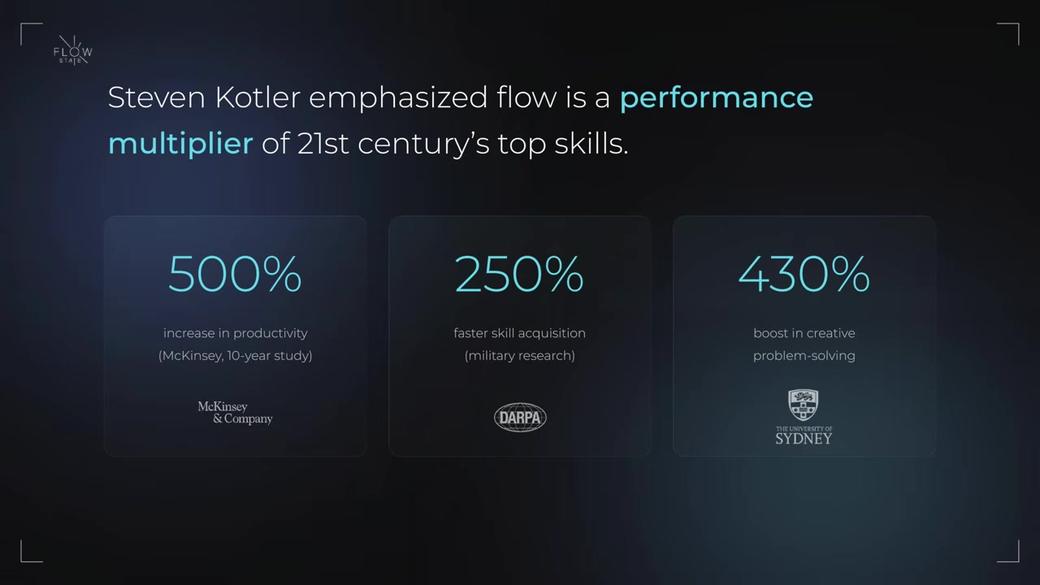
| الرقم | ما نطقه هو | ما كُتب على الشريحة |
|---|---|---|
| 500% | «الإنتاجية لدى التنفيذيين الذين درسوهم تزيد بما يصل إلى 500٪ في التدفّق» [8:27] | «500% increase in productivity» — بلا تحفّظ «بما يصل إلى» |
| 250% | «بحث أجراه الجيش على القنّاصة وجد أن قدرتهم على التعلّم تزيد بما يصل إلى 250٪» [8:54] | منسوب إلى DARPA تحديداً |
| 430% | «جامعة سيدني وجدت أن حلّ المشكلات الإبداعي يتحسّن بما يصل إلى 430٪» [8:54] | مطابق |
وتعليقه على الأرقام نفسها: «هذه، بالمناسبة، لمن يعرف البحث العلمي، أرقام ضخمة. التدفّق قويّ جداً» [8:54]. ولم يذكر اسم دراسة واحدة ولا سنة نشر ولا حجم عيّنة لأيٍّ من الثلاثة.
وأضاف قراءةً حرفية للرقم الأول: «بمعنى، لو أخذتَه حرفياً، أنهم في حالة التدفّق يُنجزون عمل أسبوع في يوم واحد» [8:27].
ما الذي يحدث في الجسد أثناء التدفّق
[9:21 – 11:17]
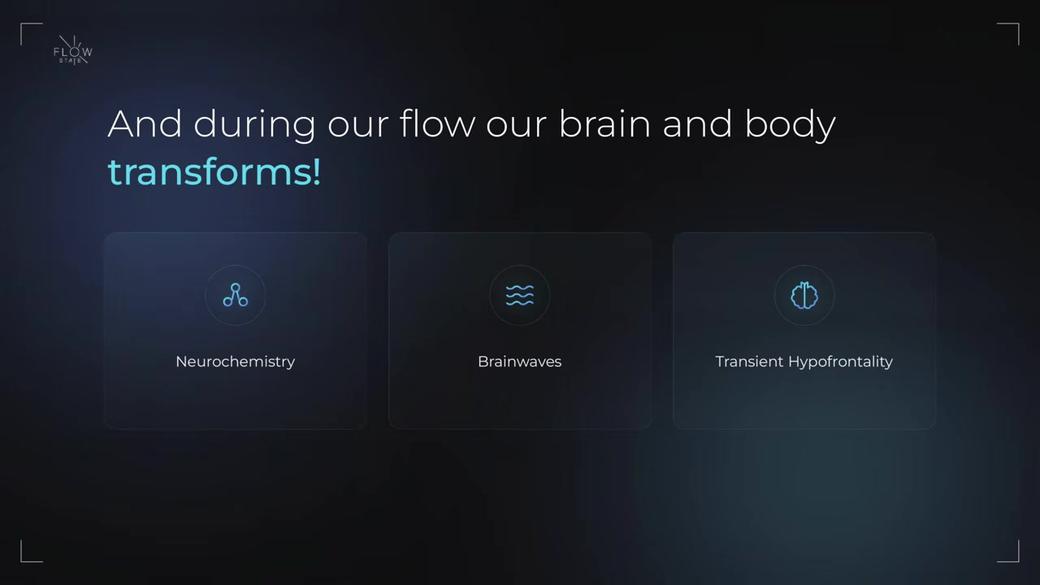
أولاً، شلّال كيميائي عصبي: «السيروتونين، والنورإبينفرين، والإندورفينات، والأناندامايد، والدوبامين — كلها تغمر الدماغ، فتُعلي التركيز، وتُحسّن الدافعية، وتُهيّئنا للأداء الأمثل» [9:50].
ثانياً، تحوّل الموجات الدماغية: «تنتقل موجاتنا الدماغية من موجات بيتا (beta) المتعرّجة المشتّتة نزولاً إلى الحدّ الفاصل بين ألفا وثيتا (alpha–theta borderline)، إلى حالة أكثر انسجاماً هي التي تُنتج الإبداع والتركيز المرتفع» [9:50].
ثالثاً، هدوء القشرة الجبهية: «القشرة الجبهية الأمامية (prefrontal cortex)… هي المسؤولة عن تتبّع الزمن وعن إدراك الجهد. ذلك الجزء ينخفض نشاطه فعلاً» [10:21]. ويقلب بها مقولةً شائعة: «سمعتم كلكم فكرة أننا لا نستخدم إلا 10٪ من دماغنا وأننا لو استطعنا استخدام 100٪ منه… الأمر في الحقيقة معكوس نوعاً ما. ذلك الجزء يهدأ، وهو ما يسمح لأجزاء أخرى بالانطلاق» [10:21] [10:47].
كيف بنى المؤسسة
«قرّرت أن أفعل ما بدا وقحاً بعض الشيء لإيرلندي في التاسعة عشرة: أن أجد بريد كوتلر — وجدته على مدوّنة قديمة في Psychology Today — وأراسله على البارد أطلب العمل معه. وردّ» [10:47] [11:17]. ثم أسّسا معاً Flow Research Collective.
والمشكلة التي وضعها هدفاً: «رغم أن التدفّق يدفع الأداء إلى مرتبة عالية جداً، فهو مراوغ ومتقطّع. يظهر فنكون في المنطقة، ثم يذهب فنعود إلى التشتّت» [11:17] [11:46].
والحصيلة كما ذكرها: «طبّقناها مع أكثر من 15,000 رائد أعمال، منهم سلاح الجو الأمريكي، وAudi، وAccenture، وMeta، وانتهى بنا الأمر إلى نشر بحثنا في Nature Neuroscience مع الدكتور كارل فريستون (Karl Friston) — الذي وصفه بأنه أكثر عالِم أعصاب استشهاداً في العالم و«مُرشِد للدكتور أندرو هوبرمان» [12:13].
قصّة الجبل — المجاز الذي تقوم عليه المحاضرة كلها
جبل Croagh Patrick في مقاطعة Mayo [12:49 – 15:32]
يروي يوماً قرّر فيه تسلّق الجبل، ويعدّ ما استغرقه قبل أن يبدأ الصعود فعلاً:
| ما فعله | الزمن كما ذكره |
|---|---|
| القيادة نحو الجبل ثم اكتشافه أنه لا يملك المعدّات | كان يبعد ساعة ونصفاً |
| البحث عن متجر وشراء المعدّات والطعام والمؤن | «٤٥ أو ٥٠ دقيقة» · «نحو ساعة ونصف من الشراء» |
| تفريغ المعدّات وترتيبها وتغيير ملابسه ومعرفة المسار | «نحو ساعة ونصف أخرى» |
| الصعود الفعلي حتى جاع | «نحو ساعتين» |
| إعداد وجبة «معقّدة بلا داعٍ» على موقد تخييم وتنظيف العدّة | «نحو ساعة ونصف» |
| ساعة أخرى من الصعود — ثم حلّ الظلام | فعاد أدراجه دون القمّة |
والإدراك الذي خرج به: «في تلك اللحظة أدركت أني كنت أؤدّي نشاطين مختلفين طوال ذلك اليوم: كنت أتسلّق، وكنت أفعل كل الأشياء التي تُمكِّن التسلّق والتي هي ضرورية — أعني، أنت تحتاج معدّات، وتحتاج طعاماً — لكنها لا تُصعِدك الجبل فعلاً» [15:04].
التمييز المركزي: عمل الدفع وعمل الجذب
Push work · Pull work [15:32 – 19:36]
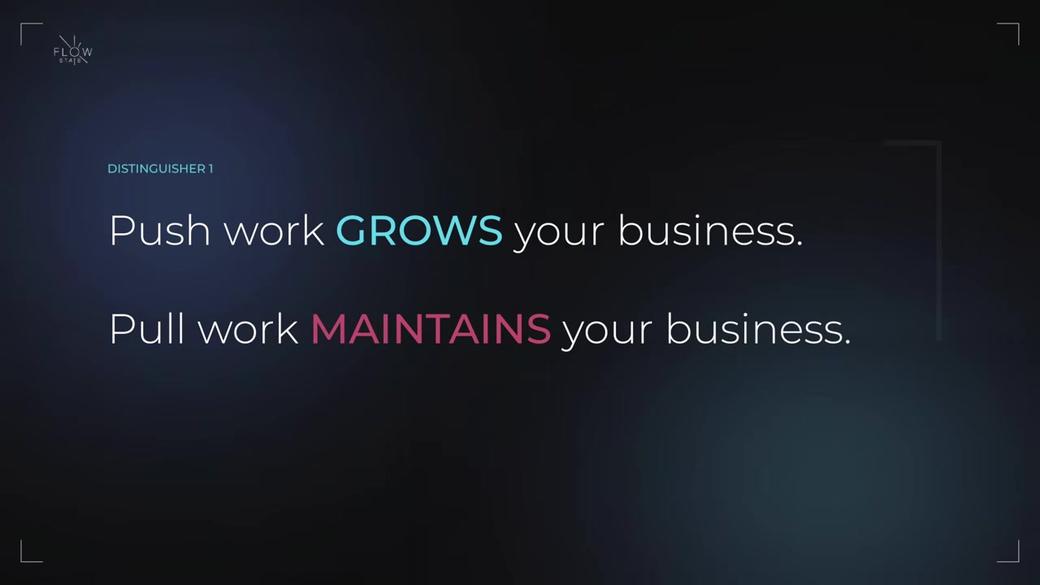
المثال الذي بنى عليه: «لنقل أنك تدير وكالة تسويق للمؤلّفين، والقمّة التي تريد بلوغها أن تصل إلى ١٠ ملايين في الإيرادات، وتعرف أن قيدك الرئيسي هو الحصول على عملاء أكثر، وتعرف كيف تحصل عليهم — لديك قناة تعمل، وهي التواصل البارد» [15:32].
- عمل الدفع هنا: «التواصل البارد» — «العمل الذي سيُصعِدك الجبل فعلاً نحو قمّة الحصول على عملاء أكثر».
- عمل الجذب هنا: «الردّ على أعضاء الفريق، والردّ على العملاء، ومعرفة أي برنامج إدارة مشاريع تستخدم، وتبديل برنامج إدارة المشاريع، ومعاودة الاتصال بمحاسبك — كل الأشياء الأخرى الضرورية، لكنها لا تُصعِدك الجبل مباشرة» [16:11].
ثلاثة فوارق عدّها
| # | عمل الدفع (Push) | عمل الجذب (Pull) |
|---|---|---|
| ١ | «يُنمّي عملك — يُصعِدك نحو قمّتك الريادية» | «ضروري، لكنه يُبقي عملك فقط» |
| ٢ | «استباقي — عليك أن تقرّر فعله» | «تفاعلي — يحدّده عادةً شخص غيرك» |
| ٣ | «صعب الفعل» | «صعب الامتناع عنه» |
«والأمر البشع، وهو نوع من المعضلة: العمل الذي يُنمّي أعمالنا صعبُ الفعل، بينما العمل الذي يُبقيها فقط صعبُ الامتناع عنه.»
وهدفه من الشرح: «أملي عادةً حين أشرح هذا النموذج الذهني أن تبدأ فوراً في وسم كل نوع عمل يواجهك بأنه دفع أو جذب بسرعة، فتقول: هذا دفع، هذا جذب، هذا دفع، هذا جذب» [17:29].
أمثلة أخرى ذكرها لعمل الدفع: «إعادة بناء نموذجك المالي وقضاء ساعات مركّزاً تماماً على جدول بيانات» · «إصلاح منتجك جذرياً، ويستغرق ساعات وساعات» · «إعادة بناء فريقك كلّه» [17:29] [17:59]. ولعمل الجذب: «الردّ على الرسائل، وإجراء المكالمات، ومعالجة المهامّ السريعة» — وأضاف الجمهور مثالين: «رسائل Slack» لعمل الجذب، و«مكالمات المبيعات الصادرة» لعمل الدفع [17:59] [18:28].
«ما يفعله التدفّق هو أنه يشحن عمل الدفع بالتوربو. والصورة التي أريدكم أن تحملوها: لو تعلّمتَ الدخول في حالة التدفّق أثناء عمل الدفع، فذلك يعادل ربط حقيبة نفّاثة (jetpack) على ظهرك ثم تسلّق الجبل مدفوعاً بها.»
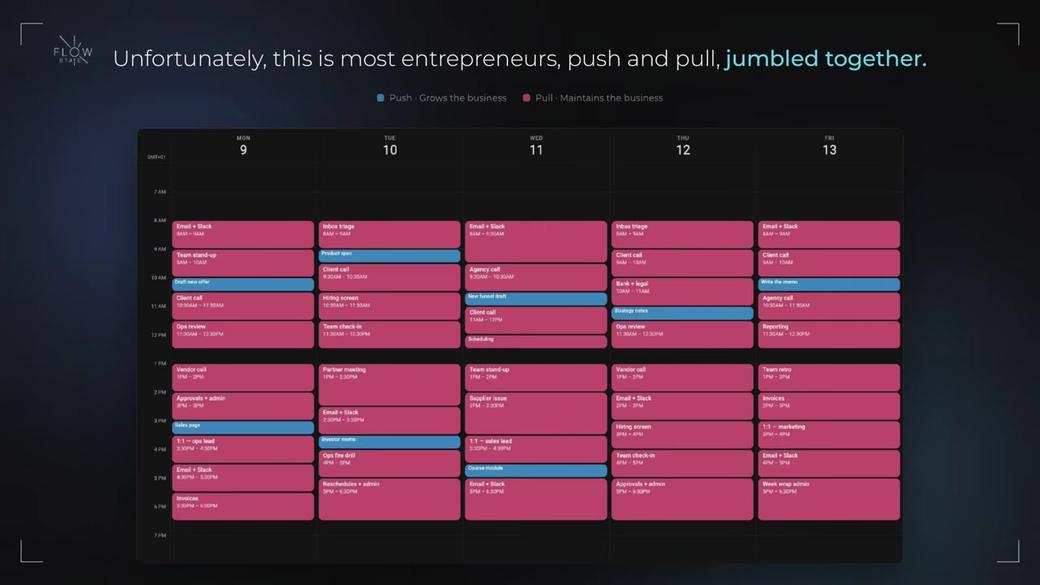
الخطوة الأولى · افصِل الدفع عن الجذب
Separate [19:36 – 21:36]
الحالة العملية التي ساقها: «قبل نحو خمس سنوات جاءتنا Audi… لأن رئيس الابتكار لديهم كان مرعوباً من Tesla التي كانت تكتسب حصة سوقية ضخمة» [19:28] [19:56].
وتشخيصه لوضعهم: «كان فريقهم التنفيذي وبقية الفريق يقضون أكثر من ٩٠٪ من أسبوعهم في ملء استمارات امتثال ألمانية، وإعادة تصميم الهيكل التنظيمي، ومتشابكين في سياسات داخلية» — «بينما عمل الدفع لديهم كان بسيطاً: بناء سيارات أفضل، أسرع، وأرخص» وما يعنيه ذلك تحديداً: «ترقية مصانعهم، وإعادة تصميم السيارات، وإيجاد موردين أفضل يعطونهم قطعاً أفضل وأرخص» [19:56] [20:27].
وما فعلوه معهم: «جعلناهم يُصوّرون بصرياً كل عمل الجذب مقابل عمل الدفع، ليروا أنهم كانوا جالسين على جانب الجبل — بينما لديهم قمّة عليهم بلوغها» [20:27].
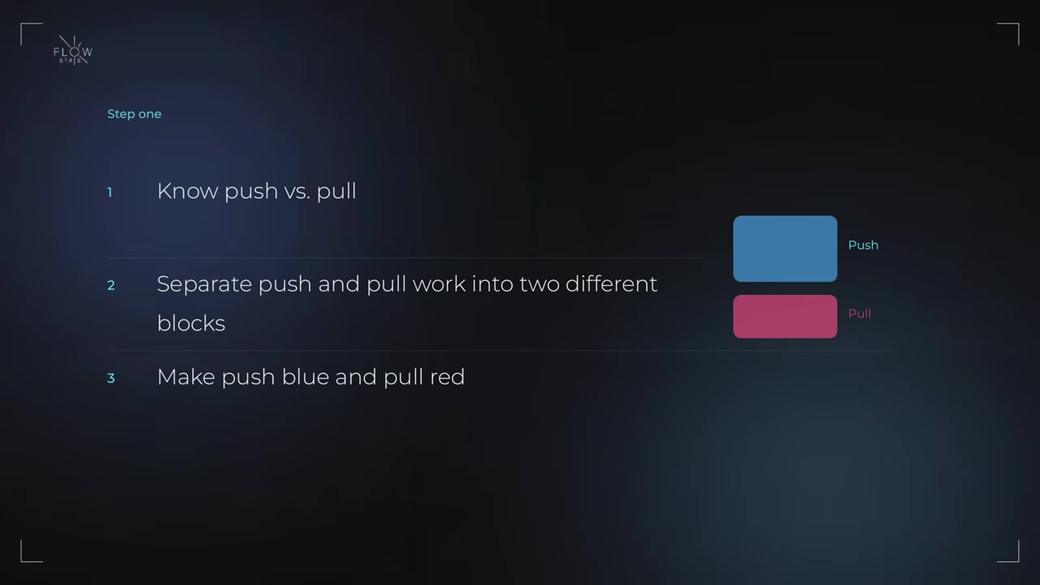
وعناصرها الثلاثة كما نطقها: «الأول مجرّد استحضار هذا النموذج الذهني لتستطيع وسم العمل. الثاني أن نفكّر في يوم عملنا بوصفه كتلتين رئيسيتين: كتلة عمل دفع وكتلة عمل جذب، ونفصلهما قدر الإمكان. والثالث، وهي ملاحظة تكتيكية جداً: اجعل عمل الدفع أزرق وعمل الجذب أحمر في تقويمك. إنه أمر كاشف جداً» [20:58] [21:36].
الخطوة الثانية · رتّب الدفع أولاً
Sequence [21:36 – 28:21] — وهي أطول خطوة، ومعها التكتيك الأشهر في المحاضرة.
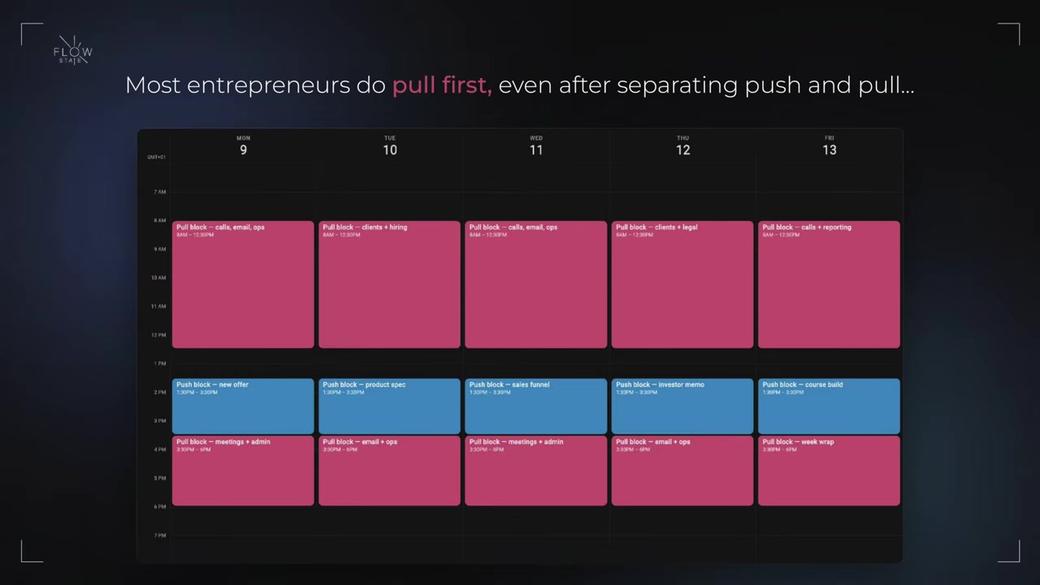
«لو أني ذهبتُ مباشرةً إلى قاعدة القمّة وبدأتُ التسلّق، لقطعتُ مسافة أكبر بكثير… لكن لسوء الحظ، معظم روّاد الأعمال يؤدّون عمل الجذب أولاً — لأن، مرة أخرى، عمل الجذب صعب الامتناع عنه، وعمل الدفع صعب الفعل» [22:05].
لماذا: حقل القوة والجاذبية
«السبب أن عمل الدفع حوله حقل قوة (force field)… كلنا نتماهى مع أننا نُسوّف عمل الدفع. لدينا مقاومة له. حتى حين نبدأه نقول: آه! ونريد فعل شيء آخر يمنحنا جرعة دوبامين أسرع» [22:34].
«وفي الوقت نفسه، عمل الجذب حوله حقل جاذبية يشفطك ويُغريك. فأنت كرائد أعمال تخوض حرباً على جبهتين في كل وقت: تحاول اختراق حقل قوة عمل الدفع بينما تقاوم جاذبية عمل الجذب» [23:00].
التفسير العلمي الذي أعطاه لكلٍّ منهما:
- حقل القوة = طور الصراع (struggle phase): «حين تبدأ مهمة، قبل أن تنتقل فعلاً إلى حالة التدفّق، تحصل على عكس حالة التدفّق تقريباً، ويُسمّى طور الصراع. وفسيولوجيتك تحسب ما إذا كان الجهد يستحقّ الكلفة، فيرتفع الكورتيزول. وهو غير مريح لمدة ١٥ إلى ٢٠ دقيقة» [23:27].
- حقل الجاذبية = السعي وراء الدوبامين: «هناك جزء في الدماغ اسمه النواة المتّكئة (nucleus accumbens) يعشق الجرعات السريعة من الدوبامين. فكّر في الردّ على رسالة Slack: جرعة دوبامين مؤكّدة وفورية ومضمونة لا تُصعِدنا الجبل إطلاقاً» [23:58].
التكتيك: «استيقظ وتدفّق»
يقدّمه بتحفّظ صريح: «سأعطيكم أداة تكتيكية ستظنّونها كلكم سخيفة وعلى الأرجح لن تفعلوها، لكني آمل أن تفعلوها لأنها تعمل جيداً جداً» [24:24].
الأساس الفسيولوجي: «حين تستيقظ صباحاً تكون في حالة تُسمّى النافذة التالية للنوم (hypnopompic window)… وتدوم ٥ إلى ١٠ دقائق بعد الاستيقاظ. وكما ذكرت، موجات التدفّق على حدّ ألفا–ثيتا. وفي النوم تتحرّك موجاتنا بين دلتا وثيتا — أي ليست بعيدة عن التدفّق» [24:53].
الخطأ الشائع: «معظم الناس يستيقظون ويصعدون طول الطريق إلى بيتا. ثم حين يصلون إلى العمل أخيراً بعد ساعة ونصف من رعاية الأطفال والتنقّل وتفقّد البريد، يحاولون النزول من بيتا إلى ألفا–ثيتا — بينما كانوا هناك أصلاً حين استيقظوا» [25:21].
الفكرة: «أن تبدأ العمل خلال ٥ إلى ١٠ دقائق من الاستيقاظ قبل فعل أي شيء آخر» — لسببين: «حقل القوة المحيط بعمل الدفع في أنحف نقطة له في اليوم كلّه خلال تلك النافذة… وجاذبية عمل الجذب في أضعف نقطة أيضاً لأنك لم تشتبك مع العالم بعد» [25:58] [26:26].
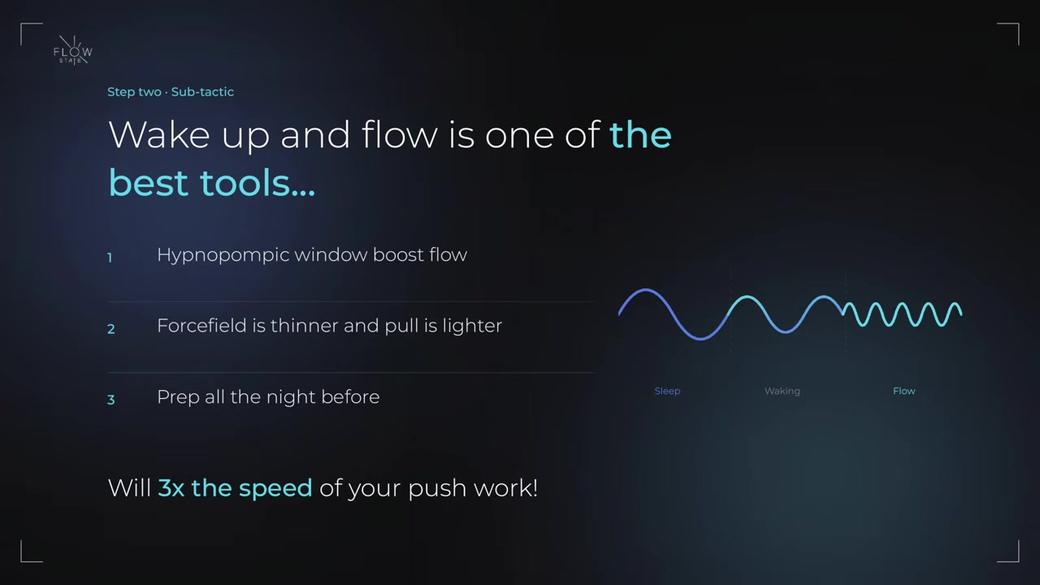
شرط التنفيذ: «الشيء الأخير في التطبيق: من المهم جداً أن يكون عملك مُجهَّزاً من الليلة السابقة، فتستيقظ وعمل الدفع جاهز، وفي تلك الحالة نصف النائمة تبدأ، فتسقط فوراً في التدفّق، ثم تُشغّلها ككتلة عمل دفع لمدة ساعة إلى ثلاث ساعات» [26:26] [26:58].
«في خبرتنا مع أكثر من 15,000 رائد أعمال، يميل الناس إلى إنجاز عمل الدفع بنحو ثلاثة أضعاف السرعة حين يطبّقون «استيقظ وتدفّق»… وبحلول وقت بدء يومك أصلاً، تكون قد أنجزت من عمل الدفع أكثر ممّا يُنجزه معظم روّاد الأعمال في أسبوع كامل.»
واعترافه بصعوبة التطبيق: «حين أعمل مع رؤساء تنفيذيين فردياً لا أنظر إليها كتكتيك فوري. قد يكون تطبيقها صعباً. عليك فعلاً أن تبني بنية تحتية حولها — التفاوض مع الزوج أو الزوجة، وأحياناً ترتيب مربّية لرعاية الأطفال. لكن إن أخذتَ ما أقوله بجدّية — أنك تستطيع مضاعفة سرعة عمل دفعك ثلاث مرات — فالأمر يستحقّ إنفاق سنة لبناء تلك البنية» [27:28] [27:54].
الخطوة الثالثة · مدِّد كتلة الدفع
Stretch [28:21 – 30:21]
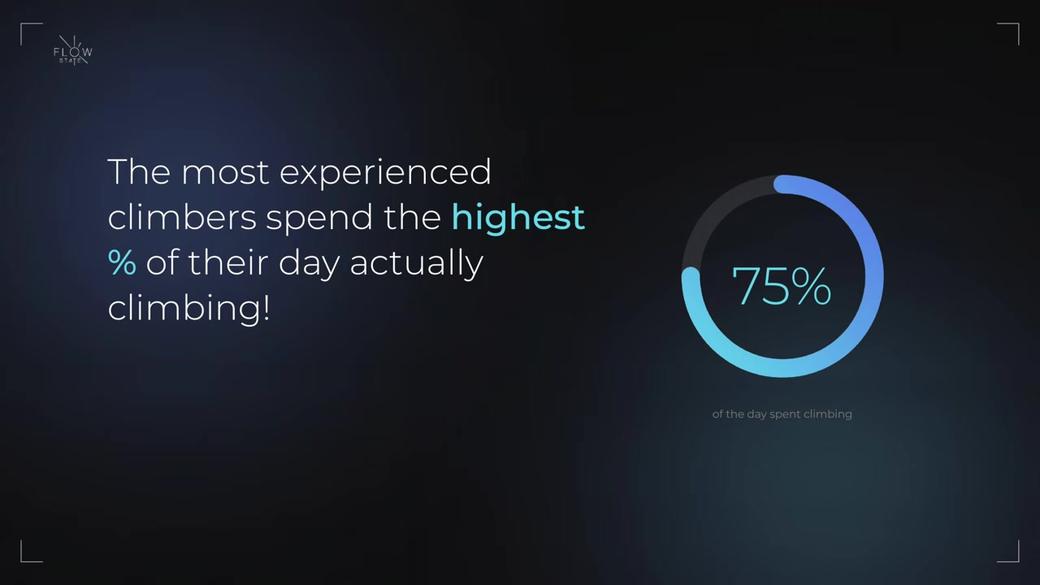
الملاحظة التي بنى عليها: «إن سبق أن تسلّقت جبلاً، خصوصاً مزدحماً، ستلاحظ أن من السهل تمييز المتسلّقين الأكثر خبرة… ولاحظت فيهم شيئاً: أنهم يقضون أغلب يومهم في التسلّق الفعلي. يقضون أعلى نسبة ممكنة من يومهم وهم يتسلّقون الجبل بالفعل» [28:21] [28:52].
سببان أعطاهما:
- «الأول بديهي: وقت أطول في الصعود. لو أمضيت ساعة في التسلّق مقابل أربع ساعات، ففي حالة الأربع ساعات ستقطع أربعة أضعاف المسافة» [29:20].
- «والثاني يتعلّق بحالة التدفّق: الكتل الممتدّة من الوقت غير المُقاطَع هي بمثابة الأكسجين لحالة التدفّق. هي ما يعيش عليه التدفّق» — «والتدفّق يعمق مع الوقت، بحيث تستمرّ تحسّنات الأداء التي تحدث فيه في التراكم. فكلما طالت كتلة عمل دفعك، عمُقت حالة التدفّق التي تصل إليها، ومن ثمّ غطّيت أرضاً أكثر في الساعة الواحدة — إضافة إلى قضائك ساعات أكثر في الصعود أصلاً» [29:20] [29:54].
الخطوة الرابعة · اضغط كتلة الجذب
Squeeze [30:21 – 32:18]
المشهد الذي يقابل به نفسه: «بينما كنت آكل تلك النسخة السخيفة من كاري الدجاج المخيّم جالساً على جانب الجبل، رأيت أحد المتسلّقين الأكثر خبرة يتناول وجبته. أدار ظهره للريح، ومدّ يده في جيبه، وأخذ حفنة من المكسّرات المشكّلة، ودفعها في حلقه، ثم أكل لوح بروتين، ثم استدار وواصل التسلّق» [30:21].
«ما استغرق مني ساعة أو ساعة ونصفاً، أنجزه هو في ٥ إلى ١٠ دقائق. فالمتسلّقون الأكثر خبرة بارعون جداً في أداء عمل الجذب بسرعة فائقة، لأنهم يعرفون أن كل ساعة إضافية في عمل الجذب هي ساعة لم تُقضَ في الصعود.»
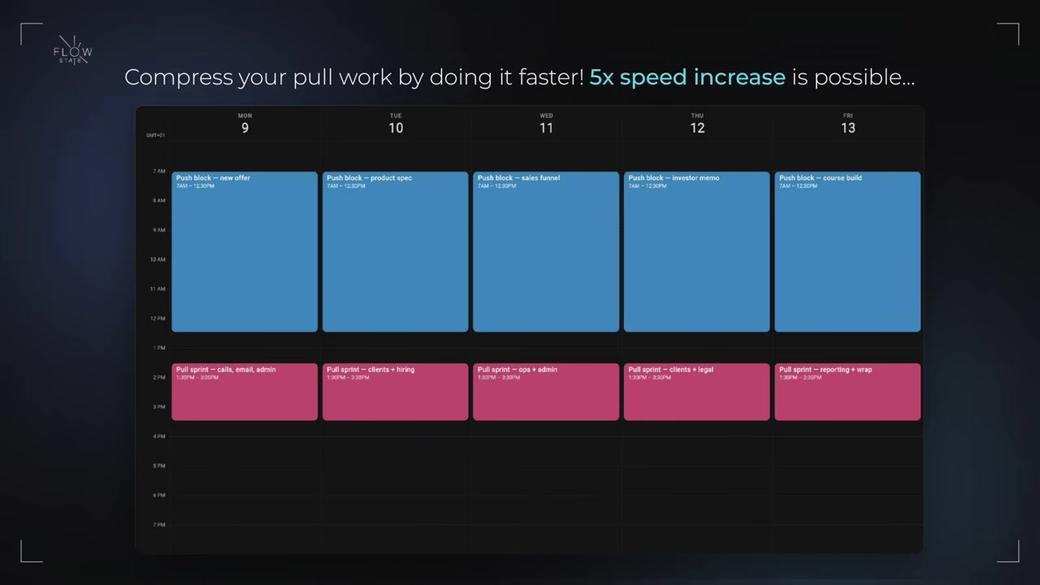
التشبيه الذي أعطاه للتعامل مع عمل الجذب: «أن تعامل عمل جذبك كإخراج القمامة. إنه ضروري. علينا فعله. لكننا ننجزه فقط: ندخل ونخرج. حين تُخرج القمامة لا تسكبها على أرضية غرفة المعيشة، ولا تنثرها في الممرّ — لكنك أيضاً لا تُخرج كل قطعة وتغسلها ثم تُعيدها مرتّبة أبجدياً» [30:54] [31:23].
وتشخيصه للخطأ: «لكن إن راقبت كثيراً من المشغّلين أو روّاد الأعمال، فتلك هي طريقتهم في التعامل مع عمل الجذب. هم لا يميّزون في أذهانهم بين الأنشطة التي تُصعِدهم الجبل وتلك التي تُبقي العمل فقط. فيعطونهما معاملة متساوية — ونحن لا نريد ذلك» [31:23] [31:52].
وتحفّظه على المصطلح: «لا أقصد الإساءة إلى عمل الجذب… ما هو بشع في عمل الجذب ليس أنه غير ضروري أو أنه سيّئ. هو ضروري. وذلك بالضبط ما يجعله ماكراً وخبيثاً» [31:52] [32:18]. وأمثلة من الجمهور: «الإيميلات، والأعمال الإدارية»، و«الاجتماعات» [32:18].
الخطوة الخامسة · اكبح التشتيت
Suppress [32:18 – 37:11]
المفارقة التي يفتتح بها: «كلما صعدت الجبل أكثر، نظرت إلى هاتفي فوجدت خدمة الشبكة قد اختفت. وهذا يعني أن لا أحد يستطيع مراسلتي أو الاتصال بي، ومن ثمّ لا أحد يستطيع منعي من مواصلة الصعود. لكن تسلّق الجبل الريادي لا يوفّر مثل هذه الحماية من التشتيت» [32:46].
الضرر الأول — على التدفّق: «لا تستطيع الوصول إلى التدفّق إذا كان انتباهك مُجزّأً. التدفّق يتطلّب استمرارية الانتباه… فالانتقال من تركيز عميق على إعادة بناء النموذج المالي إلى القفز في Slack ثم في البريد يُصفّر قدرتك على الدخول في التدفّق ويعيدك إلى البداية» [33:12].
الضرر الثاني — على اليوم كلّه: «جاذبية عمل الجذب ستنتصر تماماً وتنتزعك من كتلة عمل دفعك بحيث لن تستطيع العودة إليها ذلك اليوم» — ويصف السلسلة: «تعمل على الشيء الذي تعرف أنه سيُحقّق النتائج، فيشتعل حريق وتتلقّى مكالمة، وأثناء المكالمة ترى بريداً يقودك إلى الاتصال بشخص بعدها، ثم فجأة تكون الساعة الرابعة عصراً، وقد أمضيت اليوم كلّه جالساً على جانب الجبل تفعل أشياء ضرورية لا تُصعِدك» [33:49] [34:20].
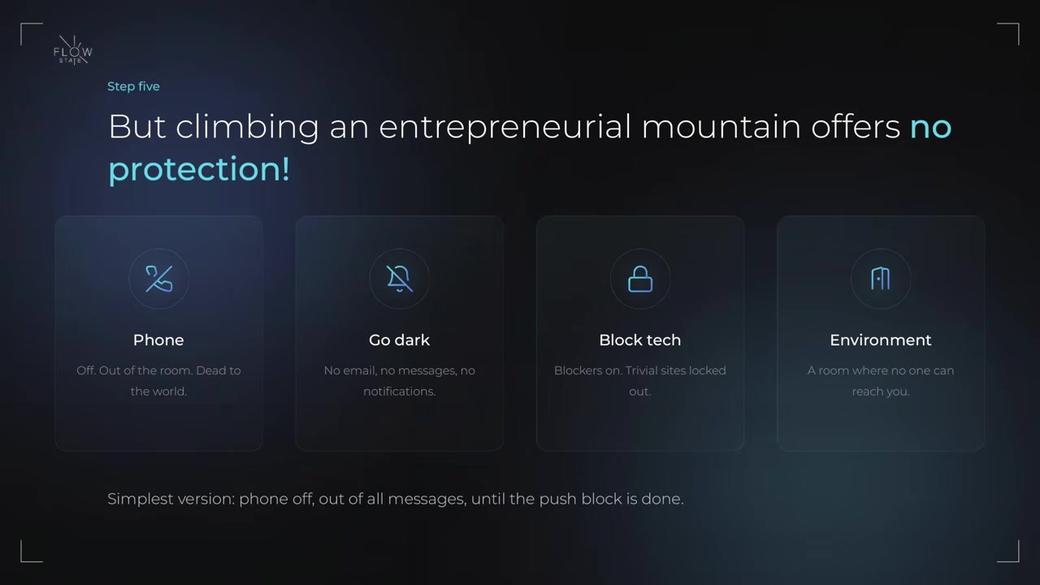
ويسمّي الترتيب «وضع تسلّق الجبل دون اتصال (mountain climbing offline mode)»، ويحدّد الطلب: «ساعة إلى ستّ ساعات لكل ٢٤ ساعة، دون اتصال تماماً — على الأقل من الوارد وعمل الجذب. أعرف أنه طلب كبير» — «فإن استطعت جعلها أقرب إلى ست ساعات يومياً، فذلك رائع» [34:46] [35:12].
حجّته ضدّ الاعتراض: «الإلحاح وهم»
ينسب الشطر الأول إلى البحث بتحفّظ: «البحث يُظهر أن الإلحاح — في معظمه — وهمٌ». ثم ينتقل مباشرةً إلى تأكيد من عنده دون أن ينسبه إلى بحث: «الإلحاح شعور في أجهزتنا العصبية. ليس واقعاً موجوداً في الخارج» [35:12]. وقد فُصلت الجملتان هنا عمداً لأن الثانية أقوى من الأولى ولا سند لها في كلامه. ويسمّي الظاهرة: «هناك بحث على شيء يُسمّى أثر مجرّد الإلحاح (the mere urgency effect)، ويُظهر أن الشيء الأول الذي يستخدمه البشر لتحديد مدى أهمية شيء ما هو مدى إلحاحه» — «فكّر كم هذا جنوني: لأن مدى شعورك بالإلحاح لا يُملي في الواقع بأي حال درجة أهمية الشيء. الذي يُملي أهميته هو مدى تحريكه لك نحو هدفك الفعلي» [35:38].
«حين يقول لي رؤساء تنفيذيون إنه لا سبيل للانقطاع ساعةً إلى ستّ ساعات يومياً، أقول: أخرِج تقويمك ولنعُد عبر السنة الماضية وجِد لي مثالاً واحداً لو أنك لم تلتقط شيئاً لمدة ساعتين أو ثلاث أو أربع أو خمس حتى نهاية كتلة الدفع لكان ذلك ضارّاً بالعمل. فعلت هذا مع عشرات ومئات الرؤساء التنفيذيين. لم يستطع أحد قطّ أن يجد لي مثالاً واحداً كان ليضرّ العمل حقاً.»
وأنظمة تُمكّن ذلك، اقترحها: «إجراء اجتماع قصير في نهاية اليوم لتتأكّد أن فريقك غير مُعطّل، أو إعلام عملائك أنك ستستطيع الردّ عليهم عند الواحدة ظهراً حين تنتهي كتلة دفعك» [36:44].
وردّ فعل الجمهور الذي وثّقه بنفسه: «هل أحد مستعدّ فعلاً لتجربة ذلك بعد هذه المحاضرة؟ نعم؟ حسناً، نحو ثلاثة منكم. سآخذها» [36:44].
الخطوة السادسة · اختم اليوم بالتعافي النشط
Seal [37:11 – 41:32]
يفتتح بالمقابلة: «تخيّل أني بعد تسلّق هذا الجبل بدأتُ فوراً تسلّق آخر، ثم في اليوم التالي آخر… بديهي أن قدرتي على قطع المسافة ستنهار يوماً بعد يوم. بديهي في ذلك السياق. لكن لسوء الحظ، روّاد الأعمال لا ينظرون إلى تسلّقهم بالطريقة نفسها» [37:11] [37:36].
والسبب الفسيولوجي: «حالة التدفّق مُرهِقة للجهاز العصبي. حين نكون فيها فهي مُكلفة كيميائياً عصبياً. وعمل الدفع يحتاج تعافياً منه، لأنك في اليوم التالي تدخل المعركة نفسها على الجبهتين: اختراق حقل قوة الدفع ومقاومة جاذبية الجذب. وإن حضرت تلك المعركة مستنزَفاً ومُتعباً من عمل دفع الأمس، فلن تنتصر فيها. ستُشفَط إلى عمل الجذب وترفرف كورقة في مهبّ الريح» [37:36] [38:09].
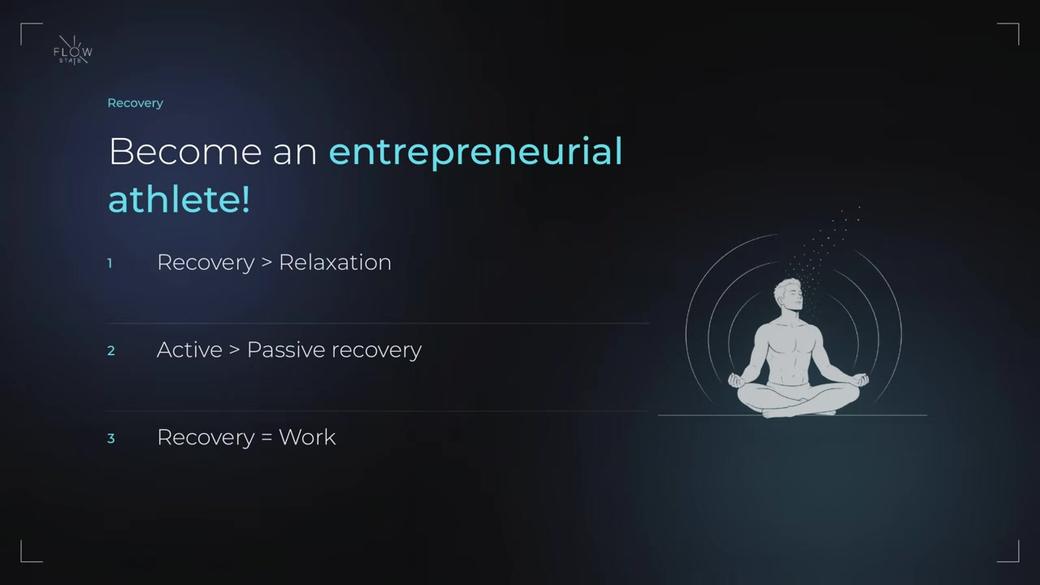
ثلاث خصال للرياضي الريادي
- يفرّق بين الاسترخاء والتعافي. «الاسترخاء يبدو جيداً ذاتياً — رفع قدميك أمام التلفاز، أو جعة، أو التمرير في إنستغرام. لكنه لا يُجدّد الجهاز العصبي. أما التعافي فقد يكون بعيداً مليون ميل عن الاسترخاء: القفز في حوض ثلج، وهو من أقلّ الأشياء استرخاءً التي أتخيّلها بعد وضع يدك على موقد ساخن — لكنه قوي جداً في دفع التعافي» [38:34] [39:00]. والمعيار: «التعافي ليس شعوراً. يمكن قياسه موضوعياً عبر تغايُر معدّل ضربات القلب (HRV). إنه الحالة الفعلية لجهازك العصبي» [39:26].
- يُقدّم التعافي النشط على السلبي. «التعافي السلبي هو ترك جهازك يتعافى بإعطائه مساحةً ووقتاً. والتعافي النشط هو الانخراط في أنشطة مثل الغطس البارد لتسريع عملية التعافي وتجديد جهازك العصبي أسرع» — «وكلما أسرعت في التعافي، أسرعت في تسلّق الجبل التالي» [39:26] [39:56]. وقائمته: «الساونا، والغطس البارد، والتدليك، وتحرير اللفافة العضلية، وخزّانات الطفو، والنوم» — «النوم يبدو سلبياً، لكنه ليس كذلك. من زاوية التعافي هو تعافٍ نشط لأنك تُسرّع العملية» [40:25].
- يرى التعافي جزءاً من العمل. «لأنه يُغذّي قدرتك على تسلّق الجبل بسرعة في اليوم التالي وعلى تركيب معزّز الحقيبة النفّاثة» [40:25]. ويقرّر أن التعافي هو القيد الحاكم: «التعافي لدى معظم الناس هو في الواقع السقف على قدرتهم على إنتاج عمل أكثر، وقضاء وقت أطول في التدفّق» [39:56].
والنتيجة البنيوية: «نُضيف كتلة تعافٍ في نهاية اليوم بعد كتلة عمل الجذب» [41:02].
الخلاصة كما جمعها هو
يعيد سرد الخطوات الستّ متتابعةً في جملة واحدة: «فصلنا الدفع والجذب. رتّبنا الدفع أولاً. مدّدنا كتلة الدفع. ضغطنا كتلة الجذب. كبحنا التشتيت أثناء كتلة الدفع. والآن نُضيف كتلة تعافٍ إلى نهاية اليوم» [41:02].
| # | الخطوة | الفعل الإنجليزي | الموضع |
|---|---|---|---|
| ١ | افصِل الدفع عن الجذب إلى كتلتين | Separate | [20:58] |
| ٢ | رتّب كتلة الدفع أولاً | Sequence | [21:36] |
| ٣ | مدِّد كتلة الدفع لأطول ما يمكن | Stretch | [28:52] |
| ٤ | اضغط كتلة الجذب لأقصر ما يمكن | Squeeze | [30:54] |
| ٥ | اكبح التشتيت حتى تنتهي كتلة الدفع | Suppress | [32:18] |
| ٦ | اختم اليوم بكتلة تعافٍ نشط | Seal | [37:11] |
«وهذا يتركنا — وأريدكم أن تكتبوا هذه — بأن الشكل الأساسي ليومٍ عالي التدفّق عالي الأداء لرائد الأعمال يمكن تلخيصه في ثلاث كلمات: ادفع، اجذب، تعافَ — بهذا الترتيب.»
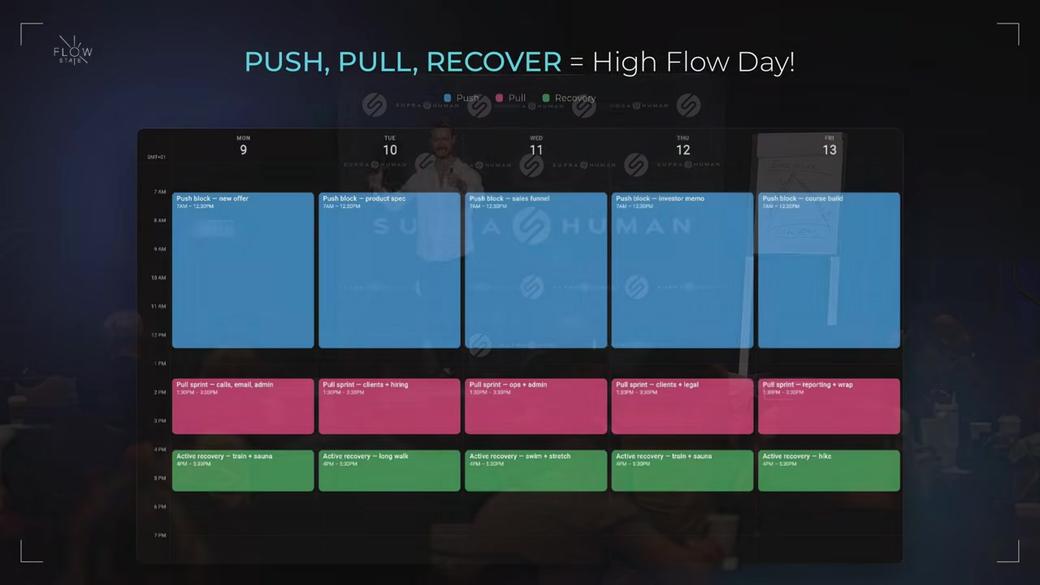
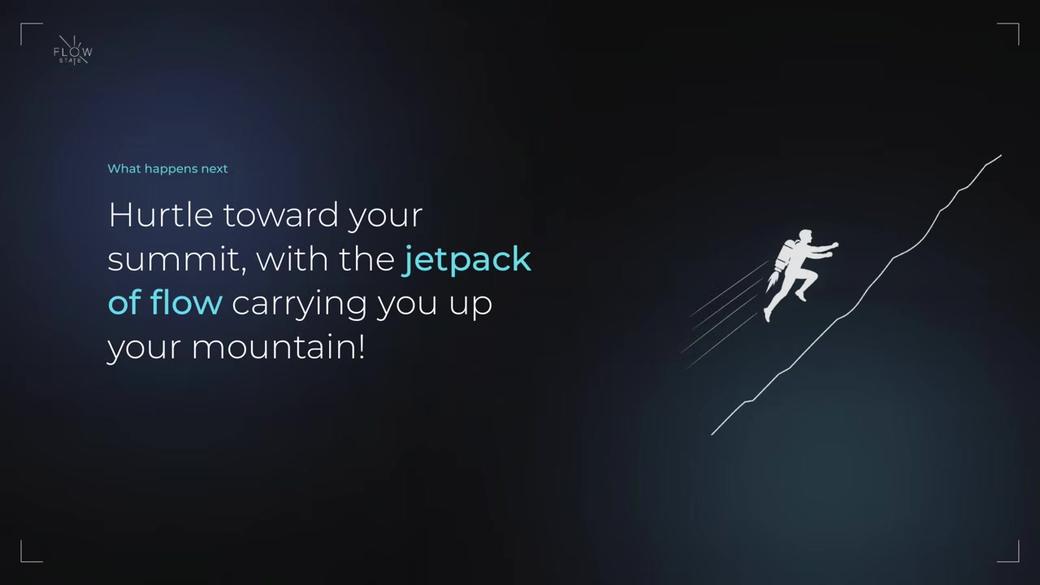
ويسمّي المجموعة في ختامه: «وأعدكم أنكم إن طبّقتم تلك القطع الستّ التي ذكرتها — «الـSـات الستّ» لتقديم عمل الدفع والوصول إلى حالة التدفّق — فستنطلقون نحو قمّتكم مدفوعين بالحقيبة النفّاثة» [41:58].
وقبلها اعتراف عن حماسه: «هذه من المحاضرات التي لو كان معي أحد في غرفة لأمسكته من كتفيه وقلت: أرجوك افعل هذه الأشياء فقط. إنها تعمل جيداً جداً. وهي بسيطة» [41:32].
ملاحظات على المصدر
مواضع تختلف فيها الشريحة عن المنطوق، أو يرد فيها ادّعاء بلا سند. أُثبتت ولم تُحسم.
- الشرائح تُسقط تحفّظه. نطق الأرقام الثلاثة كلها بصيغة «بما يصل إلى (up to)» [8:27] [8:54]، بينما كُتبت على الشريحة أرقاماً مطلقة: «500% increase in productivity». وقد أُبقي التحفّظ في هذا الملخص لأنه من كلامه.
- رقمان على الشرائح لم يُنطقا إطلاقاً: 75% في شريحة نسبة اليوم المقضيّ في التسلّق [28:50]، و5x في شريحة ضغط عمل الجذب [32:10]. لا يوجد لهما أصل في كلامه، وأُثبتا هنا بوصفهما نصّ شريحة لا قولاً.
- إسناد مختلف بين الفم والشريحة: قال «بحث أجراه الجيش على القنّاصة»، بينما تحمل الشريحة شعار DARPA تحديداً [8:54] [8:40].
- تناقض في بروتوكول النفَس نفسه. قال أولاً «٣ ثوانٍ شهيقاً عبر الأنف» [1:26]، ثم عند التنفيذ أعاده «٣ ثوانٍ شهيقاً عبر الـ… عبر الفم» ثم عاد فوراً إلى «عبر الأنف» [2:01]. اعتُمد «الأنف» في هذا الملخص لأنه المذكور مرتين، والتناقض مُثبَت هنا لأن الأمر تعليمة قابلة للتنفيذ.
- تعميم من مشاهدة واحدة. في قصّة ضغط عمل الجذب يصف متسلّقاً واحداً رآه يأكل بسرعة [30:21]، ثم يعمّم في الجملة التالية إلى «المتسلّقون الأكثر خبرة بارعون جداً في…» [30:54]. وكذلك في الخطوة الثالثة: أساسها ملاحظته هو على الجبل، ثم يُتبعها بـ«روّاد الأعمال الأعلى أداءً يفعلون هذا» [29:20] بلا أي سند.
- الرقم ٣× مُقيَّد ثم مُطلَق. ذكره أولاً بثلاثة قيود: «في خبرتنا… يميل الناس… نحو ثلاثة أضعاف» [26:58]، ثم أعاده بعد دقيقة بلا قيد: «أنك تستطيع مضاعفة سرعة عمل دفعك ثلاث مرات» [27:54]. أُثبتت الصيغتان كما وردتا.
- مثال واحد بنسبتين. يُنسب مثال رسائل Slack إلى «نيفي» في موضع [20:58] وإلى «آنا» في موضع آخر [23:58]. لم يوفّق المصدر بينهما.
- لا مرجع واحد قابل للتحقّق. لم يُذكر اسم دراسة ولا سنة نشر ولا حجم عيّنة ولا رابط لأيٍّ من الأرقام الثلاثة (500٪ · 250٪ · 430٪)، ولا لبحث «أثر مجرّد الإلحاح».
- ادّعاءات عن نفسه ومؤسّسته غير موثّقة في المحاضرة: النشر في Nature Neuroscience، ووصف كارل فريستون بأنه «أكثر عالِم أعصاب استشهاداً في العالم» و«مُرشِد لأندرو هوبرمان»، وعدد 15,000 رائد أعمال [12:13]. كلها أقواله عن نفسه، ولم يُعرَض عليها دليل في المحاضرة.
- حجّة «لم يجد أحد مثالاً واحداً» [36:18] رواية شخصية عن جلساته مع رؤساء تنفيذيين، لا دراسة ولا سجلّ — وقد ساقها هو بهذه الصفة.
- «استيقظ وتدفّق» تكتيك فرعي لا خطوة سابعة. الشريحة تصنّفه صراحةً «Step two · Sub-tactic» [27:00]، أي أنه تكتيك داخل الخطوة الثانية (ترتيب الدفع أولاً) لا خطوة مستقلّة — والخطوات ستّ كما وعد.
- مصلحة تجارية معلَنة: يختم بعرض «دليل كامل بالبروتوكول الدقيق لكل خطوة» مجاناً برابط أسفل الفيديو [41:58] [42:31]، وهو شريك مؤسّس للشركة التي تبيع هذا التدريب.
- أسماء وردت مشوّهة في التفريغ الآلي: «Mihalyi Csikszentmihalyi» بهجاء مضطرب · «anandamide» وردت مقطوعة بـ«no um» · «Pelé» و«Senna» بلا اسم كامل · «hypnopompic» التي اعترف هو بصعوبة نطقها. اعتُمد الهجاء المتعارف عليه، إفصاحاً لا تصحيحاً صامتاً.
- ما استُبعد: المزاح مع الجمهور عن أيرلندا وكأس العالم، والمقاطعات الجانبية عن القدّيس باتريك والأفاعي، ونداءات التفاعل («هل هذا واضح للجميع؟») — ليست من مادة الشرح. وأُبقي ما كان جزءاً من الحجّة نفسها (أمثلة الجمهور، وردّ فعلهم على طلب الانقطاع).
المنهجية: أُعدّ هذا الملخص في 6 سبتمبر 2026 من مصدرين من الفيديو نفسه: (١) التفريغ النصي الآلي بلغة المحاضرة (الإنجليزية)، مسحوباً بأداة yt-dlp بصيغة json3 — نحو 9,974 كلمة، وقُرئ كاملاً؛ (٢) 13 لقطة مستخرَجة من ملف الفيديو مباشرة بأداة ffmpeg عند الطوابع الزمنية المذكورة تحت كل لقطة، بدقة 1040 بكسل عرضاً، غير معدّلة ولا مقصوصة ولا ممدّدة — وكلها شرائح العرض لا لقطات متحدّث، لأن الشرائح في هذه المحاضرة تحمل معلومات لا ينقلها الكلام. وقد فُصل في هذه الصفحة فصلاً صريحاً بين ما نطقه المتحدّث وما كُتب على شريحته كلما اختلفا — لأن الشرائح تُسقط تحفّظاته في ثلاثة مواضع على الأقل، وتضيف رقمين لم يُنطقا. كل اقتباس قولُه بطابعه الزمني كما ورد، ولم يُصحَّح شيء ممّا ورد في المصدر عدا تشوّهات التفريغ المفصح عنها في «ملاحظات على المصدر». الترجمة حرفية بالمعنى الدقيق مع الحفاظ الصارم على صيغ التحفّظ («بما يصل إلى»، «عادةً»، «في خبرتنا»، «على الأرجح») — لأن هذه محاضرة تستشهد بالبحث في كل فقرة، وطمسُ التحفّظ يحوّل تقديراً إلى حقيقة. لا توجد في هذه الصفحة أي إضافة أو استنتاج أو توصية من المُلخِّص — لم يُطلب ذلك، فلم يُكتب؛ وأي إضافة مأذونة مستقبلاً تُوضع في صندوق موسوم بحسب المادة 4 من دستور الملخصات. النشر: رُفعت هذه الصفحة أول مرة بتاريخ 6 سبتمبر 2026، بناءً على أمرك النصّي الصريح لهذا الملف بعينه — وهو استثناء موثَّق من المادة 6 من دستور الملخصات التي تجعل الملخصات ملفات محلية بشكل افتراضي. وتبقى الصفحة موسومة noindex بعد النشر كما توجب المادة نفسها. والنشر على «ملخصاتي»: رُفعت هذه الصفحة على shortitfor.me/flow بتاريخ 13 سبتمبر 2026، بناءً على أمر المالك النصّي الصريح لهذا الملف بعينه («ارفعها على موقع ملخصاتي») — استثناءٌ موثَّق من المادة 6 من دستور الملخصات، والصفحة موسومة noindex كما توجب المادة نفسها.
A verbatim-faithful summary of a talk by Rían Doris, co-founder of FlowState, to an audience of entrepreneurs. The stills on this page are the slides themselves, taken from the video with their timestamps.
▶ Watch the original talk
What he promised to cover
He opens by naming his subject: “What I'm going to be talking about today I call entrepreneurial mountain climbing” [0:00], then counts off four topics: how he discovered flow state, the head injury, what kind of work benefits most from flow — “because there's a particular form of work you want to aim your flow states at” — and then:
“And then I'm going to go through six changes that you can make to your day to build your day around that kind of work and increase the amount of flow state that you're able to get access to.”
A note on order: this summary follows the talk's own order — the story first, then the definition, then the six steps. If it's the application you're after, the steps begin at the “Step one” section below.
The breathing exercise he opened with
He ran it live with the audience [0:56 – 3:23]
The analogy he introduces it with: “The way that I encourage you guys to think about the breath is that the breath is like an interface to the autonomic nervous system. … See the way the touch screen allows you to manipulate the underlying operating system in the phone? The breath is the same with respect to our nervous system. The breath is the most powerful way for us to access the parts of the nervous system that are automatic and usually not possible for us to manipulate or change” [0:56].
The pattern, with the numbers as he gave them — he calls it “the flow state breath”:
- 3 seconds in through the nose.
- Hold for 2 seconds — “without locking your throat. The reason you don't want to lock your throat is you want to use your diaphragm to hold the air in.”
- A slow, controlled 15-second exhale — “which is difficult to do, so it's going to be the slowest outbreath you'll have done all day, probably all month” [1:26].
And he added during the exercise: “If you're able to go even past 15 seconds, ride it out all the way… The slower you go, the more the parasympathetic branch of the nervous system is going to increase” [2:30] [2:57].
The daily prescription: “I encourage you to do that. You can do that 50, 100, 150 times a day, and you can just tag that breathing pattern onto other activities that you're already doing — if you're on a Zoom call or you're commuting, just learn how to do that breathing pattern in parallel” [2:57].
And its measurable effect, as he described it: “If any of you wear wearables, does anyone wear an Oura Ring or Whoop? … You'll notice your HRV will actually climb pretty consistently over time if you do that many reps of that breathing pattern, and it's going to optimize your physiology more for flow” [3:23].
The injury that led him to the subject
[3:49 – 5:42] — he tells it as the reason for his interest, not as evidence.
“I was on holidays with my family in Croatia… we found this abandoned water park with one of those 100-ft vertical slides… I was 13 years old at the time and I had what I thought was a genius idea to go down the slide head first. I went down the slide head first. I tried to somersault off the bottom… and I just went head first straight into concrete in a pool… It was about 3 ft of water” [3:49] [4:21].
And what followed: “Things would not be the same for about 7 years after that. For the next 2 years, I was basically bedridden. I had brutal amnesia to the point that I couldn't remember the name of my close friends or my favorite band. I couldn't focus. I could barely read and that lasted for 7 years. Most of the symptoms are gone now” [4:21] [4:47].
He disclosed a lingering symptom before going on: “One symptom that sometimes happens is that I can get a flare of sympathetic activation and lose what I'm talking about. So, if that happens, you guys are going to remind me what I was saying” [4:47].
And the turning point: “About 3 or 4 years into this miserable state… I decided that I would use the little bit of energy that I had and ability to focus that I had to start reading books about psychology and neuroscience in the hope that if I learned more about the brain I might speed up my own recovery” [5:17].
How he came to know “flow”
[5:42 – 9:07]
“About 6 months into this, I remember being on a train in Dublin… I'm listening to this Hungarian psychologist, and he's describing this state that he described as the pinnacle of performance” [5:42] [6:10].
“He's talking about athletes and artists and entrepreneurs accessing this particular zone of cognition where the sense of self, that inner critic, that voice in the back of your mind completely goes offline. It goes quiet. And you become one with whatever the activity is that you're doing. And during this state, time dilates. Hours go by in what feel like minutes. And the sense of effort and grind and struggle to get stuff done disappears, even though you are doing more or performing at a higher level than ever.”
“And I remember stepping off that train and getting goosebumps as he said that there's a term for this state, and the term is flow state. And the author of that book was Mihaly Csikszentmihalyi describing flow state in his book Flow” [6:37] [7:02].
The examples he drew from his reading: “Kobe Bryant and Michael Jordan… Pelé, Senna, the race car driver, describes becoming one with the car when running his best laps. Bill Gates in the '90s when he built Microsoft into the world's most valuable company described being in the zone day after day after day” [7:30].
Then the second researcher: “And I found a modern-day researcher called Steven Kotler… Csikszentmihalyi, who's a Hungarian psychologist that coined the term flow — he did the psychology research on flow. Steven Kotler did the neuroscience research on flow” [7:56].
The idea in Kotler's work that gripped him: “The skills that we most need in the 21st century as entrepreneurs are the ones most amplified by flow: high-speed decision-making, creativity, productivity, accelerated learning, accelerated skill acquisition, the ability to synthesize large swatches of complex information” [7:56] [8:27].
The numbers he cited
This is the part of the talk that most deserves scrutiny — because what he said differs from what was shown on the slide.
| Figure | What he said | What the slide said |
|---|---|---|
| 500% | “Productivity in executives that they've studied increases by up to 500% when in flow” [8:27] | “500% increase in productivity” — without the “up to” hedge |
| 250% | “Research done by the military on snipers found that snipers' ability to learn increases by up to 250%” [8:54] | Attributed specifically to DARPA |
| 430% | “The University of Sydney has found that creative problem-solving improves by up to 430%” [8:54] | Matches |
His comment on the numbers themselves: “These, by the way, if anyone knows research, these are huge numbers. Flow is very powerful” [8:54]. He gave no study name, no publication year and no sample size for any of the three.
He added a literal reading of the first figure: “Meaning, if you take that literally, that when in a flow state, they get a week's worth of work done in a single day” [8:27].
What happens in the body during flow
[9:21 – 11:17]
First, a neurochemical cascade: “Serotonin, norepinephrine, endorphins, anandamide, dopamine — all flood into the brain, heightening focus, improving motivation, and priming us for peak performance” [9:50].
Second, a shift in brain waves: “Our brain waves shift from the more jagged scattered brain waves of beta down to the alpha–theta borderline into a more harmonious state that is what gives rise to the creativity and the heightened concentration” [9:50].
Third, the prefrontal cortex going quiet: “The prefrontal cortex… is responsible for tracking time, for the perception of effort. That part of the brain actually decreases in activity” [10:21]. He uses it to turn a familiar claim on its head: “You guys have all probably heard that whole idea that we only use 10% of our brain and if we could use 100% of it… it's actually kind of the other way around. That part of the brain actually goes quiet, which allows these other parts of the brain to kick into overdrive” [10:21] [10:47].
How he built the institute
“I decided that I would be what felt a little cheeky for a young Irish 19-year-old and that I'd find Kotler's email — which I managed to find on some old Psychology Today blog — and I cold email him asking if I could work with him. And he responded” [10:47] [11:17]. The two then went on to co-found the Flow Research Collective.
The problem he set out to solve: “Although flow drives performance into such a high gear, it's elusive and sporadic. It kind of shows up, we're in the zone and then it's gone again and we're back to being distracted” [11:17] [11:46].
The track record, as he gave it: “We implemented it with over 15,000 entrepreneurs, including the US Air Force, Audi, Accenture, Meta, and we ended up getting our research published in… Nature Neuroscience, with… Dr. Karl Friston” — whom he described as the world's most cited neuroscientist and “a mentor to Dr. Andrew Huberman” [12:13].
The mountain story — the metaphor the whole talk rests on
Croagh Patrick, in County Mayo [12:49 – 15:32]
He recounts a day he decided to climb the mountain, and tallies what it took before he actually started climbing:
| What he did | Time as he gave it |
|---|---|
| Driving toward the mountain, then realizing he didn't have the gear | An hour and a half away |
| Finding a shop and buying gear, food and supplies | “45, 50 minutes” · “about an hour and a half… of buying gear” |
| Unpacking and rearranging the gear, getting changed, and figuring out the trail | “about another hour and a half” |
| The actual climb, until he got hungry | “about 2 hours” |
| Making an “unnecessarily complicated” meal on a camping stove and cleaning up the gear | “about an hour and a half” |
| Another hour of climbing — then it got dark | So he headed back down, short of the summit |
The realization he came away with: “It was in that moment that I realized that I was doing two different activities that whole day. I was climbing and I was doing all of the things that enable the climb that are necessary — I mean, you need gear, you need food — but they don't actually move you up the mountain” [15:04].
The central distinction: push work and pull work
Push work · Pull work [15:32 – 19:36]
The example he built on: “Let's just say… you run a marketing agency for authors and the summit that you want to climb is you want to get to 10 million in revenue and you know that your main constraint is getting more clients and you know how to get more clients — you've got a channel that works, it's cold outreach” [15:32].
- Push work here: “cold outreach” — “the work that's actually going to move you up the mountain towards the summit of getting more clients.”
- Pull work here: “responding to team members, responding to clients, figuring out which project management software to use, switching project management software, calling back your accountant — doing all the other stuff that is necessary, but that does not directly move you up the mountain” [16:11].
Three differences he listed
| # | Push work | Pull work |
|---|---|---|
| 1 | “Grows your business — it moves you up the mountain towards whatever entrepreneurial summit you're trying to reach” | “Necessary, but it only maintains your business” |
| 2 | “Proactive — you have to decide to do it” | “Reactive — it's usually determined by someone other than yourself” |
| 3 | “Hard to do” | “Hard not to do” |
“And the nasty thing is… it's kind of a conundrum: the work that actually grows our business is hard to do, while the work that only maintains it is hard not to do.”
His aim in explaining it: “My hope generally as I explain this mental model to people is that you start to immediately… be able to tag every kind of work that you come up against as either push or pull really quickly. So, you're able to say, ‘Oh, that's push. That's pull. That's push. That's pull’” [17:29].
Other examples he gave of push work: “rebuild your financial model and spend hours completely focused… poring over a spreadsheet” · “overhaul your product… and it takes hours and hours” · “rebuild your whole team” [17:29] [17:59]. And of pull work: “responding to messages, making calls… handling quick tasks” — and the audience added two examples: “answering Slack messages” for pull work, and “outbound sales calls” for push work [17:59] [18:28].
“What flow state does is flow state turbocharges push work. And the visual that I want to give you all, that I want you to hold in your mind, is that if you can learn how to get into flow state while doing push work, it's the equivalent of strapping a jetpack onto your back and then climbing the mountain propelled forward up the mountain with a jetpack.”
Step one · Separate push from pull
Separate [19:36 – 21:36]
The case he cited: “About five or so years ago, Audi… came to us because their head of innovation was terrified of Tesla, who were gaining massive market share” [19:28] [19:56].
His diagnosis of their situation: “Their executive team, and… the rest of their team, they were spending like 90-plus percent of their week filling out German compliance forms, redesigning their org chart… wrapped around the axle with internal politics” — “And their push work was simple. Their push work was to build better cars faster and cheaper,” and what that specifically looked like: “upgrading their factories, redesigning the cars, finding better suppliers that are going to give them better parts and give them cheaper parts” [19:56] [20:27].
And what they did with them: “What we did with Audi was have them visualize all of their pull work versus their push work so they could see that they were just kind of sitting around on the side of the mountain — yet, they had a summit that they had to reach” [20:27].
And its three elements as he spoke them: “The first one is just having this mental model in mind of being able to tag work as push or pull. The second is that we think of our work day as two key blocks, a push work block and a pull work block, and we separate those out as much as possible. And the third, as a very tactical note: make your push work blue and your pull work red on your calendar. It's very illuminating” [20:58] [21:36].
Step two · Sequence push first
Sequence [21:36 – 28:21] — the longest step, and with it the talk's most famous tactic.
“Imagine I just went straight to the base of the summit and I started climbing. I would have made way more coverage… Now, unfortunately, most entrepreneurs, they do their pull work first because again, pull work is hard not to do. Push work is hard to do” [22:05].
Why: the force field and the gravitational pull
“The reason is that push work has a force field around it… I'm sure all of us can resonate with the fact that we procrastinate our push work. We have resistance to it. Even when we start doing it, we kind of are like, ‘Ah!’ And we want to, you know, do something else that gets us a faster dopamine hit” [22:34].
“Now, at the same time though, pull work has a gravitational field around it that is sucking you in and luring you in. So, as an entrepreneur… you're fighting a two-front war at all times. You're trying to bust through the force field of push work while trying to resist the gravitational pull of pull work” [23:00].
The scientific explanation he gave for each:
- The force field = the struggle phase: “When you begin a task, before you actually transition into a flow state, you get kind of the opposite of a flow state, and it's called the struggle phase. And your physiology is calculating whether the effort is worth the cost, and cortisol rises. It's uncomfortable for 15 to 20 minutes” [23:27].
- The gravitational field = dopamine seeking: “There's a part of the brain called a nucleus accumbens, which just loves getting quick dopamine hits. And think about responding to a Slack message… It's a certain, immediate, guaranteed hit of dopamine that doesn't really move us up the mountain at all” [23:58].
The tactic: “Wake up and flow”
He introduces it with an explicit caveat: “I'm going to give you a very tactical flow-related tool for doing this that you're all going to think is ridiculous and probably not going to do, but I hope you do do it cuz it works really well” [24:24].
The physiological basis: “When you wake up in the morning, you're in this state called a hypnopompic window… The hypnopompic window lasts for 5 to 10 minutes after waking. And as I mentioned, the brain waves in flow are on the alpha–theta borderline. In sleep, our brain waves move between delta and theta, not very far from flow” [24:53].
The common mistake: “What most people do is, you know, they get up in the morning and they wake up all the way to beta. And then, when they get to work, finally, after an hour and a half of, you know, looking after the kids and commuting and bladdy bladdy blah, checking emails probably, they try and drop back down from beta back down to alpha–theta, but they were just there when they woke up first thing in the morning” [25:21].
The idea: “you start work within 5 to 10 minutes of waking up before doing anything else” — for two reasons: “The force field that surrounds your push work is at the thinnest point in the whole day during that hypnopompic window… The gravitational pull of pull work is also at its weakest point in the day because you haven't engaged with the world yet” [25:58] [26:26].
The implementation condition: “The final thing in terms of implementation: it's really important to have your work prepped the night before, so that you wake up, your push work is ready to go, and in that half-asleep state you start, you'll drop immediately into flow, and then you run that as a push work block for 1 to 3 hours” [26:26] [26:58].
“In our experience working with over 15,000 entrepreneurs, people tend to get their push work done at about three times the speed when they do ‘wake up and flow’… By the time your day even starts, you've done more push work… than most entrepreneurs do in an entire week.”
And his admission that it is hard to implement: “When I work with CEOs in a one-on-one capacity, I don't view it as like this immediate tactic that we just want to implement. It can be hard to implement. You actually have to build infrastructure around it. So, you know, they have to negotiate with the spouse. Sometimes they have to figure out a nanny to be able to look after the kids, but if you take what I'm saying seriously, that you can get three times the speed on your push work, it's worth spending a year to build the infrastructure” [27:28] [27:54].
Step three · Stretch the push block
Stretch [28:21 – 30:21]
The observation he built on: “If anyone has ever climbed a mountain before, particularly a busy one, you'll notice that it's kind of easy to spot the more experienced climbers… I noticed something about those more experienced climbers, which is that they spent the majority of their day actually climbing the mountain. They spent as high a percentage of their day as they possibly could actually climbing the mountain” [28:21] [28:52].
Two reasons he gave:
- “The first one is obvious. It's just more time spent… if you spend an hour climbing a mountain versus 4 hours, well, in the 4-hour case, you're going to cover four times as much ground” [29:20].
- “The second reason, though, relates to flow state… extended blocks of uninterrupted time is the equivalent of oxygen for flow state. It's what flow lives on” — “And flow deepens with time such that the performance improvements that occur in flow continue to compound over time. So the longer the block you have for your push work, the deeper the flow state you'll be able to access and thus the more ground you will cover per hour in addition to spending more hours actually moving up the mountain in the first place” [29:20] [29:54].
Step four · Squeeze the pull block
Squeeze [30:21 – 32:18]
The scene he contrasts with his own: “While I was eating that silly camping version of chicken curry… sitting on the side of the mountain, I saw one of these more experienced climbers have his meal… He turned with his back facing the wind, he reached into his pocket, he grabbed a handful of mixed nuts, he shoved them down his throat, and then he ate a protein bar, then he turned back to the wind and kept climbing” [30:21].
“What had taken me like an hour, hour and a half, he managed to do in 5 to 10 minutes. So, the most experienced climbers are really good at doing their pull work extremely quickly because they know that every extra hour they spend doing pull work is an hour not spent climbing.”
The analogy he gave for handling pull work: “You want to treat your pull work kind of like taking out the trash… It's necessary. We have to do it. But we just get it done. We get in and we get out. When you take out the trash, you don't spill it all over the living room floor… You don't sprawl it all over the driveway, but you also don't take each piece out, wash each piece, and then put it back in alphabetical order” [30:54] [31:23].
His diagnosis of the mistake: “But if you watch a lot of operators or entrepreneurs, that is how they treat their pull work. They're not differentiating in their mind the activities that actually move them up the mountain versus the ones that just maintain the business. And so, they give them equal treatment. But we do not want to give them equal treatment” [31:23] [31:52].
His caveat on the term: “I don't mean to be insulting to pull work… what's nasty about pull work is not that it's not necessary or that it's bad. It is necessary. That's actually what's insidious and tricky about it” [31:52] [32:18]. Examples from the audience: “Emails, administrative” and “Meetings” [32:18].
Step five · Suppress distraction
Suppress [32:18 – 37:11]
The contrast he opens with: “As I climbed higher up the mountain, I looked at my phone and my cell service was gone. And this meant no one could email me, no one could text me, no one could call me. And thus, no one could stop me from continuing to climb up the mountain… But climbing an entrepreneurial mountain offers no such protection from distraction” [32:46].
The first harm — to flow: “You cannot access flow if your attention is fragmented. Flow requires continuity of attention… going from being deeply focused on rebuilding that financial model to then, you know, jumping into Slack, to then jumping into email, resets your ability to get into flow and kind of brings you back down to the beginning” [33:12].
The second harm — to the whole day: “The gravitational pull of pull work will just completely win and rip us out of our push work block such that we will not be able to reenter it for the day” — and he describes the chain: “You're working on the thing that you know is going to actually drive results and a fire goes off and you get a call and then while you're on that call, you see an email which leads to you calling someone back after and then, you know, it's 4:00 p.m. And you've just spent the whole day sitting on the side of the mountain doing necessary stuff that does not move you up the mountain” [33:49] [34:20].
He calls the arrangement “mountain climbing offline mode” and spells out the ask: “take one to six hours per 24 hours completely offline at least from inbound and pull work… I know it's a big ask” — “if you can make it closer to six hours per day, that's great” [34:46] [35:12].
His answer to the objection: urgency is “illusory”
He attributes the first half to research, with a hedge: “Research shows that for the most part, urgency… is illusory.” Then he moves straight to an assertion of his own, without attributing it to any research: “Urgency is a feeling we have in our nervous systems. It is not a reality that exists outside” [35:12]. The two sentences are deliberately kept apart here because the second is stronger than the first and nothing in his words supports it. He names the phenomenon: “there's research… on something called the mere urgency effect, and it shows that the number one thing human beings use to determine how important something is is how urgent it feels” — “Think about how crazy that is for a second. Cuz how urgent it feels does not in reality really in any way dictate the degree to which the thing is important. What dictates how important the thing is is the degree to which it moves us towards our actual goal” [35:38].
“When I'm working with CEOs and they're like… there's no way I'm going offline for, you know, one to six hours per day, I say, ‘Look, pull out your calendar and let's go back through the last year and find me one example of where if you hadn't caught something for two, three, four, five hours till the end of the push work block, it would have been detrimental to the business.’ I've done this with dozens and hundreds of CEOs. No one has been ever able to find me one example that would have, you know, really been detrimental to the business.”
Systems that enable this, as he suggested: “a huddle at the end of the day so that you can make sure your team is unblocked, or letting your clients know that, you know, at whatever, 1:00 p.m. once your push work block is done, that you're going to be able to respond to them then” [36:44].
And the audience reaction he put on record himself: “Is anyone up for actually trying that after this talk? Yeah? Okay, about three of you guys. I'll take it” [36:44].
Step six · Seal the day with active recovery
Seal [37:11 – 41:32]
He opens with the comparison: “Imagine for a moment that after climbing this mountain, I immediately started trying to climb another one. And then the next day I immediately climbed another one… Obviously, my ability to actually gain ground and move up the mountain would just be plummeting day over day. It's obvious in that context. The thing is, though, unfortunately, entrepreneurs do not view their own mountain climbing the same way” [37:11] [37:36].
The physiological reason: “Flow state is taxing to the nervous system. When we're in flow state… it's neurochemically expensive. Push work… needs to be recovered from because the next day you're going into that same fight that you have to fight on two fronts: to bust through the force field of push work and resist the gravitational pull of pull work. And if you show up to that fight, all depleted and fatigued from the push work you've done the day before, you're not going to win the fight. You're going to get sucked into pull work and just kind of flitter around like a leaf in the wind” [37:36] [38:09].
Three traits of the entrepreneurial athlete
- Distinguishes relaxation from recovery. “Relaxation feels good subjectively — kicking your feet up in front of the TV, having a little beer… scrolling… Instagram… But it does not rejuvenate the nervous system. Recovery, on the other hand, may be a million miles from relaxing: jumping in an ice bath… is one of the least relaxing things I can imagine besides putting your hand on a hot stove — but it's incredibly powerful at driving recovery” [38:34] [39:00]. And the criterion: “Recovery is not a feeling. Recovery can be measured objectively through heart rate variability [HRV]. It's the actual state of your nervous system” [39:26].
- Prioritizes active recovery over passive. “Passive recovery is just kind of allowing your system to recover by taking space and time. Active recovery means engaging in activities like the cold plunge to speed up the recovery process and rejuvenate your nervous system more quickly” — “the faster you can recover, the faster you can summit the next mountain” [39:26] [39:56]. And his list: “sauna, cold plunge, massage, myofascial release, flotation tanks, sleep” — “Sleep sounds passive, it's not passive. From a recovery standpoint, sleep is active recovery cuz you're accelerating the recovery process” [40:25].
- Views recovery as part of the work. “Because it's fueling your ability to rapidly summit the mountain the next day and to put the jetpack booster of flow on” [40:25]. And he casts recovery as the governing constraint: “Recovery for most people is actually the cap on their ability to produce more work, spend more time in flow” [39:56].
The structural upshot: “We're adding a recovery block to the end of the day after the pull work block” [41:02].
The wrap-up, as he pulled it together
He runs back through all six steps in sequence, in a single passage: “We've separated push and pull. We've sequenced push first. We've stretched the push work block out. We've squeezed our pull work block down. We've suppressed distraction during the push work block. Now… we're adding a recovery block to the end of the day” [41:02].
| # | Step | His “S” verb | Where in the talk |
|---|---|---|---|
| 1 | Separate push from pull into two blocks | Separate | [20:58] |
| 2 | Sequence the push block first | Sequence | [21:36] |
| 3 | Stretch the push block as long as possible | Stretch | [28:52] |
| 4 | Squeeze the pull block as short as possible | Squeeze | [30:54] |
| 5 | Suppress distraction until the push block is done | Suppress | [32:18] |
| 6 | Seal the day with an active-recovery block | Seal | [37:11] |
“And this leaves us — and I want you guys to write this one down… the basic shape of a high flow, high-performing day for entrepreneurs can be summarized in three words: push, pull, recover — in that order.”
And he names the set as he closes: “And I promise you if you implement those six pieces that I mentioned — those six S's of prioritizing push work and accessing flow state — you will hurtle towards your summit turbo boosted by the jetpack of flow state” [41:58].
And just before that, an admission of his own enthusiasm: “This is one of those talks where if I had someone… in a room with me, I just want to grab them by the shoulders and just say, ‘Just please do this stuff. It works so well. It's simple.’” [41:32].
Notes on the source
Places where the slide departs from the spoken word, or where a claim arrives without support. Logged, not resolved.
- The slides drop his hedge. He spoke all three figures as “up to” [8:27] [8:54], while the slide printed them as absolute figures: “500% increase in productivity.” The hedge is kept in this summary because it is his own wording.
- Two figures on the slides that were never spoken: 75% on the slide about the share of the day spent climbing [28:50], and 5x on the compress-your-pull-work slide [32:10]. Neither has any basis in his words; both are recorded here as slide text, not speech.
- Attribution differs between speech and slide: he said “research done by the military on snipers,” while the slide carries the DARPA logo specifically [8:54] [8:40].
- A contradiction inside the breathing protocol itself. He first said “3 seconds in through the nose” [1:26], then, when running it, restated it as “3 seconds in through the… through the mouth” before reverting at once to “through the nose” [2:01]. “Nose” is adopted in this summary because it was said twice, and the contradiction is logged here because this is an instruction someone can act on.
- A generalization from a single sighting. In the compress-your-pull-work story he describes one climber he saw eating fast [30:21], then generalizes in the very next sentence to “the most experienced climbers are really good at…” [30:54]. Likewise in step three: its basis is his own observation on the mountain, which he follows with “The highest performing entrepreneurs do this” [29:20] with no support at all.
- The 3× figure: hedged, then unhedged. He first gave it with three qualifiers: “In our experience… people tend to… about three times the speed” [26:58], then repeated it a minute later with none: “you can get three times the speed on your push work” [27:54]. Both wordings are recorded as spoken.
- One example, two attributions. The Slack-messages example is credited to “Nivi” at one point [20:58] and to “Anna” at another [23:58]. The source never reconciles the two.
- Not one verifiable reference. No study name, publication year, sample size, or link is given for any of the three figures (500% · 250% · 430%), nor for the “mere urgency effect” research.
- Claims about himself and his institute, unsubstantiated in the talk: the publication in Nature Neuroscience, the description of Karl Friston as “the world's most cited neuroscientist” and “a mentor to Dr. Andrew Huberman,” and the figure of 15,000 entrepreneurs [12:13]. All are his own statements about himself, and no evidence for them is presented in the talk.
- The “no one has been ever able to find me one example” argument [36:18] is a personal account of his sessions with CEOs, not a study or a record — and he himself presented it as such.
- “Wake up and flow” is a sub-tactic, not a seventh step. The slide explicitly labels it “Step two · Sub-tactic” [27:00], that is, a tactic inside step two (sequencing push first), not a step of its own — and the steps are six, as he promised.
- Declared commercial interest: he closes by offering a “complete guide with the exact protocol for each step,” free, via a link below the video [41:58] [42:31] — and he is a co-founder of the company that sells this training.
- Names garbled in the auto-generated transcript: “Mihalyi Csikszentmihalyi” with garbled spelling · “anandamide” cut off by a “no um” · “Pelé” and “Senna” without full names · “hypnopompic,” which he himself admitted was hard to pronounce. The standard spellings were adopted, as a disclosure, not a silent correction.
- What was left out: the banter with the audience about Ireland and the World Cup, the side tangents about St. Patrick and the snakes, and the check-ins with the room (“That makes sense, everyone?”) — none of it is part of the material being taught. Whatever belonged to the argument itself was kept (the audience's examples, and their reaction to the ask to go offline).
Methodology: This summary was prepared on 6 September 2026 from two sources, both from the video itself: (1) the auto-generated transcript in the language of the talk (English), pulled with yt-dlp in json3 format — about 9,974 words, read in full; (2) 13 stills extracted directly from the video file with ffmpeg at the timestamps given under each still, at 1040 pixels wide, unedited, uncropped, and unstretched — all of them the slides, not shots of the speaker, because in this talk the slides carry information the speech does not. This page draws an explicit line between what the speaker said and what his slide said wherever the two differ — because the slides drop his hedges in at least three places and add two figures that were never spoken. Every quotation is his own words, with its timestamp as given, and nothing in the source was corrected except the transcript garbling disclosed in “Notes on the source.” The translation is literal in the strict sense of meaning, with the hedging language strictly preserved (“up to,” “usually,” “in our experience,” “probably”) — because this is a talk that cites research in every paragraph, and erasing a hedge turns an estimate into a fact. There is no addition, inference, or recommendation from the summarizer anywhere on this page — none was asked for, so none was written; any addition authorized in future goes in a labeled box, per Article 4 of the Summaries Constitution. Publication: this page was first published on 6 September 2026, on your explicit written instruction for this specific file — a documented exception to Article 6 of the Summaries Constitution, which makes summaries local files by default. The page stays tagged noindex after publication, as the same article requires. Publication on “My Summaries”: this page was uploaded to shortitfor.me/flow on 13 September 2026, on the owner's explicit written instruction for this specific file (“upload it to the My Summaries site”) — a documented exception to Article 6 of the Summaries Constitution, and the page is tagged noindex as the same article requires.