إن كانت لديك اهتمامات متعددة — خلاصة فيديو دان كو
تلخيص حرفي لفيديو دان كو (Dan Koe): ثلاثة أنواع من الناس في المستقبل، ولماذا يكسب متعدّدو المعارف في عصر الذكاء الاصطناعي، وكيف تصير «رجل نهضة رقمياً» ومتعلّماً ذاتياً.
 ▶ شاهد الفيديو الأصلي
الأطروحة
«أعتقد أنه سيكون هناك ثلاثة أنواع من الناس في المستقبل، وأظن أن الهوّة بينهم تتّسع كل يوم. وإن أردت أن تفوز أو تنجح في السنوات العشر القادمة — عشر سنوات غير مؤكّدة جداً مع الاتجاه الذي يمضي إليه الذكاء الاصطناعي وكل شيء آخر — فمن الحاسم أن تتجنّب أن تصير النوع الأول أو الثاني» [0:00].
لاحظ أن الجملة صياغة اعتقاد وتنبّؤ («أعتقد»، «سيكون»)، لا وصفاً لواقع قائم — وقد حُفظت هذه الصيغة في كل الملخص.
| النوع | تعريفه بألفاظه | الموضع |
|---|---|---|
| النقاؤون The purists | «هم الذين يظنّون أنهم بقوا نظيفين… النقاؤون في سياق عالم اليوم هم الذين يرفضون الذكاء الاصطناعي. لا يريدون شيئاً منه، وينسحبون إلى البساطة أو الطبيعة أو العيش بلا شاشات — وهم عادةً أكثر الناس التصاقاً بشاشاتهم». | [0:00] [0:27] |
| الآليون أو السايبورغ The automatons / cyborgs | «هم الذين يُسنِدون كل قرار للخارج. يتبنّون التقنية تبنّياً كاملاً بلا أي تفكير نقدي، فينتهي الأمر بتدمير أدمغتهم… مصابون بحساسية من الاحتكاك، ومدمنون على التحسين». | [1:00] |
| الخيار الثالث multi-dimensional | «أن تصير متعدّد الأبعاد، أن تصير رجل نهضة جديداً، رجل نهضة رقمياً». | [5:28] |
ويستخدم تشبيهاً من هاري بوتر للنوع الأول: «في هاري بوتر هناك أنقياء الدم وأوحال الدم» [0:27]. ويأخذ على النقاويين تناقضاً: «لا يدركون أنهم بمجرد استخدام الإنترنت أو وسائل التواصل يسهمون في انتشار الذكاء الاصطناعي» [0:27].
ويُفصح عن ميله الشخصي بين الاثنين: «بصراحة، النوع الثاني هو الذي أميل إليه أكثر من الأول، لأن النقاويين مزعجون جداً حتى لو كانوا على حق. لا أريد حتى أن أُنسب إليهم. لكن الآليين أو السايبورغ لا يعرفون أين ينتهي الذكاء الاصطناعي وأين تبدأ الحياة» [1:28].
وتفسيره لانقسام الناس إلى معسكرين: «مثل السياسة أو الدين أو أي أيديولوجيا أخرى، معظم الناس يظنّون أن عليهم اختيار جانب لأن هذه فطرتهم. تريد أن تقبلك قبيلة لئلا تُطرد، ولكي تنجو، ولكي لا تموت» [1:28]. ثم موقفه: «أنا مقتنع أن كلا الجانبين مخطئ. لست مضطراً لرفض الذكاء الاصطناعي رفضاً كاملاً، ولست مضطراً لتبنّيه تبنّياً كاملاً» [2:03].
أرباع الواقع الأربعة
الإطار الذي يبني عليه كل حجّته اللاحقة [2:32 – 5:57]
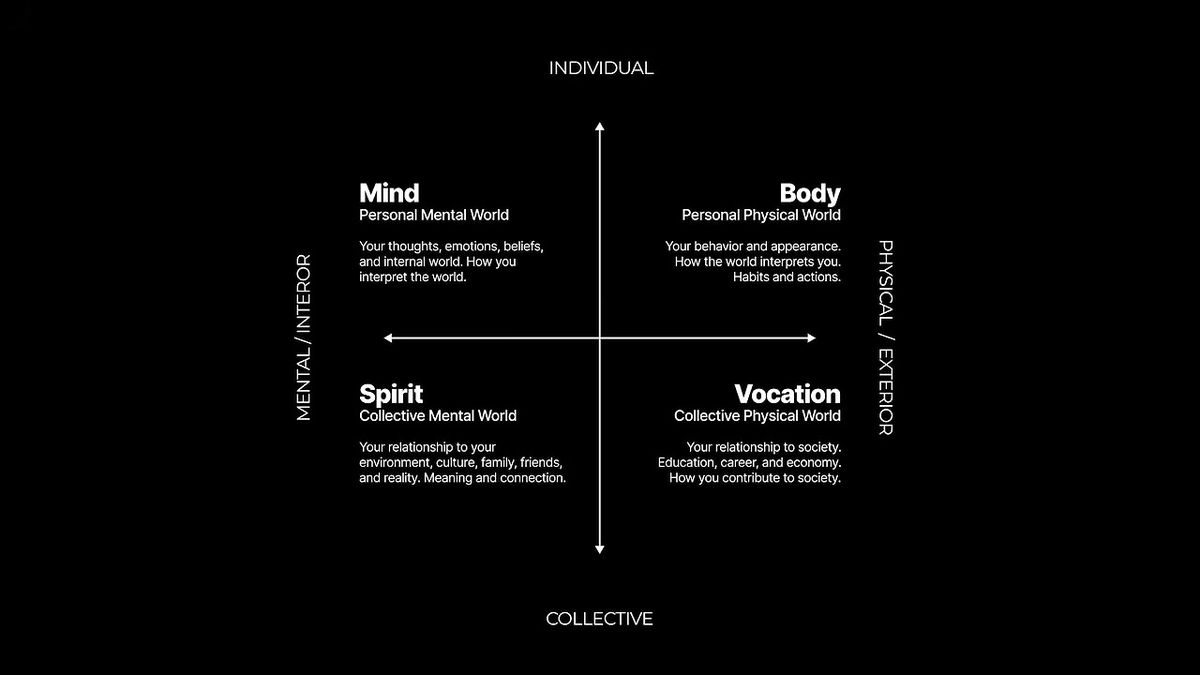
| الربع | ما هو بألفاظه |
|---|---|
| العقل — أعلى اليسار الفرد الداخلي | «أفكارك وعواطفك ومعتقداتك وعالمك الداخلي. إنه كيف تفسّر أنت العالم». |
| الجسد — أعلى اليمين الفرد الخارجي | «سلوكك ومظهرك، أو كيف يفسّرك العالم. عاداتك وأفعالك». |
| الروح — أسفل اليسار الجمعي الداخلي | «علاقتك ببيئتك وثقافتك وعائلتك وأصدقائك والواقع. إنه المعنى والاتصال». |
| المهنة — أسفل اليمين الجمعي الخارجي | «علاقتك بالمجتمع، وتعليمك، ومسارك المهني، والاقتصاد، وكيف تسهم في العالم». |
ونسبته صريحة: «وهذا بالطبع مقتبس من نظرية التكامل (Integral theory) لكِن ويلبر (Ken Wilber)، وأشجّع الجميع على استكشافها» [3:29].
ويشخّص الخلل في كل معسكر بهذا الإطار: «المشكلة أن النقاويين يرفضون العالم الخارجي — وهذا ليس جديداً، فالهيبيّون ومن يفرطون في التماهي مع روحانيتهم يفعلون ذلك أيضاً. أما الآليون فيميلون إلى رفض العالم الداخلي، فيركّزون كلياً على المال والسلطة والتقنية والتقدّم. وذلك مدمّر لإمكانك بداهةً، لأنك ترفض جزءاً كاملاً من الواقع» [3:29].
تشبيه شجرة المهارات
«أريدك أن تفكّر في هذا مثل شجرة مهارات في لعبة فيديو… تضع نقاطاً كثيرة في القوة فتصير قوياً جداً. لكن الأمر أن هذه متشابكة: إن وضعت النقاط في القوة فقط، فستكون بداهةً في وضع أسوأ في أجزاء أخرى من اللعبة، وستخسر معارك أكثر مما تربح. وعادةً في ألعاب الفيديو، لا تستطيع وضع أكثر من قدر معيّن في القوة قبل أن تُجبرك اللعبة على وضعها في الذكاء» [4:02].
ثم يُنزّله على الواقع بثلاثة أمثلة:
- «تستطيع محاولة تعظيم مالك أو الذهاب كلياً في العمل التجاري. لكن إن لم تحسّن عقلك أو جسدك أو روحك إطلاقاً، فبداهةً لن تستطيع الذهاب إلا إلى حدّ معيّن» [4:30].
- «يأتي وقت يكون عليك فيه تحسين عقلك، أو ربما تصل إلى درجة من الاحتراق والإجهاد تُضطرّ معها إلى الميل نحو الروحانية، لأن المزيد من المال لن يحلّ تلك المشكلة» [4:58].
- «لا يهمّ كم أنت روحاني أو متنوّر، إن كان جسدك هزيلاً وأنت غير صحي، وإن لم يكن باسمك مال — وهو شريان حياة المجتمع — فستعاني بلا داعٍ وأكثر. الروحانية لن تحلّ تلك المشكلة لأنها ليست في مجال الواقع نفسه» [4:58].
ويختم الفصل بمأزق دائري: «وأبعد من ذلك: الحلّ الذي يقع في مجال آخر — كالمال — تعتبره أنت شرّاً أو ترفضه، فلا يبقى لك خيار إلا لعب دور الضحية» [5:28].
النهضة الثانية وتاريخ «الوظيفة»
[5:57 – 9:27]
«نحن في منتصف النهضة الثانية، حيث يحلّ إثبات العمل محلّ السيرة الذاتية، ويحلّ الجمهور محلّ صاحب العمل، ويحلّ الذوق محلّ الشهادات.»
«وأعتقد أن أعظم مأساة في زماننا أننا خُدعنا لنصدّق أن الحياة الميكانيكية هي الطريق الوحيد للنجاح. قيل لك: اختر مساراً واحداً. وأُقنعتَ بأن تعدّد الاهتمامات عيب في الشخصية» [5:57]. ويعترف بمعقولية ذلك سابقاً: «وبصراحة، بدا ذلك معقولاً جداً قبل عشرين سنة. لكنك الآن تشعر أنك قابل للاستبدال» [6:32].
الحقيقة التاريخية التي يبني عليها: «معلومة طريفة: النسخة الحديثة من الوظيفة، ما نسمّيه وظيفة اليوم، عمرها نحو 250 سنة فقط. صار طبيعياً جداً لنا أن نحصل على وظيفة، أو أن الوظيفة هي كيف تنجو — بينما لم يكن ذلك هو الحال لمئات ومئات السنين. الحياة الحديثة مجرّد شريحة صغيرة، ونظن أننا فهمنا كل شيء، لكننا لم نفهم» [6:32].
والمقابلة التي يعقدها: «قبل النسخة الحديثة من الوظيفة، كان المثال الأعلى إنساناً حرّاً يعرف كيف يفعل أشياء كثيرة طوال حياته ويسعى وراء رؤيته الخاصة — مقابل العبد الذي كان يُتوقَّع منه أداء مهمة واحدة متخصّصة في مهامّ متكرّرة، أي النسخة الحديثة من الوظيفة. الحِرفي والمزارع والقرصان كلهم أمثلة على من كان يعرف كيف يدير عملية كاملة، لا قطعة متخصّصة واحدة منها. كانوا المفكّر والصانع، الفنان والعالِم في آنٍ واحد» [7:03].
ومثاله المركزي: «دخل ليوناردو دافنشي (Leonardo da Vinci) ورشة فيروكيو (Verrocchio) ليتعلّم الرسم، فخرج وهو يعرف التشريح والهندسة والبصريات وسبك البرونز. لم يخبره أحد أن هذه أشياء منفصلة يُفترض أن تُتعلَّم كلٌّ منها كشهادة أو درجة مستقلة — وذلك المزيج هو ما جعله أحد عظماء النهضة» [7:30]. ثم: «لم يكن أحد يكترث لتخصّصك الدقيق. كانوا يكترثون لما أنت قادر عليه» [7:30].
وما فعلته الصناعة: «خلال التصنيع، لم يكن نموذج المصنع يقصد تدمير التعليم والتفكير النقدي والفاعلية الفردية والذوق. لكنه فعل ذلك بالضبط. صار التعليم تدريباً بدل أن يكون اكتشافاً. والتوظيف والمهامّ المتكرّرة أبقتنا جهلاء بالعملية الريادية كاملةً، فلم نطوّر الخبرة أو الفاعلية لنفعل شيئاً خاصاً بنا» [7:58]. ويضيف: «المسار المهني الخطّي صار طبيعياً لنا بدل المسار الأسّي، والجماهير ببساطة لا تشكّك فيه» [8:28].
التمييز الذي يبني عليه دور الإنسان
«صار بإمكان شخص واحد أن يفعل ما كان يفعله فريق من 10 إلى 50، بحسب المهمة. وصار لدى شخص واحد كل المعلومات المعروفة في متناول يده — وأريد أن أُبرز كلمة «المعروفة»» [8:28].
«هذا ما يجيده الذكاء الاصطناعي: المعلومات المعروفة. لا المجهولة ولا البِكر التي تأتي من التجربة ومن الغوص في المجهول ومن سلوك مسار غير معروف. تلك هي وظيفتك أنت — وذلك يسلّط الضوء على كيف تُدمج الذكاء الاصطناعي.»
ويضيف الرافعة الثانية إلى جانب المعلومات: «وإلى جانب الوصول إلى كل المعلومات المعروفة، صار لدى شخص واحد وصول إلى وسائل التواصل. شركات إعلام بشخص واحد — أي المبدعون — تظهر يميناً ويساراً، لأنه توزيع مجاني لعملهم — إن فهموا الإعلام والانتباه وعلم النفس البشري وغيرها» [8:57].
رجل النهضة الرقمي: التناقض المتحرّك
[9:27 – 15:07]
يفتتح بحجّة معكوسة على منتقدي الذكاء الاصطناعي: «الناس قلقون جداً من أن الذكاء الاصطناعي سيُفسد تفكيرنا ويجعلنا أشبه بالآلات — بينما هم يعيشون كالآلات طوال حياتهم أصلاً» [9:27]. ويشتدّ: «ما هي المئتا سنة الماضية؟ كانت ذلك بالضبط، وأنت عشتَه، وأنت فقط تجترّ البرنامج الذي وُضع في عقلك. تلك هي الأيديولوجيا المضادة للذكاء الاصطناعي. إن لم يكن ذلك آلةً وانعداماً للتفكير النقدي، فلا أدري ما هو» [10:02].
ووظيفة من ينضمّ إلى «النهضة الثانية» بثلاث كلمات: «اختر حِرفتك، ووظّف الذكاء الاصطناعي لتدير العملية كاملةً — أي عمل حياتك — وركّز على الذوق والاتجاه والحُكم» [10:02]. والسبب: «لأن مُخرَج الذكاء الاصطناعي لا يملك منظوراً… إنه كـكيس ماء عليك أن تشكّله» [10:36].
«يجب أن تصير تناقضاً متحرّكاً متعدّد الأبعاد لا يمكن استبداله، لأن أكثر الناس إثارةً للاهتمام هم كذلك تماماً: تناقضات متحرّكة — مثقّفون مفتولو العضلات، ملياردير عفويّ، محاربون روحانيون. الحياة أفضل حين لا يمكن حشرك في صندوق يسهل على غيرك فهمه.»
بين طرفين: الإبداع الخالص والإنتاجية الخالصة
«في المستقبل، أكثر الناس إثارةً للاهتمام وقيمةً سيكونون من يعيشون بين طرفين: الإبداع الخالص والإنتاجية الخالصة» [10:36]. ويصف الطرفين:
- النمط التناظري: «لا شاشات، قراءة الكتب، الحفاظ على إنسانيتك، فعل ما يقود إلى أفكار بِكر وتجارب بِكر. لا استعجال، مجرّد استمتاع خالص بالحياة» [11:12].
- النمط الإنتاجي المتجذّر في الذكاء الاصطناعي: «توظيف التقنية لفعل ما كان مستحيلاً» — «إنها حالة تدفّق ضيّقة مركّزة، تنجز العمل على حاسوبك، وقد جرّبها كثيرون وهي شعور جميل حقاً» [11:12].
ويضع الطرفين على طيف واحد: «فهو بين طرفَي قراءة كتاب في حديقة بلا همّ، والانغلاق في ثقافة الكدح على حاسوبك — لأن كليهما طريقتان ممتعتان جداً للعيش» [11:12]. وفي الطرف الآخر «حالة تركيز منفتحة جداً تكون فيها أكثر اتصالاً بالواقع — وهنا تدخل الروحانية… وبفعل ذلك تختبر المدى الكامل للوعي والتركيز» [11:41].
«المعنى والرضا لا يوجدان في نمط حياة مسطّح متوازن. يوجدان في التباين — لأنك لو كنت سعيداً طوال الوقت، لما اعتبرتَه سعادة. لاعتبرتَه الوضع الطبيعي، ولكان مملاً بعض الشيء. ولاحتجتَ نشوة أكبر فأكبر لتشعر بما تظنّه سعادة. ولهذا لا يستطيع الناس اليوم ترك هواتفهم: لأن حياة سعيدة عادية مملّة جداً بالنسبة إليهم.»
ومقابلها: «لكن حين تفشل وتكافح وتتألّم من أجل شيء تهتمّ به، تتعلّم ما هي السعادة الحقيقية على الجانب الآخر. فمن سيفوزون سيميلون إلى ذلك التباين» [12:08]. و«يعملون بعمق ويرتاحون بعمق. حياتهم كلها لعب لأنهم يحبّون ما يفعلون. لديهم نوبات تركيز مكثّفة على حِرفتهم، تتبعها راحة كاملة عميقة، تماماً كما يفعل أكثر الناس إبداعاً في العالم» [12:36].
مثاله المفصّل: يوم تشارلز داروين
«تشارلز داروين (Charles Darwin) كتب 19 كتاباً في حياته، وهو أمر عبثي بحدّ ذاته. لكن روتينه الصباحي سيفاجئ الناس بالنظر إلى ذلك المستوى من الإنتاج» [12:36].
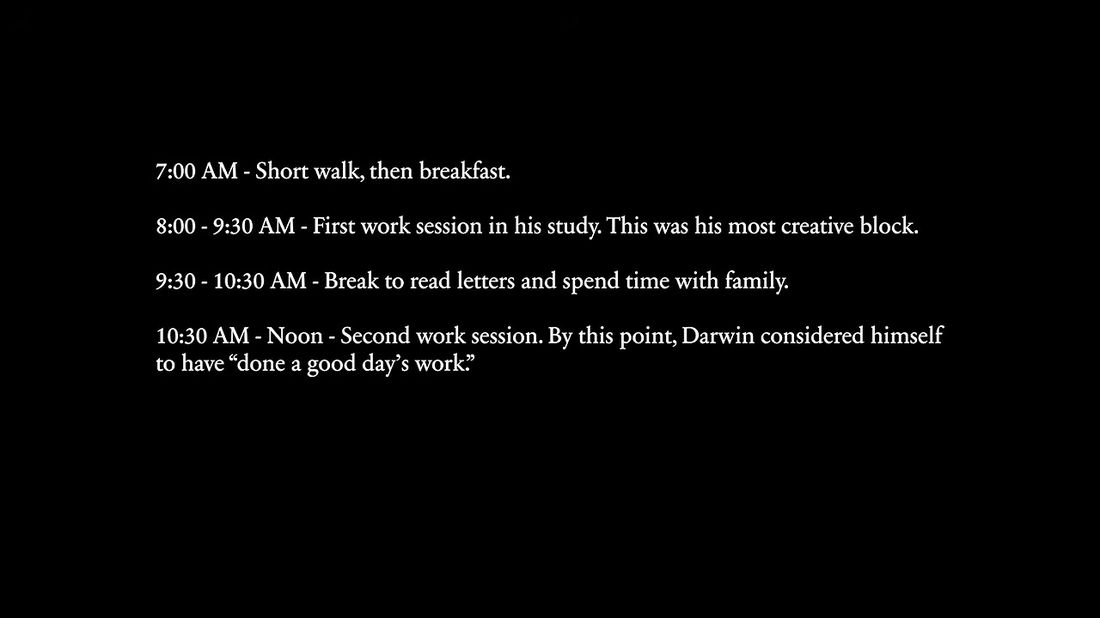
وبقيّة اليوم كما سردها: «ثم بعد الظهر مشيته الثانية حول the sand walk، وهو ممرّ حصوي شهير طوله ربع ميل بناه خصّيصاً للتفكير والتأمّل… ثم بعد الغداء قرأ داروين الصحيفة، ثم استراح بينما كانت زوجته تقرأ له بصوت عالٍ. وفي الرابعة عصراً كانت مشيته الثالثة، حول الـ sand walk غالباً، وأحياناً برفقة أحد» [13:06] [13:34].
ويُقحم تعليقاً شخصياً هنا: «أحبّ المشي، وأمشي طوال الوقت. إنه محور توليد الأفكار وعملي، وهكذا أوازن بين الإنتاجية المركّزة المكثّفة على حاسوبي وبين حالة تركيز إبداعي أكثر انفتاحاً» [13:34]. وعن ممرّ داروين: «أريد حقاً أن أفعل ذلك يوماً ما. تخيّل أن تبني ممرّ مشي خاصاً بك» [13:06].
تنبّؤ صريح
«أعتقد أنه سيكون هناك عشرة أضعاف من أمثال داروين ودافنشي في عالم اليوم، لمجرد الموارد المتاحة لك. سيكون هناك عشرة أضعاف من أمثال أفلاطون وأرسطو وسقراط — لكننا بالطبع لن ندرك ذلك إلا لاحقاً في المستقبل، لأننا للأسف لا نكترث كثيراً لعمل الناس حتى يموتوا، لأن الموت يضفي على العمل نوعاً مختلفاً من المعنى» [14:10].
ويعطي دليله على أن ذلك بدأ: «ونستطيع رؤية هذا يحدث بالفعل. هناك كثير من الناس الأذكياء على الإنترنت يشاركون معرفتهم. الأمر جنوني. تعلّمتُ من يوتيوب أكثر مما تعلّمتُ في المدرسة قط، وسأقف عند هذا القول» [14:38].
وصياغة التنبّؤ النهائية: «أعتقد أن ناس المستقبل الذين سيزدهرون سيكون لديهم صيغة ما من هذا الروتين، لكن بإنتاج 10 إلى 20 شخصاً، ما يتيح لك فعل الكثير، وستستطيع بمفردك بناء عمل حياتك. أو يمكن أن يكون لديك فريق صغير جداً وتفعل الكثير» [14:38].
الأعمال بشخص واحد، والفضول بديلاً عن المنهج
[15:07 – 17:58]
«بعبارة أخرى، سيكون لدى هؤلاء عمل بإنسان واحد (one human business): إنسان واحد مع وكلاء تقنيين وذكاء اصطناعي إلى جانبه. وسنفصّل كيف تبني هذا في فيديو آخر» [15:07].
ويستشهد بنافال: «واقتباس من نافال (Naval) يشير إلى هذا: هناك نحو 7 مليارات إنسان على هذا الكوكب. أتمنى أن يكون هناك يوماً ما نحو 7 مليارات شركة» — ثم يضع تحفّظه: «نحن نقترب أكثر فأكثر من ذلك الواقع. لا أعرف إن كانت كل الوظائف ستختفي، لكني أحبّ ذلك المثال الأعلى حقاً» [15:07].
وأساسه الأنثروبولوجي: «أعتقد أن البشر كائنات ريادية — لا بالمعنى التجاري، بل بمعنى أن الاشتباك مع الواقع، عملية التجربة والخطأ، هي أكثر طرق العيش معنىً وإبداعاً. لا أن تُحبس في مكعّب مكتبي تؤدي مهامّ متكرّرة طوال اليوم — وذلك ماصّ للروح، وكلنا نعرف ذلك الآن» [15:35].
ويعود إلى ما قبل المصانع: «كنت تعمل حتى تنتهي المهمة، لا حتى تنتهي نوبتك ذات الثماني ساعات. كنت تعمل وفق إيقاع الفصول وضوء الشمس والطاقة» [15:35]. «والأهمّ أنك لم تتعلّم كيف تصير ذا قيمة عبر منهج موحّد واختبارات حفظ بلا معنى — وهذا هو ما تفعله المدارس الحكومية. بل تعلّمتَ بالفعل. تعلّمتَ في الورشة، من متدرّب إلى صانع إلى معلّم، مقلّداً من يعرف ما يفعل حتى يتشكّل ذوقك وحُكمك أنت» [16:03].
«كيف تصير رجل النهضة الجديد أو الرقمي؟ تفعل كل شيء. تصير كاتباً ومصمّماً ومسوّقاً وصانع أفلام وكمال أجسام أو عدّاءً أو أياً كان ما يشتهيه فضولك. لكنك تُوجّه تركيزك وانتباهك إلى وعاء واحد، حِرفة واحدة، شيء واحد تختار أن تُعرف به — وتطوّرك متعدّد الأوجه لن يزيد إلا في قدرتك على التقدّم.»
ثم يشخّص لماذا يعارض بعض المبدعين الذكاء الاصطناعي: «معظم الفنانين والكتّاب والمبدعين الذين تراهم على الإنترنت يثورون ضدّ الذكاء الاصطناعي يفعلون ذلك لأنهم تماهوا مع المهارة أو الأداة أو طريقتهم الخاصة في العمل» [17:00]. وموقفه من الجدل نفسه: «شخصياً لا يهمّني الجدل حول ما إذا كان فنّ الذكاء الاصطناعي فنّاً حقيقياً أو كتابته كتابةً حقيقية. يبدو لي أعظم إلهاء هذا العام — لأنك بينما تجادل في ذلك، لم تكن تصنع فنّاً. لم تكن تفعل الشيء الذي تقول إنك تحبّه كثيراً» [17:00].
ويضيف تهمة الحافز: «ومعظم الوقت، أنت تفعله للحافز فقط، لأنك تعرف أنه سيجلب كثيراً من المشاهدات والإعجابات. والأسوأ أنك تعزّز هويةً لن تخدمك في السنوات القادمة» [17:28].
«حِرفتك تقع عند تقاطع: ما تهتمّ به، وما تستطيع أنت فعله على نحو فريد، وما يرغب الآخرون في الدفع لك مقابله.»
الطبقات الثلاث لمكدّس المهارات غير القابل للاستبدال
Irreplaceable skill stack [17:58 – 21:11] — «وفي نظري، هناك ثلاث طبقات» — والصياغة صياغة رأي لا تقرير.
| الطبقة | ما تتضمّنه بألفاظه | وظيفتها في المعادلة |
|---|---|---|
| ١ | أساس من الطبيعة البشرية أو علم النفس «التسويق، المبيعات، الكتابة، الخطابة، أو علم النفس نفسه» | «هذه هي ما يرغب الآخرون في الدفع لك مقابله» |
| ٢ | هوسك بمجالك واهتماماتك الفريدة «الفلسفة، اللياقة، التصميم، البرمجة، التغذية أو أي شيء آخر» | «هذه هي طبقة ما تهتمّ به وما تستطيع فعله على نحو فريد، وهي ما يجعل الناس يأتون إليك أنت دون غيرك» |
| ٣ | المهارة التقنية «برمجيات التسويق بالبريد، أو Photoshop، أو تصميم المواقع بلا كود، أو إدارة وسائل التواصل، أو كتابة الكود فعلياً» | «كانت هذه هي الأهمّ لأن تعلّم هذه الأدوات كان يستغرق وقتاً وجهداً. لكن الذكاء الاصطناعي الآن يفعلها كلها بسهولة» |
شرح الطبقة الأولى: «إنه فهم ميكانيكا الانتباه البشري، وكيف أن ما يراه الناس ذا قيمة أمر ذاتي إلى حدّ بعيد ويتغيّر بتغيّر العالم» [17:58]. وحجّته ضدّ القلق من محتوى الذكاء الاصطناعي: «الجميع قلق من الإنترنت الميت ومن نفايات الذكاء الاصطناعي، لكنهم لا يفهمون أن ما يراه الناس ذا قيمة يتغيّر مع الوقت. مثل: آه، إن كان الذكاء الاصطناعي سيكتب كل المحتوى، فمحتواي يصير فوراً invaluable — بينما ليس ذلك هو الحال، لأن كل من يضخّون محتوى الذكاء الاصطناعي يبدون متشابهين تماماً، فيعتاد الناس عليه بسرعة شديدة ولا يعودون يرونه ذا قيمة» [17:58].
ويصف طبيعة هذه الطبقة: «التسويق والمحتوى والمنتج والعمل التجاري عملية تكرارية للغاية. لا تتوقف أبداً. أنت دائماً في حالة تجربة وخطأ وتحسين. فكل من يريد النجاح بمفرده يجب أن يتقن هذا المجال» [18:41].
شرح الطبقة الثانية: «هذه المجالات لا يختفي أيٌّ منها. هي ببساطة تتطوّر» [19:09]. و«مزيج هذه الاهتمامات هو حيث يكمن تفرّدك» — ومثاله: «الفيلسوف مفتول العضلات أثمن بكثير من فيلسوف الأريكة الذي لا ينمّي إلا عقله دون تجربة مباشرة تختبر نظرياته، وهو أيضاً أكثر إثارةً للاهتمام بكثير» [19:09]. ثم يضيف الطبقة الأولى فوقه: «تخيّل الفيلسوف مفتول العضلات الذي لديه فعلاً عمل تجاري ومنتج، فيستطيع كسب المال من كونه فيلسوفاً مفتول العضلات. إنه لا يُوقَف» [19:39].
وتحذيره في الطبقة الثالثة: «يجب ألّا تراهن بمستقبلك على إتقان أداة، لأن الذكاء الاصطناعي هو الأداة القصوى. فإن كانت هويتك كلها أداةً مثل Photoshop، فيؤسفني القول إن أمامك بضع سنوات. وقد يبدو ذلك ترويعاً، لكني أظنّه رهاناً جيداً» [20:05].
«وهذا هو نمط كل تحوّل تقني: عليك أن تتكيّف. الجزء الميكانيكي من المهارة يُؤتمَت، ويصعد الدور البشري طبقةً إلى أعلى. صار النسّاخ محرّراً، وصار الحائك اليدوي مشغّلاً للآلة.»
أن تصير متعلّماً ذاتياً «بشكل خطير»
dangerously self-educated [20:41 – 25:06]
«لأن المدارس تعلّمك كيف تعمل داخل المجتمع، وهذا جيّد وضروري إلى حدّ ما، لكنها لا تعلّمك كيف تشقّ مسارك أنت» [20:41]. ويصفها بصراحة مع اعتراف مقابل: «المدارس الحكومية آليات ترشيح وتكييف أكثر من أي شيء آخر. ومرة أخرى، هذا جيّد. إنه شرّ لا بدّ منه. عليك أن تُكيَّف إلى حدٍّ ما: أن تتعلّم المشي، والكلام، والحساب الأساسي، وكيف توجد ببساطة» [21:11].
«لكن التعليم الحقيقي اكتشاف. التعليم الذي يجعلك غير قابل للاستبدال هو الاكتشاف. إنه عملية تعلّم ما يلزم لتحقيق رؤية وأهداف مولَّدة ذاتياً — لا عملية تكديس المعرفة أو حفظ الحقائق لتبلي حسناً في اختبار لا يقابل الواقع.»
وتشخيصه لما يحدث بعد التخرّج: «والأسوأ أن معظم الناس يتوقّفون عن التعلّم بعد التخرّج. يبلغون العشرين إلى الخامسة والعشرين ويكرّرون اليوم نفسه بقية حياتهم. لا يسعون وراء تحدٍّ إبداعي يتطلّب معرفة فريدة. ليس لديهم مطلب للتعلّم. ليس لديهم هدف أو رؤية قوية بما يكفي لتحفّزهم على الاستيقاظ صباحاً» — والسبب الذي يعطيه: «لأنهم بصراحة يظنّون أن عليهم أن يعرفوا كيف يفعلونه قبل أن يبدأوا، وهذا مقلوب» [21:41].
نموذج التلمذة
«تتّبع نموذج التلمذة: تتتلمذ على يد معلّم أو مرشد. والشيء الجميل في عالم اليوم أنك تستطيع إيجاد مرشد أو معلّم بمجرّد التقاط كتاب، أو فتح هاتفك والذهاب إلى يوتيوب» [22:09].
ويعالج اعتراض الضجيج بحلّ مباشر: «نعم، الخلاصة (feed) مزدحمة ومليئة بالضجيج، لكن هذا بالضبط سبب حاجتك إلى رؤية وأهداف — لأن الرؤية والأهداف آلية ترشيح لعقلك. ترشّح المشتّتات وتتيح لك ملاحظة الإشارة» [22:09]. ومثاله: «إن كنت تعمل على بناء عمل تجاري وفتحت يوتيوب، فعلى الأرجح لن تهتمّ بفتح فيديو ترفيهي. ستتصفّح عمداً لتجد فيديو عن الأعمال يقرّبك من أهدافك» [22:35].
وموقفه من مصدر المعلومة نفسه — وهو موقف لافت: «لا يهمّني إن استخدمتَ الذكاء الاصطناعي للحصول على المعلومات. لا يهمّني إن أخذتَ كل نصائحك من معلّم يوتيوب واحد. ما يهمّني هو أن تكون لديك رؤية، وهدف، وأن تعمل نحو ذلك الهدف، وأن تطبّق ما تتعلّمه على المشكلات التي تظهر في الطريق. تلك هي طريقة اختبار ما تتعلّمه للتحقّق من صلاحيته لحالتك أنت» [22:35].
ومقارنته بين المصادر: «سواء هلوس الذكاء الاصطناعي أم لا، أو أعطاك معلومة خاطئة — فهناك أيضاً كثير من البشر الأغبياء إلى حدّ عميق الذين لا ينبغي أن تسمع منهم أصلاً، ويعطون معلومات فظيعة أو خاطئة تماماً. على الأقل الذكاء الاصطناعي لا يحاول الكذب. أما البشر فيكذبون طوال الوقت، ويدافعون عن أكاذيبهم حتى الموت إن تماهوا معها» [23:03] [23:33].
وقاعدة الترتيب التي يشدّد عليها: «لا تستطيع أن تعرف إن كانت المعلومة أو النصيحة تستحقّ إلا بعد أن تجرّبها. لا تستطيع مشاهدة فيديو عن كيفية جني مليون دولار وتقرّر إن كان احتيالاً أم لا وأنت لم تفعل به شيئاً. فلا تتعلّم ثم تفعل — تلك طريقة تعلق بها في الجحيم» [23:33]. والصياغة المقابلة: «تفعل الشيء أولاً، أو تحاول فعله، وعندها فقط يصير عقلك مهيّأً لتلقّي الدرس الذي يتيح لك التقدّم» [24:06].
«المبدعون هم نظام التعليم الجديد»
«وأعرف أن ذلك يبدو سخيفاً، لكن ألا ترى؟ المبدعون هم نظام التعليم الجديد. ألا تتعلّم معظم الأشياء المفيدة فعلاً في حياتك على Substack أو YouTube أو البودكاست أو حسابات متخصّصة على X؟» [24:37]. ويضيف عن الثقة: «ألا تثق بمبدع قضيتَ وقتاً مع أفكاره أكثر من ساسة لديهم بداهةً مصالحهم الخاصة؟» [24:37].
«الإنترنت رافعة بلا استئذان. لا تحتاج موافقة لبناء جمهور أو بدء عمل تجاري أو بيع منتج. إنه مسار الفاعلية العالية.»
ماذا تبني: «المبدع» بمعناه المجرّد
[25:06 – 27:39]
«وأخيراً، الذكاء الاصطناعي يُسرّع العموميّ ومتعدّد المعارف، بمعنى أنك تستطيع فعلاً أن تصير عملاً بإنسان واحد» [25:06].
ثم يجرّد المصطلح من دلالته الشائعة: «حين أقول مبدع هنا، ربما تفكّر في مؤثّر أو علامة شخصية، لكن ليس ذلك ما أعنيه بالضبط. أعني شخصاً يصنع قيمة. أعني مبدعاً مجرّداً من ارتباطاتك الذهنية به: يحلّون المشكلات، ويصنعون الحلول، ويساعدون غيرهم على فعل الشيء نفسه» [25:06] [25:34].
وربطه بالمال: «وبما أن تبادل القيمة هو محور العلاقات الإنسانية، فهم يردّون الجميل، غالباً في صورة مال. تلك هي طريقة كسب المال خارج الوظيفة: تصنع شيئاً» — و«المنتج أو الخدمة مجرّد طريقة لتأطير ما صنعتَه بحيث يكون ذا قيمة لشخص آخر، إلى درجة أنه يدفع لك مقابله فعلاً» [25:34] [26:00].
ومثاله المحدّد: «حين تفكّر في شخص مثل جيمس كلير (James Clear) — نعم لديه علامة شخصية، لكنه في الحقيقة يكتب نشرات وكتباً ومحتوى ليضع عمل حياته أمام عيون أكثر، فيكسب دخلاً مستقلاً» [26:00].
وتنبّؤه مع تحفّظه: «أعتقد شخصياً أن معظم الأفراد الطموحين سيسلكون هذا الطريق في المستقبل، حتى لو لم تكن وسائل التواصل كما نعرفها اليوم هي المكان الذي تضع فيه عملك. في الماضي كانت الصحيفة والراديو، والآن هي وسائل التواصل. لكن من يدري ما ستكون في المستقبل» [26:00] [26:36].
ولماذا يوصي بالبدء من هناك تحديداً: «ما أعرفه أن البدء على وسائل التواصل يضعك أمام الجميع، لأن هناك حيث الانتباه. وبالطبع هناك طرق أخرى للحصول على الانتباه، كالإعلانات المدفوعة أو بدء عمل محلّي في موقع جيّد. لكن للشخص الذي لا يملك مالاً ولا نقطة انطلاق، ولديه فقط تعطّش للتعلّم وطموح — فوسائل التواصل هي حيث الانتباه» [26:36].
وموقفه من «العلامة الشخصية»: «والعلامة الشخصية مجرّد أعلى وعاء رافعةً لتكون مبدعاً الآن. ومن المؤسف أنها تحوّلت إلى هوية «صانع محتوى» قابلة للتسويق، لكن هذا هو العالم الذي نعيش فيه. وذلك لا يعني أن عليك أن تتوافق مع ما تظنّ أن صانع المحتوى ينبغي أن يكون» [27:04].
كيف يدخل الذكاء الاصطناعي: التكرار لا الطلبة الواحدة
[27:39 – 31:23]
«معظم الناس لا يدركون أن الذكاء الاصطناعي أكثر من مولّد نفايات ومحرّك بحث بصيغة جديدة. لا يدركون أنهم يستطيعون حرفياً أن يطلبوا منه بناء برمجية، أو صفحة هبوط، أو قُمع، أو تطبيق، أو أداة، أو أي شيء آخر يحتاجونه لفعل أي شيء على الإنترنت. أنا جادّ. هل جرّبتَ؟» [27:39].
ووصفة عملية أعطاها بالتفصيل: «لست مضطراً لبناء برمجية الآن، لكني سألعب بها فقط. ادخل Claude، ادخل Claude Code. أعرف أن اسم Claude Code يجعله يبدو مخيفاً، لكنه مجرّد صندوق محادثة. افتح Claude، اضغط تبويب الكود، فكّر في برمجية تريد بناءها — تطبيق مهامّ — ثم قل فقط: مرحباً Claude، كيف أبني تطبيق مهامّ معك؟ فسيخبرك» [28:05].
وطبقة التعلّم فوقها: «وإن أردت أن تتعلّم فعلاً في الطريق، فاسأله: ما أفضل طريقة لفعل هذا؟ ثم تتخذ أنت القرارات في الطريق. وإن فعل شيئاً لا تعرف كيف يُفعل، تطلب منه أن يعلّمك ما فعله» [28:05] [28:32]. ووعده: «إن فعلت هذا يوماً أو يومين أو ثلاثة، فسيكون لديك تطبيق مذهل وستقول: يا إلهي، فهمتُ الآن» [28:32].
ثم يواجه الاعتراض بنفسه: «والاعتراض هناك: لكن يا دان، هذا لا يقود إلا إلى نفايات الذكاء الاصطناعي. صحيح — لأن هناك يتوقّف معظم الناس. لا يدركون أن التكرار موجود، وأن نسختك الأولى كانت ستكون سيئة بالذكاء الاصطناعي أو بدونه» [28:32].
حجّة التوزيع
يسوق ملاحظة عن التطبيقات: «هناك تطبيقات جوّال أكثر من أي وقت مضى، لكن استخدام تطبيقات الجوّال بقي على حاله تقريباً» [28:32] [28:59]. ثم ينقل عن مصدر يُبقيه غير مؤكّد بصيغته: «أو الرئيس التنفيذي — أظن، أظن أنه كان الرئيس التنفيذي للشركة التي تصنع GTA 6. كان له اقتباس في بودكاست يقول فيه: كان بإمكانك صناعة لعبة فيديو قبل عشر سنوات متى شئت. كان بإمكانك تعلّمها وبناؤها، لكنك لم تفعل. وحتى لو فعلت، فالأرجح أنها لم تكن لتصير ناجحة… ثم مضى ليقول: نحن نصنع النجاحات» [28:59].
وخلاصته منها: «وحتى لو صنعتَ شيئاً قريباً من GTA 6، فذلك لا يعني أنه سيحصل على توزيع. لا يعني أنك ستضعه فعلاً في أيدي الآخرين وتجني ملايين الملايين، أو أنك ستفهم فعلاً كيف تدير شركة بذلك الحجم، أو تنظّم مشروعاً بذلك الحجم — بالذكاء الاصطناعي أو بدونه. هناك ما هو أكثر بكثير في المعادلة. الذكاء الاصطناعي مجرّد شكل ضخم واحد من الرافعة» [29:27].
وحكمه على التفكير الثنائي: «يظنّون: آه، الذكاء الاصطناعي لا يصنع إلا كومة نفايات — وهو فعلاً يصنع كومة نفايات، لكن ذلك لا يعني أنه عديم الفائدة. هذا تفكير أبيض وأسود» [29:56].
«صفحة الهبوط التي تبنيها تبدأ مسوّدةً أولية. ثم عليك أنت إجراء تعديلات دقيقة حتى تصير فعّالة فعلاً. والبرمجية التي تبنيها ستكون مليئة بالعلل وتبدو فظيعة حتى تصلح العلل مراراً وتكراراً، إلى أن تصير أفضل من 99٪ من التطبيقات في السوق. ومعظم الناس ببساطة لا يملكون ذلك المستوى من المثابرة والتكرار.»
وملاحظته الختامية في هذا الفصل: «الشيء الآخر الذي لا يبدو أن الناس يفهمونه هو أن نفايات الذكاء الاصطناعي اختار أحدٌ ما أن يُخرجها. وذلك وحده يبيّن مستوى تطوّر من يُخرجون تلك النفايات» [30:26].
دليل البدء السريع: ثلاث قواعد
«أريد أن أعطيك دليل بدء سريع لفعل أي شيء بالذكاء الاصطناعي» [30:57 – النهاية]
- اعرف ما تريد، واعرف كيف يبدو الجيّد. «لأن معظمكم سيستخدم الذكاء الاصطناعي لبناء عمل بشخص واحد. وإن كنت لا تعرف كيف تبني عملاً تجارياً، فستتوقّع من الذكاء الاصطناعي أن يفعلها لك بإتقان دون أن تعرف ما تحتاج» — ثم تحفّظه الصريح: «ما زال الأمر يستغرق سنوات من التكرار لرؤية أي شكل من أشكال النجاح. لم يتغيّر شيء في هذا الصدد. ما زلت تحتاج التسويق، وما زلت تحتاج المنتج، وما زلت تحتاج المبيعات، وما زلت تحتاج التوزيع، وما زلت تحتاج كل ما كنت تحتاجه في الماضي» [30:57] [31:23].
ونقطة البداية التي يوصي بها: «أفضل مكان للبدء هو استخدام الذكاء الاصطناعي أداةَ تعلّم مفصّلة. استخدمه لتتعلّم صناعة العروض أو كتابة النصوص الإعلانية أو وسائل التواصل. لا تستطيع أن تجعله يفعل شيئاً لك إن كنت لا تعرف ما يجب فعله» [31:23]. - ليكن لديك معايير عالية بشكل عبثي. «لأن سبب كون كل استجابة تحصل عليها نفاياتٍ هو أنك تعامل المسوّدة الأولى على أنها المسوّدة النهائية. لا تفهم أنك ستظلّ مضطراً لتعديل كل خاصية تصميم صغيرة وكل كلمة وكل جملة» [31:23] [31:57].
وتشخيصه للسبب الجذري: «ما تصنعه بالذكاء الاصطناعي سيّئ لأنك ترى الذكاء الاصطناعي شيئاً يُفترض أن يكون عبقرياً مطلقاً، بدل أن تراه أداةً تلتقي بمستوى ذكائك وطموحك أنت» [31:57]. - حاوِل أن تستبدل نفسك بالذكاء الاصطناعي. «نعم، أعتقد أن أفضل طريقة لتعلّم الذكاء الاصطناعي هي محاولة أتمتة نفسك خارج العمل. لماذا؟ لأنك ستتعلّم بسرعة ما يمكن أتمتته وما لا يمكن بعد» [31:57] [32:24].
والنتيجة: «وحين تفهم ما يمكن أتمتته وما لا يمكن، عندها وحدك تستطيع اختيار أي أجزاء عملك وحِرفتك تفوّضها للذكاء الاصطناعي» [32:24].
ما يفوّضه هو، ولماذا
«بالنسبة لي، الذكاء الاصطناعي بديهياً ممتاز في بناء صفحات الهبوط والقُمُع، والمرور على كتل ضخمة من المعلومات لأبحث وأجد الأنماط والاتجاهات» [32:24]. والشرط الذي يجعل ذلك ممكناً: «وبما أني أعرف كيف يبدو الجيّد — لأني بنيتُ صفحات هبوط، وبنيتُ القُمُع، وأعرف ما يؤدّي إلى نتائج — فأنا أعرف كيف أوجّه الذكاء الاصطناعي للوصول إلى تلك النقطة، لأن المسوّدة الأولى بديهياً لن تصل» [32:54].
وعن استراتيجية المحتوى: «سيكون من السخف مني في هذه المرحلة أن أبحث يدوياً في فيديوهات يوتيوب والتغريدات وغيرها ممّا هو فيروسي أو رائج أو ناجح، لأن ذلك يضعك الآن في وضع أسوأ بكثير… عليك أن تدرس وتجمع المعلومات لتصنع استراتيجية رابحة بناءً على ما ربح في الماضي وما يربح الآن. بداهةً لا تريد أن تلعب يداً خاسرة لأنك لم تدرس ما يربح» [32:54] [33:28].
لماذا يُبقي الكتابة لنفسه
يعطي سببين صريحين: «أولاً، أحبّ عملية الكتابة الإبداعية، فأجعلها جزءاً من يومي. ثانياً، قيمة الكتابة في عين القارئ. أما مع الكود، فلا يهتمّ المستخدم النهائي بشكل الكود. لا يراه. يهتمّ بما إذا كان مفيداً له. ولهذا أكتب: لأن ذلك يمنحني تحكّماً دقيقاً في القيمة المقدَّمة» [33:57] [34:28].
تمرين البداية
«إن كنت لا تعرف من أين تبدأ في أتمتة نفسك، ففكّر في أي شيء تفعله يومياً. اكتب حرفياً ما تفعله في كل وقت خلال اليوم. ثم أعطِ تلك القائمة للذكاء الاصطناعي واسأله: ما الذي يمكن تحويله إلى عملية قابلة للتكرار بتلقين أو مهارة أو أداة أو برمجية أو غير ذلك؟ وسيعطيك بعض الخيارات» [34:28].
«وبالطبع، افهم أن تلك الأتمتة، ذلك التلقين، تلك المهارة، تلك الأداة، تلك البرمجية التي تبنيها — هي أيضاً مسوّدة أولى. وستكون سيّئة في البداية… لكن ذلك لأنك لا تعامل الذكاء الاصطناعي كموظّف رقمي. أنت لا تفهم الإدارة أو التدريب. حين تُدخل موظفاً جديداً، لا يعرف تلقائياً كيف يفعل كل شيء داخل العمل. عليك أن تدرّبه. عليك أن تعلّمه بالضبط كيف تريده أن يُنجَز، خطوة بخطوة.»
وخلاصته الأخيرة: «فعليك أن تتواصل ذهاباً وإياباً حتى يصل إلى تلك النقطة، وعندها — بوم — يكون لديك العملية القابلة للتكرار» [35:33]. ثم يَعِد بمتابعات: «في فيديوهات قادمة سنغوص في كل ما ذكرناه في هذا الفيديو: النهضة الرقمية، وكيف تتعلّم بفعالية، وأفضل المهارات لتتعلّمها، وكيف تستخدم الذكاء الاصطناعي، وكيف تفكّر بوضوح، وأكثر» [35:33].
ملاحظات على المصدر
مواضع ورد فيها المصدر ملتبساً أو غير محسوم. أُثبتت كما هي ولم تُحسم.
- الفيديو تنبّؤ ووصفة، لا تقرير. معظم جُمله المحورية مصوغة بـ«أعتقد» أو «في نظري» أو «سيكون»، وقد حُفظت هذه الصيغ حرفياً في كل الملخص. ولا يقدّم في الفيديو مصدراً أو بيانات لأيٍّ من تنبّؤاته.
- «فريق من 10 إلى 50»: ورد في مسار الترجمة هكذا: «what a 10 to 50% team used to do» [8:28] — والعلامة «%» في هذا الموضع لا تستقيم مع السياق، ولم يوضّح المصدر المقصود.
- نسبة الاقتباس عن GTA 6 غير مؤكّدة من قائلها: صاغها هو بتردّد صريح: «أو الرئيس التنفيذي — أظن، أظن أنه كان الرئيس التنفيذي للشركة التي تصنع GTA 6» [28:59]، ولم يسمّ الشخص ولا البودكاست.
- عمر «الوظيفة» 250 سنة: ذكره بوصفه «معلومة طريفة» [6:32] دون مصدر.
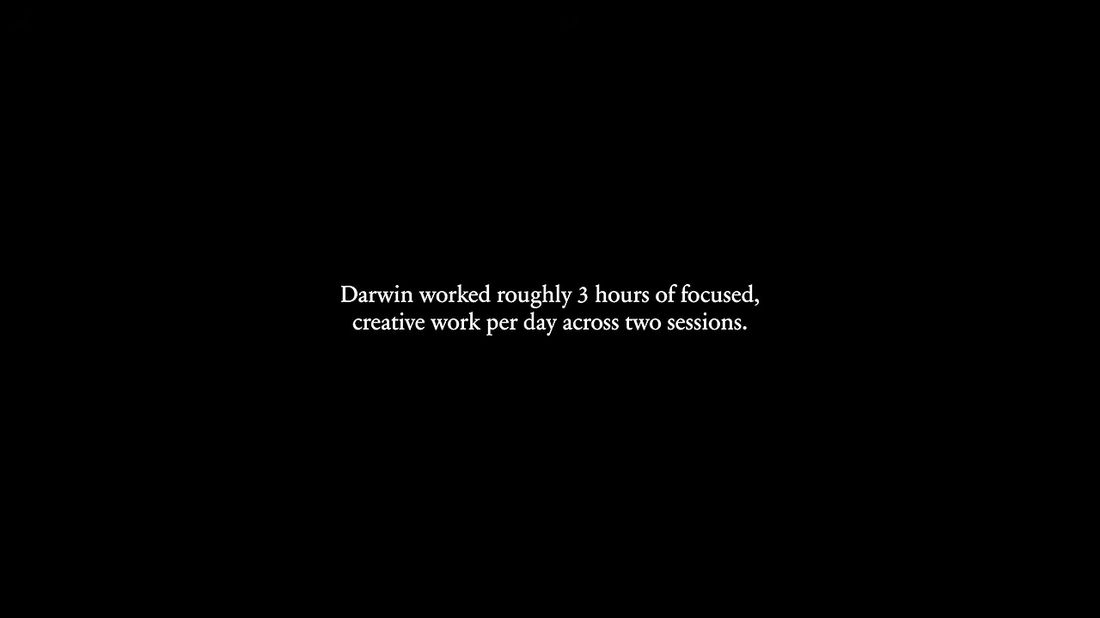
- 19 كتاباً لداروين وثلاث ساعات عمل: رقمان يذكرهما دون إحالة، والثاني يظهر على الشاشة نصّاً بصيغة «roughly» أي «نحو» [12:36] [14:05].
- تناقض ظاهري في موقفه من النوعين: يقول «كلا الجانبين مخطئ» [2:03]، لكنه يقول قبلها إن النوع الثاني «هو الذي أميل إليه أكثر» [1:28]. لم يوفّق المصدر بينهما.
- توتر ثانٍ في موقفه من مصادر المعرفة: يقول «لا يهمّني إن استخدمتَ الذكاء الاصطناعي… لا يهمّني إن أخذتَ كل نصائحك من معلّم يوتيوب واحد» [22:35] [23:03]، ثم يقول بعدها «الأمر متروك لك لتفكّر نقدياً. عليك أن تسأل وتختبر وتجرّب» [23:33]. لم يوفّق المصدر بين اللامبالاة بالمصدر والإلحاح على التمحيص.
- مصلحة تجارية معلَنة في الفيديو: يذكر في متن الشرح معسكر المبدعين الذي يبدأ في 9 سبتمبر ويدعو للتسجيل فيه [27:04]، ويذكر منتجه Eden ويدعو لتجربته [33:28]. أُبقيت الإشارتان لأنهما وردتا داخل الشرح نفسه، واستُبعد ما عداهما من روابط ترويجية.
- كلمة تناقض سياقها: في الطبقة الأولى يقول «my content just instantly becomes invaluable» [17:58] — و
invaluableفي الإنجليزية المعيارية تعني «لا يُقدَّر بثمن»، بينما السياق يقتضي عكسها أي «بلا قيمة». أُبقيت الكلمة الإنجليزية في موضعها ولم تُترجَم ولم تُصحَّح. - روتين داروين: تعارض بين المنطوق والمعروض. نصّ الترجمة كما هو مرقّم يجعل 8:00–9:30 وقت الفطور، تاركاً جلسة العمل الأولى بلا وقت. أما النصّ المعروض على الشاشة فيجعل 8:00–9:30 جلسة العمل الأولى [13:20]. اعتُمد في الجدول ما ظهر على الشاشة لأنه من المصدر نفسه، ويُنبَّه هنا إلى التعارض.
- تسميتان لنفس المفهوم: يقول «one human business» [15:07] [24:06] [27:04]، ويقول «one person business» [30:57]. لم يوحّد المصدر بينهما، ونُقل كلٌّ بموضعه.
- اضطرابات إملائية في مسار الترجمة نفسه: «navel» بدل Naval [15:07] · «Ken Wilbur» بدل Ken Wilber [3:29] · «clod» بدل Claude في جملة واحدة [28:05] · «Jacques philosopher» بدل jacked في موضع واحد [19:39] · «a full eating guide» حيث يُرجَّح Eden [33:28]. اعتُمد في هذا الملخص الهجاء المتعارف عليه للأسماء، إفصاحاً لا تصحيحاً صامتاً، ولم يُغيَّر أي لفظ آخر.
- تنبّؤات وأرقام بلا مصدر: «أفضل من 99٪ من التطبيقات في السوق» [29:56] · «عشرة أضعاف من أمثال داروين ودافنشي» [14:10] · «إنتاج 10 إلى 20 شخصاً» [14:38] — كلها بلا إحالة إلى أي بيانات.
- «معسكر المبدعين يبدأ 9 سبتمبر» [27:04] — دون ذكر السنة.
- أسماء وردت منقوصة: «نافال» دون اسم كامل [15:07] · «ورشة فيروكيو» دون اسم أول ودون صيغة الإضافة [7:30].
- ما استُبعد: روابط الاشتراك والترويج في وصف الفيديو، ونداء الإعجاب والاشتراك في الخاتمة — ليست من مادة الشرح.
المنهجية: أُعدّ هذا الملخص في 4 سبتمبر 2026 من مصدرين من الفيديو نفسه: (١) مسار الترجمة الرسمي المنقّح المرفق بالفيديو (Kind: captions لا تفريغاً آلياً) — نحو 1,066 مقطع ترجمة، وقُرئ كاملاً؛ (٢) ثلاث لقطات استُخرجت من ملف الفيديو مباشرة بأداة ffmpeg عند الطوابع الزمنية المذكورة تحتها، غير معدّلة ولا مقصوصة ولا ممدّدة. واقتُصر على ثلاث لقطات عمداً: المرئيات في هذا الفيديو نصوصٌ تعيد ما يقوله بصوته في معظمها، فلم يُؤخذ منها إلا ما يحمل معلومة لا ينقلها النصّ — مخطّط الأرباع الأربعة، وجدول روتين داروين. كل اقتباس قولُه هو بطابعه الزمني كما ورد، ولم يُصحَّح شيء ممّا ورد في المصدر، بما في ذلك المواضع الملتبسة المثبتة في «ملاحظات على المصدر». الترجمة حرفية بالمعنى الدقيق مع الحفاظ الصارم على صيغة التنبّؤ والرأي («أعتقد»، «في نظري»، «سيكون»، «أظن») — لأن هذا الفيديو تنبّؤ ووصفة لا تقرير وقائع، وطمسُ هذه الصيغ يقلب معناه. لا توجد في هذه الصفحة أي إضافة أو استنتاج أو توصية من المُلخِّص — لم يُطلب ذلك، فلم يُكتب؛ وأي إضافة مأذونة مستقبلاً تُوضع في صندوق موسوم بحسب المادة 4 من دستور الملخصات. النشر: رُفعت هذه الصفحة أول مرة بتاريخ 4 سبتمبر 2026، بناءً على أمرك النصّي الصريح لهذا الملف بعينه — وهو استثناء موثَّق من المادة 6 من دستور الملخصات التي تجعل الملخصات ملفات محلية بشكل افتراضي. وتبقى الصفحة موسومة noindex بعد النشر كما توجب المادة نفسها. والنشر على «ملخصاتي»: رُفعت هذه الصفحة على shortitfor.me/renaissance بتاريخ 13 سبتمبر 2026، بناءً على أمر المالك النصّي الصريح لهذا الملف بعينه («ارفعها على موقع ملخصاتي») — استثناءٌ موثَّق من المادة 6 من دستور الملخصات، والصفحة موسومة noindex كما توجب المادة نفسها.
A verbatim digest of a Dan Koe video: three types of people in the future, why polymaths win in the age of AI, and how to become a "digital Renaissance man" and self-educated.
▶ Watch the original video
The Thesis
"I believe that there will be three types of people in the future, and I think that the divide is growing bigger between them every single day. And if you want to win or succeed in the next ten years — very uncertain ten years with where AI and everything else is going — then it is critical that you avoid becoming the first or second type of person" [0:00].
Note that the sentence is framed as belief and prediction ("I believe," "there will be"), not as a description of an existing reality — and this framing has been preserved throughout the summary.
| Type | His definition, in his words | Timestamp |
|---|---|---|
| The purists The purists | "They are the ones who think that they stayed clean… The purists in the context of today's world are the ones who reject AI. They want nothing to do with it, and they retreat to simplicity or nature or screen free living — when they're usually the ones who are on their screens the most". | [0:00] [0:27] |
| The automatons or the cyborgs The automatons / cyborgs | "They're the ones that outsource every decision. They fully adopt tech without any critical thought, and it ends up ruining their brain… They're allergic to friction and addicted to optimization". | [1:00] |
| The third option multi-dimensional | "To become multi-dimensional, to become a new Renaissance man, a digital Renaissance man". | [5:28] |
He uses a Harry Potter analogy for the first type: "In Harry Potter there's the pure bloods and the mud bloods" [0:27]. And he faults the purists for a contradiction: "They don't realize that simply by using the internet or using social media, they are contributing to the spread of AI" [0:27].
He discloses his personal leaning between the two: "Honestly, the second type of person is the one that I lean more towards than the first type of person, because the purists or the first type of person are just so annoying, even if they're right. Like I don't even want to be associated with them, but the automatons or the cyborgs don't know where AI ends and life begins" [1:28].
His explanation for why people split into two camps: "Just like with politics or religion or any other kind of ideology, most people think that they have to pick a side because it's just how they're wired. You want to be accepted by a tribe so that you don't get cast out, and so you can survive, and so you don't die" [1:28]. Then his stance: "I'm convinced that both sides are wrong. You don't need to fully reject AI and you don't need to fully adopt it" [2:03].
The Four Quadrants of Reality
The framework on which his entire subsequent argument is built [2:32 – 5:57]
| Quadrant | What it is, in his words |
|---|---|
| Mind — upper left the interior individual | "Your thoughts, emotions, beliefs and internal world. It's how you interpret the world". |
| Body — upper right the individual exterior | "Your behavior and appearance, or it's how the world interprets you. It's your habits and actions". |
| Spirit — bottom left the collective interior | "Your relationship to your environment, culture, family, friends and reality. It's meaning and connection". |
| Vocation — bottom right the collective exterior | "Your relationship to society, your education, your career, the economy, how you contribute to the world". |
His attribution is explicit: "And of course, this is adapted from Ken Wilber's Integral theory, which I encourage everyone to explore" [3:29].
Using this framework, he diagnoses the flaw in each camp: "The problem is that the purists reject the external world, and this is nothing new. The hippies and the people who identify too heavily with their spirituality tend to do this as well. And then the automatons… tend to reject the internal world, so they focus fully on money, power, technology, progress, etc. But that is obviously destructive to your potential because you are rejecting an entire portion of reality" [3:29].
The Skill-Tree Analogy
"I want you to think of this like a skill tree in a video game… you can put a bunch into strength and you get really strong. But the thing is, is that these interconnect: if you only put points in strength, you're obviously going to be at a disadvantage in different parts of the game, and you're going to lose more battles than you win. And typically in video games, you can only put so many points in strength before it forces you to start putting them in intellect" [4:02].
He then brings it down to the real world with three examples:
- "You can try to max out your money or your finances or just go all in on business. But if you haven't improved your mind, body or spirit at all, then obviously you're only going to be able to go so far" [4:30].
- "There comes a time where you have to improve your mind, or maybe you get to the point of being so burnt out and stressed out that you have to lean into spirituality, because more money is not going to solve that problem" [4:58].
- "It doesn't matter how spiritual or enlightened you are, if your body is frail and you're unhealthy, and if you don't have any money to your name, which is the lifeblood of society, you're just going to suffer unnecessarily and more. Spirituality is not going to solve that problem because it's not in the same domain of reality" [4:58].
He closes the section with a circular bind: "And even further, the solution to your problems that lies in the other domains, like money, you consider evil or you reject it, so you have no choice but to just play the victim" [5:28].
The Second Renaissance and the History of the "Job"
[5:57 – 9:27]
"We're in the middle of the Second Renaissance where proof of work replaces the resume, an audience replaces the employer, and taste replaces credentials."
"And I believe that the greatest tragedy of our times is that we were fooled into believing that the mechanical life is the only path to success. You were told to pick a lane. You were convinced that having multiple interests was a character flaw" [5:57]. He concedes that this once seemed reasonable: "And honestly, that felt pretty reasonable 20 years ago. But now you just feel replaceable" [6:32].
The historical fact he builds on: "Fun fact: the modern version of a job, what we call a job today, is only about 250 years old. It is so normal for us to just get a job nowadays, or a job is how you survive — when that wasn't the case for hundreds upon hundreds of years. Modern life is just a small little sliver and we think we have it all figured out, but we don't" [6:32].
The contrast he draws: "Before the modern version of the job, the ideal was a free person who knew how to do many things throughout their life and pursued their own vision — compared to a slave who was expected to do one specialized task in repetitive tasks, aka the modern version of a job. The artisan, the farmer, and the pirate are all examples of those who knew how to run an entire operation, not just one specialized piece of it. They were both the thinker and the maker, the artist and the scientist" [7:03].
His central example: “Leonardo da Vinci walked into Verrocchio's workshop to learn painting and left knowing anatomy, engineering, optics and bronze casting. Nobody told him these were separate things that were supposed to be learned as their own credential or degree — and that combination of things is what made him one of the greats in the Renaissance” [7:30]. Then: “Nobody cared about your niche. They cared about what you were capable of” [7:30].
What industrialization did: "During industrialization, the factory model wasn't meant to destroy education, critical thinking, individual agency and taste. But that's exactly what it did… Education became training instead of discovery. Employment and repetitive tasks kept us dumb to the entire entrepreneurial process, so we didn't develop the experience or agency to do our own thing" [7:58]. He adds: "The linear career is normal to us instead of the exponential career, and the masses just don't question it" [8:28].
The Distinction the Human Role Rests On
“One person can now do what a team of 10 to 50 used to do, depending on the task. One person now has any and all known information at their fingertips — and I want to highlight the word ‘known’” [8:28].
"That's what AI is good at: known information, not unknown or novel information that comes from experience and diving into the unknown and pursuing an unknown path. That's what your job is — and that shines a light on how you can incorporate AI."
He adds the second lever alongside information: "And along with access to all known information, one person has access to social media. One-person media companies, aka creators, are popping up left and right because it's free distribution for their work — if they understand media, attention, human psychology, etc." [8:57].
The Digital Renaissance Man: The Walking Contradiction
[9:27 – 15:07]
He opens by turning the argument back on AI's critics: "People are so worried that AI will ruin our thinking and make us more like machines — when they've already been living like machines for the whole of their lives" [9:27]. He presses harder: "What have the past 200 years been? It's been exactly that, and you've been living it, and you're just regurgitating the program that was put into your mind. That is the anti-AI ideology. If that is not a machine and a lack of critical thinking, I don't know what is" [10:02].
And the job of anyone who joins the "Second Renaissance," in three imperatives: "choose your craft, leverage AI so that you can manage the entire operation, aka your life's work, and focus on taste, direction, and judgment" [10:02]. The reason: "Because the output of AI does not have perspective… It's like a bag of water that you must mold" [10:36].
"You must become a multi-dimensional, irreplaceable walking contradiction, because the most interesting people are just that. They're walking contradictions — jacked intellectuals, casual billionaires, spiritual warriors. Life is better when you can't be shoved into a box that others can easily make sense of."
Between Two Extremes: Pure Creativity and Pure Productivity
"In the future, the most interesting and valuable people will be those who live between two extremes: pure creativity and pure productivity" [10:36]. He describes the two extremes:
- The analog lifestyle: "No screens, reading books, maintaining their humanity, doing the things that lead to novel ideas and novel experiences. No urgency, just pure life enjoyment" [11:12].
- The AI-native productive lifestyle: "Leveraging technology to do what used to be impossible" — "It's narrow, focused flow state getting work done at your computer, which many people have experienced and it feels really good" [11:12].
He places the two extremes on a single spectrum: "So it's between the two extremes of reading a book in a park, carefree, and being locked in hustle culture to your computer — because both are very enjoyable ways to live" [11:12]. And on the other end, it is "a very open state of focus where you're more connected with reality — that's where the spirituality comes into play… And by doing that, you experience the full range of consciousness and focus" [11:41].
"Meaning and fulfillment are not found in a flat, balanced lifestyle. They are found in contrast — because if you were happy all the time, you wouldn't consider it happiness. You would consider it normal and, honestly, it would be a bit boring. You would need greater and greater euphoria to feel what you think happiness is. Hence why people can't get off their phones today, because a normal happy life is too boring for them."
And the counterpart: "But when you fail and you struggle and you suffer for something that you care about, you learn what true happiness is on the other side. So those who win will lean into that contrast" [12:08]. And "they work and they rest deeply. Their entire life is play because they love what they're doing. They have intense bursts of focus on their craft, followed by complete and deep rest, just like the world's most creative people do" [12:36].
His Detailed Example: Charles Darwin's Day
"Charles Darwin wrote 19 books in his lifetime, which is just absurd in and of itself. But his morning routine would surprise people for that level of output" [12:36].
And the rest of the day as he narrated it: "Then afternoon he had a second walk of the day around the sand walk, which is a famous quarter mile gravel path that he built specifically for thinking and reflection… Then after lunch, Darwin read the newspaper, then rested while his wife read aloud to him. At 4 p.m. he had the third walk of the day, usually around the sand walk again, sometimes with company" [13:06] [13:34].
And he interjects a personal comment here: "I love walks, I go on walks all the time. It is the crux of idea generation and my work, and that is how I balance out the intense focus productivity at my computer with a more open state of creative focus" [13:34]. And on Darwin's path: "I really want to do that one day. Imagine building your own walking path" [13:06].
An Explicit Prediction
"I believe that there will be ten times more Darwins and da Vincis of today's world, simply because of the resources available to you. There will be ten times more Platos, Aristotle, Socrates — but of course, we won't realize that until later into the future, because unfortunately, we don't really care about people's work that much until they're dead, because the death brings a different kind of meaning to the work" [14:10].
And he offers his evidence that this has already begun: "And we can already see this playing out. There are plenty of brilliant people online sharing their knowledge. It's crazy. I have learned more from YouTube than I ever did in school, and I will stand by that" [14:38].
And the prediction's final formulation: "I believe that the people of the future who are going to thrive will have some variation of this kind of routine, but with the output of 10 to 20 people, allowing you to do so much more, and you'll be able to single handedly build your life's work. Or you can have an incredibly small team and just do so much" [14:38].
One-Human Businesses, and Curiosity in Place of a Curriculum
[15:07 – 17:58]
"In other words, these people will have a one human business: one human with technology agents, AI at their side. And we will break down how to build this one human business in another video" [15:07].
And he cites Naval: "And a quote from Naval that kind of points at this is: there are almost 7 billion people on this planet. Someday I hope there will be almost 7 billion companies" — then he adds his caveat: "We are getting closer and closer to that reality. I don't know whether all jobs are going to go away, but I really like that ideal" [15:07].
And his anthropological premise: "I believe that humans are entrepreneurial creatures — not in the business sense, but in the sense that engaging with reality, the process of trial and error, is the most meaningful and creative way to live. Not to be locked in a cubicle doing repetitive tasks all day — that is soul sucking. We all know that now" [15:35].
And he goes back to before the factories: "You worked until the task was done. Not until your eight hour shift was over. You worked according to the rhythm of seasons, sunlight and energy" [15:35]. "And more importantly, you didn't learn how to become valuable through a standardized curriculum and meaningless memorization tests. That's what public schools are. Instead, you learned by doing. You learned in the workshop, from apprentice to journeyman to master, imitating someone who knew what they were doing until your own taste and judgment were formed" [16:03].
"How do you become this new or digital Renaissance man? You do it all. You become a writer, a designer, a marketer, a filmmaker, a bodybuilder or runner or whatever your curiosity desires. But you channel your focus and attention into one vessel, one craft, one thing that you choose to become known for — and your multifaceted development will only contribute to your ability to get ahead."
He then diagnoses why some creators oppose AI: "Most artists, writers and creatives that you see online that are revolting against AI do so because they have identified with the skill or the tool or their specific way of working" [17:00]. And his stance on the debate itself: "Personally, I don't care about the argument of whether or not AI art is real or AI writing is real. That seems like the greatest distraction of this year — because as you're arguing about that, you weren't creating art. You aren't doing the thing that you say you love so much" [17:00].
And he adds the charge about the incentive: "And most of the time, you're just doing it for the incentive because you know it's going to get a lot of views and likes. And the worst thing is that you're just reinforcing the identity that is not going to serve you in the coming years" [17:28].
"Your craft lives at the intersection of what you care about, what you can uniquely do, and what others are willing to pay you for."
The Three Layers of the Irreplaceable Skill Stack
Irreplaceable skill stack [17:58 – 21:11] — "And in my eyes, there are three layers" — and the phrasing is that of an opinion, not a report.
| Layer | What it includes, in his words | Its role in the equation |
|---|---|---|
| 1 | A foundation of human nature or psychology "marketing, sales, writing, speaking, or just psychology itself" | "This is the what others are willing to pay you for" |
| 2 | Your domain obsession and unique interests "philosophy, fitness, design, coding, nutrition or anything else" | "This layer is the what you care about and what you uniquely can do layer, and it is the thing that people come to you for over another person" |
| 3 | The technical skill "email marketing software or Photoshop or no code website design or social media management or typing physical code" | "This used to be the most important because it took time and effort to learn these tools. But now AI does it all with ease" |
Layer one explained: "It's understanding the mechanics of human attention and how what people perceive as valuable is highly subjective and changes as the world does" [17:58]. His argument against the worry over AI content: "Everyone's worried about the dead internet and AI slop, but they don't understand that what people see as valuable changes over time like, oh, if AI just writes all the content, then my content just instantly becomes invaluable — when that's not the case, because everyone pumping out the AI content all looks the same, and so people get used to it extremely fast and they no longer see it as valuable" [17:58].
He describes the nature of this layer: "Marketing and content and product and business is just an extremely iterative process. It never stops. You're always in this state of trial and error improving. So every single person who wants to succeed on their own must master this domain" [18:41].
Layer two explained: Of these domains, "none of these are going away. They are simply evolving" [19:09]. And "the combination of these interests is where your uniqueness lies" — his example: "the jacked philosopher is far more valuable than the armchair philosopher, who only grows their mind without direct experience to test their theories, and is just far more interesting" [19:09]. He then stacks layer one on top of it: "Imagine the jacked philosopher who actually has a business and a product so they can make money from being a jacked philosopher. They're unstoppable" [19:39].
His warning on layer three: "You should not bank your future on mastery of a tool because AI is the ultimate tool. So if your entire identity is a tool like Photoshop, then I hate to say it, but you have a few years left. And that may sound like fear mongering, but I think it's a pretty good bet" [20:05].
"And that's just the pattern of every single technological shift: You have to adapt, the mechanical part of the skill gets automated and the human role moves up a layer. The scribe became the editor and the hand weaver became the machine operator."
Becoming "Dangerously" Self-Educated
dangerously self-educated [20:41 – 25:06]
"Because schools teach you how to operate within society, which is fine and necessary to some extent, but they do not teach you how to navigate your own path" [20:41]. He describes them bluntly, with an offsetting concession: "Public schools are filtering and conditioning mechanisms more than anything. And again, that's fine. It's a necessary evil. You have to be conditioned to some point. You have to learn how to walk. You have to learn how to speak. You have to learn how to do basic math. You have to learn how to just exist" [21:11].
"But true education is discovery. The education that makes you irreplaceable is discovery. It is the process of learning what's necessary to achieve self-generated vision and goals — not the process of hoarding knowledge or memorizing facts to do well on a test that does not map to reality."
His diagnosis of what happens after graduation: "And even worse, most people stop learning after graduation… They turn 20 to 25 and repeat the same day for the rest of their life. They do not pursue a creative challenge that demands unique knowledge. They don't have a demand to learn something new. They don't have a goal or vision so potent that motivates them to wake up in the morning" — and the reason he gives: "because honestly, they think that they have to know how to do it before they start, which is backwards" [21:41].
The Apprenticeship Model
"You follow the apprenticeship model: you apprentice under a master or a mentor. And the beautiful thing about today's world is that you can find a mentor or a master simply by picking up a book, or opening your phone and going onto YouTube" [22:09].
He answers the noise objection with a direct fix: "And yes, the feed is very crowded and noisy, but that's exactly why you need a vision and goals. Because vision and goals are a filtering mechanism for your mind. They filter out distractions and allow you to notice signal" [22:09]. His example: "If you're working on building a business and you open up YouTube, you're probably not going to be interested in opening an entertainment video. You're going to be scrolling to find a business video intentionally that helps you get closer to your goals" [22:35].
His stance on the source of the information itself — a striking one: "I don't care if you use AI to get information. I don't care if you get all your advice from one YouTube guru. What I do care about is if you have a vision, have a goal, work toward that goal and apply what you learn to problems that come up along the way. That is how you test what you learn to verify its validity for your specific situation" [22:35].
His comparison of the sources: "Whether AI hallucinates or not or gives you the wrong information, there are still plenty of profoundly stupid people — humans — that you shouldn't listen to in the first place and that give terrible information or completely wrong. At least the AI doesn't try to lie. Humans lie all the time, and they will defend their lies to death if they identify with them" [23:03] [23:33].
The sequencing rule he stresses: "You can only tell if information or advice is worthwhile after you try it. You can't watch a YouTube video on how to make $1 million and decide whether it's a scam or not, if you haven't even done anything with it. So you don't learn and then do — that's how you get stuck into hell" [23:33]. And the converse formulation: "You do the thing first or attempt to do the thing, and only then is your mind primed to receive the lesson that allows you to make forward progress" [24:06].
"Creators Are the New Education System"
"And I know that sounds silly, but can you not see it? Creators are the new education system. Do you not learn most of the things that are actually useful in your life on Substack, YouTube, podcasts, or niche accounts on Twitter / X?" [24:37]. He adds, on trust: "Do you not trust a creator whose thoughts you've spent time with over politicians who obviously have their own self-interest in mind?" [24:37].
"The internet is permissionless leverage. You don't need approval to build an audience or start a business or sell a product. It is the high agency path."
What You Build: The "Creator," Stripped of Its Connotations
[25:06 – 27:39]
"And last, AI accelerates the generalist and the polymath, meaning you can actually become a one human business" [25:06].
He then strips the term of its common connotation: "When I say creator here, you might think of an influencer or a personal brand, but that's not exactly what I mean. I mean someone who creates value. I mean a creator stripped of your connotations with it. They solve problems, they create solutions, and they help others do the same" [25:06] [25:34].
He ties it to money: "And since value exchange is the crux of human relationships, they return the favor, often in the form of money. That's how you make money outside of a job. You create something" — and "A product or service is just a way to frame what you've created in a way that is valuable to another person, to the point where they actually pay you for it" [25:34] [26:00].
His specific example: "And when you think of someone like James Clear, he has a personal brand. Yes, but he's really just writing newsletters and books and content to get his life's work in front of more eyes so he can earn an independent income" [26:00].
His prediction, with its caveat: "I personally believe that most ambitious individuals will take this route in the future, even if what we know as social media today isn't where you put your work in front of other people. In the past, it was the newspaper and the radio, and now it's social media. But who knows what it will be in the future" [26:00] [26:36].
And why he recommends starting there specifically: "What I know is that starting on social media puts you in front of everyone, because that's where the attention is. Of course, there are other ways to get attention, like paid ads or starting a local business in a good location. But for the person who doesn't have any money, doesn't have any starting point, they just have a thirst for learning and they are ambitious — then social media is where the attention is" [26:36].
His stance on the "personal brand": "And a personal brand is just the highest leverage vessel to be a creator right now. And it's unfortunate that it's turned into a marketable content creator identity, but that's the world we live in. That doesn't mean you have to conform to what you think a content creator should be" [27:04].
How AI Comes into Play: Iteration, Not a One-Shot Request
[27:39 – 31:23]
"Most people do not realize that AI is more than a slop generator and a new age search engine. They do not realize that they can quite literally ask it to build a software, a landing page, a funnel, an app, a tool, or whatever else they need to do anything on the internet. I'm serious. Have you tried it?" [27:39].
A practical recipe he gave in detail: "You don't need to go and build a software right now, but I would just play around with it. Go into Claude, go into Claude Code. I know that Claude Code makes it sound scary, but it's just a chat box. Open up Claude. Click on the code tab. Think of a software that you want to build — a to-do app — and then just say, Hey Claude, how can I go about building a to-do app with you? And then it'll tell you" [28:05].
And the learning layer on top of it: "And if you want to actually learn along the way, you just ask it, okay, what's the best way to do this? And then you make the decisions along the way. And if it does something that you don't know how to do, you ask it to teach you what it did" [28:05] [28:32]. His promise: "If you do this for one, two, three days, you will have a crazy app and you'll be like, oh my gosh, I get it now" [28:32].
He then confronts the objection himself: "And the objection there is: But Dan, that just leads to AI slop. Correct — because that's where most people stop. They don't realize that iteration exists and that your first iteration would suck with or without AI" [28:32].
The Distribution Argument
He brings in an observation about apps: "There are more mobile apps than ever. But the usage of mobile apps has stayed around the same" [28:32] [28:59]. He then relays a source that his own phrasing leaves unconfirmed: "Or the CEO, I think. I think it was the CEO of the company that's creating GTA 6. He had a quote in a podcast where he's like: you could create a video game ten years ago whenever you wanted. You could have learned it and built it, but you didn't. And even if you did, it probably wasn't going to be a hit… And then he went on to say that we create hits" [28:59].
His takeaway from it: "And even if you created something close to GTA 6, that doesn't mean that it would get distribution. That doesn't mean that you'd actually get it in front of other people's hands and make millions upon millions of dollars, or actually understand how to manage that size of a company, or organize that size of a project — with AI or without it. There is so much more to the equation. AI is just one massive form of leverage" [29:27].
His verdict on the binary thinking: "They just think, oh, AI just creates a bunch of slop — and it does just create a bunch of slop, but that doesn't mean that it's useless. This is black and white thinking" [29:56].
"The landing page that you build starts as a rough draft. Then it's up to you to make micro adjustments until it's actually effective. The software you build will be extremely buggy and look horrible until you fix the bugs over and over again, until it's better than 99% of apps on the market. Most people just don't have that level of persistence and iteration."
His closing remark in this section: "That's the other thing people don't seem to understand, is that the AI slop was chosen to be put out by someone. That just demonstrates the level of development of the people who are putting out the AI slop" [30:26].
The Quick-Start Guide: Three Rules
"I want to give you a quick start guide to do anything with AI" [30:57 – end]
- Know what you want, and know what good looks like. "Because for most of you, you're going to use AI to build a one person business. And if you don't know how to build a business, then you're going to expect the AI to do it perfectly for you without knowing what you need" — then his explicit caveat: "It still takes years of iteration to see any form of success. Nothing has changed in that regard. You still need marketing. You still need product. You still need sales. You still need distribution. You still need all of the things you needed in the past" [30:57] [31:23].
And the starting point he recommends: "The best place to start is by simply using AI as a tailored learning tool. Use it to learn offer creation or copywriting or social media. You can't have AI do something for you if you don't know what to do" [31:23]. - Have absurdly high standards. "Because the reason every response you get from AI is slop is that you treat the first draft as the final draft. You don't understand that you will still have to tweak every little design feature, word, sentence" [31:23] [31:57].
And his diagnosis of the root cause: "What you create with AI sucks because you see AI as this thing that should just be an absolute genius, rather than seeing it as a tool that meets your level of intelligence and ambition" [31:57]. - Try to replace yourself with AI. "Yes, I believe the best way to learn AI is to try to automate yourself out of work. Why? Because you will quickly learn what can and can't be automated yet" [31:57] [32:24].
And the result: "And so once you understand what can and can't be automated, then only you can choose which parts of your business and craft to delegate to AI" [32:24].
What He Delegates, and Why
"For me, AI is obviously great at building landing pages and funnels and going through large swaths of information so I can research and find patterns and trends" [32:24]. And the condition that makes this possible: "And since I know what good looks like — because I've built landing pages, I've built the funnels and I know what leads to results — then I know how to guide the AI to get to that point, because the first draft obviously isn't going to get there" [32:54].
And on content strategy: "It would be silly of me at this point to manually research YouTube videos and tweets and other things that are viral or trends or things that are working, because that now puts you at a massive disadvantage… You have to study and gather the intel and information to create a winning strategy based on what has won in the past and what is winning now. You obviously don't want to play a losing hand because you haven't studied what's winning" [32:54] [33:28].
Why He Keeps the Writing for Himself
He gives two explicit reasons: "One, I like the creative process of writing, so I make it a part of my day. Two, the value of writing is in the eyes of the reader. With code, no end user cares about what the code looks like. They don't see it. They care about if it's beneficial to them. That's why I write, because it gives me fine tuned control over the value provided" [33:57] [34:28].
The Starting Exercise
"If you don't know where to start with automating yourself or trying to use AI to replace you, just think of anything that you do on a daily basis. Literally write down what you do at every time throughout the day. Then give that list to AI and ask what could be turned into a repeatable process with a prompt, a skill, a tool, a software, or whatever, and it will give you some options" [34:28].
"And of course, understand that that automation, that prompt, that skill, that tool, software that you build is also a first draft. And it will suck at first… but that's because you're not treating AI as a digital employee. You don't understand management or training. When you bring on an employee, they don't just automatically know how to do every single thing inside of the business. You have to train them. You have to teach them exactly how you want it done, step by step."
And his closing takeaway: "So you have to communicate back and forth until it gets to that point, and then boom, you have the repeatable process" [35:33]. He then promises follow-ups: "In future videos, we're going to dive into everything that we've mentioned in this video: the digital renaissance, how to learn effectively, the best skills to learn, how to use AI, how to think with clarity and more" [35:33].
Notes on the Source
Places where the source is ambiguous or unsettled. They are recorded as they stand and left unresolved.
- The video is a prediction and a prescription, not a report. Most of its key sentences are framed with "I believe," "in my eyes," or "there will be," and these framings have been preserved verbatim throughout the summary. He offers no source or data in the video for any of his predictions.
- "A team of 10 to 50": the caption track reads: "what a 10 to 50% team used to do" [8:28] — the "%" sign does not fit the context at this point, and the source did not clarify what was meant.
- The attribution of the GTA 6 quote is unconfirmed by the speaker himself: he framed it with explicit hesitation: "Or the CEO, I think. I think it was the CEO of the company that's creating GTA 6" [28:59], and he named neither the person nor the podcast.
- The "job" being 250 years old: he presented it as a "fun fact" [6:32] without a source.
- Darwin's 19 books and three hours of work: two figures he cites without a reference; the second appears as on-screen text in the form "roughly," i.e., "about" [12:36] [14:05].
- An apparent contradiction in his stance on the two types: he says "both sides are wrong" [2:03], but earlier says the second type "is the one that I lean more towards" [1:28]. The source did not reconcile the two.
- A second tension, in his stance on sources of knowledge: he says "I don't care if you use AI… I don't care if you get all your advice from one YouTube guru" [22:35] [23:03], then says afterward "It's up to you to think critically. You need to question and test and experiment" [23:33]. The source did not reconcile the indifference to the source of information with the insistence on scrutiny.
- A disclosed commercial interest in the video: in the body of the explanation he mentions the Creator Bootcamp, which starts on 9 September, and invites viewers to enroll in it [27:04], and he mentions his product Eden and invites viewers to try it [33:28]. Both references were kept because they occur within the explanation itself; all other promotional links were excluded.
- A word that contradicts its context: in layer one he says "my content just instantly becomes invaluable" [17:58] — and
invaluablein standard English means "priceless," whereas the context calls for the opposite, i.e., "worthless." The English word was kept in place, neither translated nor corrected. - Darwin's routine: a conflict between what is spoken and what is shown on screen. The caption text, as timestamped, makes 8:00–9:30 the time of breakfast, leaving the first work session with no time slot. The text shown on screen, however, makes 8:00–9:30 the first work session [13:20]. The table follows what appeared on screen, since it comes from the same source, and the conflict is flagged here.
- Two names for the same concept: he says "one human business" [15:07] [24:06] [27:04], and he says "one person business" [30:57]. The source did not standardize the two, and each was carried over in its own place.
- Spelling irregularities in the caption track itself: "navel" for Naval [15:07] · "Ken Wilbur" for Ken Wilber [3:29] · "clod" for Claude in a single sentence [28:05] · "Jacques philosopher" for jacked in one instance [19:39] · "a full eating guide" where Eden is most likely meant [33:28]. This summary uses the conventional spelling of the names, as disclosure, not silent correction, and no other wording was changed.
- Predictions and figures without a source: "better than 99% of apps on the market" [29:56] · "ten times more Darwins and da Vincis" [14:10] · "the output of 10 to 20 people" [14:38] — all without reference to any data.
- "The next Creator Bootcamp starts on September 9th" [27:04] — with no year given.
- Names that appear incomplete: "Naval" with no full name [15:07] · "Verrocchio workshop" with no first name and no possessive form [7:30].
- What was excluded: the sign-up and promotional links in the video description, and the like-and-subscribe appeal at the close — none of it is part of the explanatory material.
Methodology: This summary was prepared on 4 September 2026 from two sources from the video itself: (1) the official edited caption track attached to the video (Kind: captions, not an automatic transcription) — about 1,066 caption cues, read in full; (2) three frames extracted directly from the video file with ffmpeg at the timestamps noted beneath them, unedited, uncropped, unstretched. The frames were deliberately limited to three: the visuals in this video are, for the most part, text repeating what he says aloud, so only what carries information the text does not convey was taken from them — the four-quadrants diagram and the table of Darwin's routine. Every quotation is his own words, with its timestamp as it appears, and nothing that appears in the source was corrected, including the ambiguous passages recorded in "Notes on the Source." The translation is literal in the strict sense, with the prediction-and-opinion framing strictly preserved ("I believe," "in my eyes," "there will be," "I think") — because this video is a prediction and a prescription, not a report of facts, and erasing these framings would invert its meaning. This page contains no addition, inference, or recommendation from the summarizer — none was requested, so none was written; any addition authorized in the future is placed in a labeled box in accordance with Article 4 of the Summaries Constitution. Publication: This page was first published on 4 September 2026, on your explicit written instruction for this specific file — a documented exception to Article 6 of the Summaries Constitution, which makes summaries local files by default. The page remains tagged noindex after publication, as the same Article requires. Publication on My Summaries (shortitfor.me): This page was uploaded to shortitfor.me/renaissance on 13 September 2026, on the owner's explicit written instruction for this specific file ("upload it to my summaries site") — a documented exception to Article 6 of the Summaries Constitution, and the page is tagged noindex as the same Article requires.