كشّاف التحيّزات المعرفية: قائمة منظَّمة لأن التفكير صعب — باستر بنسون
خلاصة تدوينة «Cognitive bias cheat sheet» لباستر بنسون (Buster Benson) على Medium: كيف أخذ 175 تحيّزاً معرفياً من قائمة ويكيبيديا المتشابكة، وحذف مكرّراتها، وجمعها في نحو عشرين استراتيجية ذهنية، ثم رتّبها تحت أربع مشكلات يحاول الدماغ حلّها — فصار لكل تحيّز سببٌ يُفهم به.
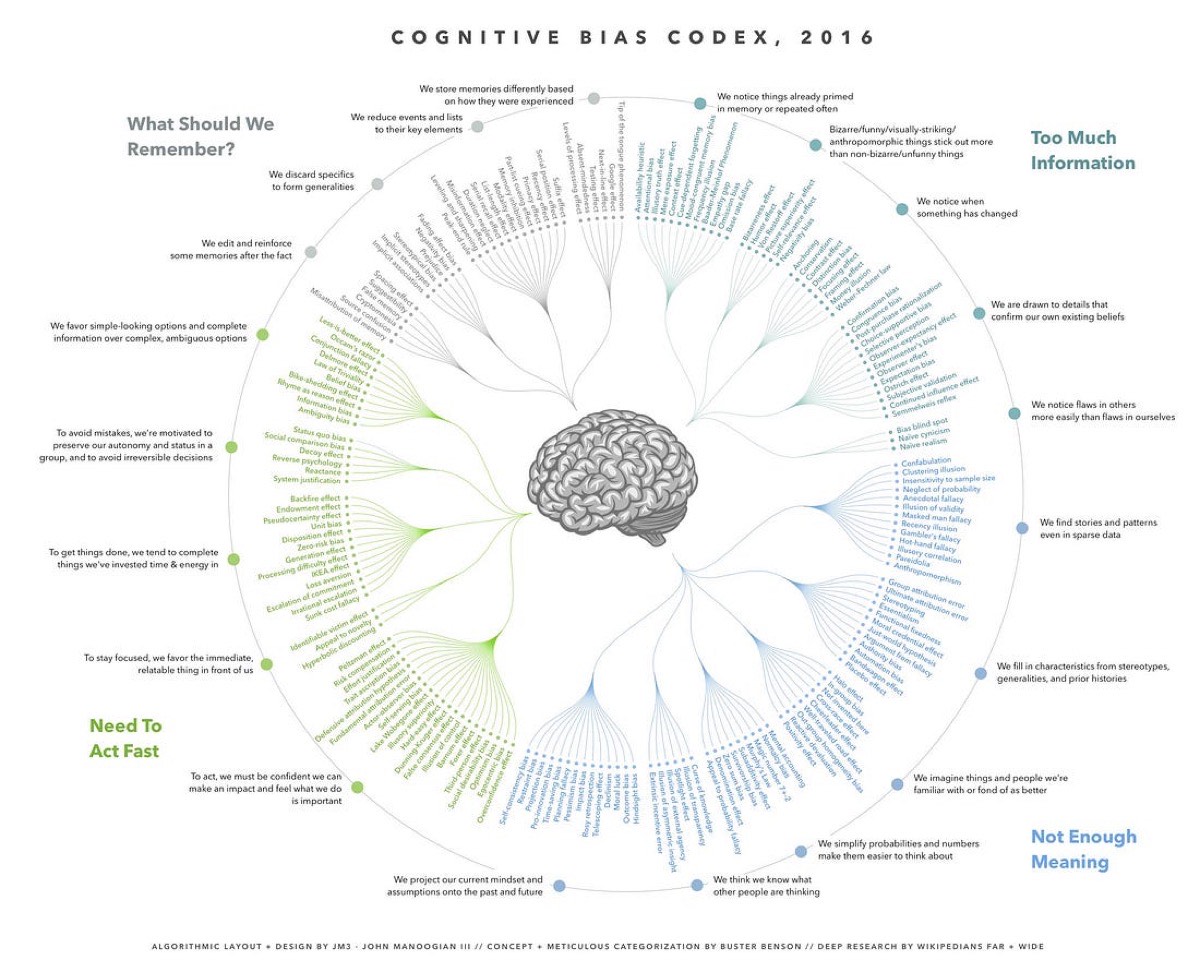
١ · لماذا كتبها: مرجعٌ لا يُنسى منه شيء
يبدأ باستر بنسون (Buster Benson) باعترافٍ عن عادته: سنواتٌ طويلة وهو يرجع إلى قائمة التحيّزات المعرفية في ويكيبيديا كلّما حدس أن نمطاً من التفكير له اسمٌ رسميّ لا يتذكّره. ويصفها بأنها كانت «مرجعاً لا يُقدَّر بثمن» في كشف العيوب الخفيّة في تفكيره هو، وأنه لم يجد غيرها بهذا الشمول وهذا الإيجاز معاً [¶4].
ثم يقول بصراحة إن الصفحة — مع ذلك — «فوضى متشابكة» بعض الشيء. حاول استيعاب محتواها مرّات كثيرة عبر السنين، فلم يعلق منه إلا القليل: يمسح الصفحة بعينه فيشعر أنه لا يعثر على التحيّز الذي يبحث عنه، ثم ينسى بسرعة ما تعلّمه. ويعزو ذلك إلى أن الصفحة نمت عضوياً عبر السنين: فهي تضع 175 تحيّزاً في تصنيفات غامضة (تحيّزات اتّخاذ القرار، تحيّزات اجتماعية، أخطاء الذاكرة…) لا تبدو له متمانعة، ثم ترتّبها أبجدياً داخل كل تصنيف. «وفيها مكرّرات بوفرة، وتحيّزات متشابهة كثيرة بأسماء مختلفة، منثورةً كيفما اتّفق» [¶5].
٢ · الطريقة: من 175 إلى عشرين إلى أربع
يقول إنه أخذ أربعة أسابيع — وكان في إجازة أبوّة — ليستوعب القائمة أعمق، وليخرج ببنية تنظيمية أبسط وأوضح تُعلَّق عليها هذه التحيّزات. «والقراءة العميقة في التحيّزات أعطت دماغي ما يمضغه وأنا أهدهد لوي الصغير لينام» [¶6].
والمسار كما يصفه [¶7]:
- بدأ بالقائمة الخام: 175 تحيّزاً، وأدخلها كلها في جدول بيانات.
- ثم مرّ عليها مرّة أخرى فحذف المكرّرات.
- ثم جمع المتشابهات (مثل bizarreness effect وhumor effect) والمتكاملات (مثل optimism bias وpessimism bias).
- فنزلت القائمة إلى نحو عشرين استراتيجية ذهنية متحيّزة، نستعملها لأسبابٍ محدّدة جداً.
ثم حاول مراراً أن يجمع هذه العشرين على مستوى أعلى، فاستقرّ أخيراً على تجميعها بحسب المشكلة الذهنية العامّة التي تحاول كلٌّ منها معالجتها. وحجّته في ذلك:
كل تحيّز معرفي موجود لسبب — أساساً لتوفير وقت الدماغ أو طاقته. فإن نظرتَ إليها من جهة المشكلة التي تحاول حلّها، صار أسهل بكثير أن تفهم لماذا وُجدت، وكيف تنفع، وما المقايضات (والأخطاء الذهنية الناتجة) التي تُدخلها معها.
والمشكلات الأربع التي تساعدنا التحيّزات على معالجتها، كما يصوغها في سطر واحد: «فيضُ المعلومات، ونقصُ المعنى، والحاجة إلى التصرّف بسرعة، ومعرفةُ ما يستحقّ أن يُتذكَّر لاحقاً» [¶10].
٣ · المشكلة الأولى: معلومات أكثر مما نحتمل
خمس استراتيجيات للتصفية [¶11–17].
«في العالم معلوماتٌ أكثر من اللازم ببساطة، ولا خيار لنا إلا أن نُرشّح جُلّها خارجاً»، يكتب. ويستعمل دماغنا حيلاً بسيطة لانتقاء الفتات الذي يُرجَّح أن ينفع بطريقةٍ ما [¶12].
| ما يلفت انتباهنا | التحيّزات المندرجة تحته (كما يسردها المقال) |
|---|---|
| نلاحظ ما هو مهيَّأ في الذاكرة سلفاً أو متكرّر كثيراً. فدماغنا أميل إلى ملاحظة ما يتّصل بشيءٍ حُمّل في الذاكرة حديثاً [¶13]. | Availability heuristic · Attentional bias · Illusory truth effect · Mere exposure effect · Context effect · Cue-dependent forgetting · Mood-congruent memory bias · Frequency illusion · Baader-Meinhof Phenomenon · Empathy gap |
| الغريب والمضحك واللافت بصرياً والمُشخَّص يبرز أكثر من عاديّه. فدماغنا يرفع أهمية ما هو غير معتاد أو مفاجئ، ويقفز عن المعلومة التي يظنّها عادية أو متوقّعة [¶14]. | Bizarreness effect · Humor effect · Von Restorff effect · Negativity bias · Publication bias · Omission bias |
| نلاحظ حين يتغيّر شيء — ونزن دلالة القيمة الجديدة باتّجاه التغيّر (صعوداً أو هبوطاً) أكثر من إعادة تقييمها كما لو عُرضت وحدها. ويسري هذا على مقارنة شيئين متشابهين [¶15]. | Anchoring · Contrast effect · Focusing effect · Framing effect · Weber–Fechner law · Distinction bias |
| تجذبنا التفاصيل التي تؤكّد ما نعتقده سلفاً. «وهذا كبير»، يقول. ولازمُه: نميل إلى تجاهل ما يناقض معتقداتنا [¶16]. | Confirmation bias · Congruence bias · Post-purchase rationalization · Choice-supportive bias · Selective perception · Observer-expectancy effect · Experimenter’s bias · Observer effect · Expectation bias · Ostrich effect · Subjective validation · Continued influence effect · Semmelweis reflex · Bucket error · Law of narrative gravity |
| نلاحظ عيوب الآخرين أسهل مما نلاحظ عيوبنا. ويسبق الكاتب قارئه هنا: «قبل أن ترى هذا المقال كلَّه قائمةَ نزواتٍ تُفسد تفكير الآخرين، أدرِك أنك أنت أيضاً خاضعٌ لهذه التحيّزات» [¶17]. | Bias blind spot · Naïve cynicism · Naïve realism |
٤ · المشكلة الثانية: معنى أقلّ مما يكفي
ستّ استراتيجيات لسدّ الفجوات [¶18–25].
«العالم شديد الإرباك، وننتهي إلى رؤية شظيّة ضئيلة منه، ومع ذلك علينا أن نصنع منها معنىً لكي ننجو». فحين يصل التيّار المُرشَّح، نصل النقاط ببعضها، ونملأ الفجوات بما نظنّ أننا نعرفه سلفاً، ونحدّث نماذجنا الذهنية عن العالم [¶19].
| كيف نصنع المعنى | التحيّزات المندرجة تحته |
|---|---|
| نجد قصصاً وأنماطاً حتى في بيانات شحيحة. فلأننا لا نحصل إلا على شظيّة ضئيلة ونُرشّح ما عداها، لا تتوفّر لنا القصة كاملة أبداً — وهكذا يعيد دماغنا بناء العالم ليبدو مكتملاً داخل رؤوسنا [¶20]. | Confabulation · Clustering illusion · Insensitivity to sample size · Neglect of probability · Anecdotal fallacy · Illusion of validity · Masked man fallacy · Recency illusion · Gambler’s fallacy · Hot-hand fallacy · Illusory correlation · Pareidolia · Anthropomorphism |
| نملأ الصفات من الصور النمطية والعموميات والتواريخ السابقة كلّما جاءتنا حالة جديدة أو فجوة في المعلومات. «ثم ننسى — على نحوٍ مريح — أيُّ الأجزاء كان حقيقياً وأيُّها مُلئ» [¶21]. | Group attribution error · Ultimate attribution error · Stereotyping · Essentialism · Functional fixedness · Moral credential effect · Just-world hypothesis · Argument from fallacy · Authority bias · Automation bias · Bandwagon effect · Placebo effect |
| نتخيّل ما نألفه أو نحبّه أفضل مما لا نألفه ولا نحبّه. شبيهٌ بما قبله، غير أن ما نملأ به الفجوات هنا يحمل افتراضات مضمرة عن جودة الشيء وقيمته [¶22]. | Halo effect · In-group bias · Out-group homogeneity bias · Cross-race effect · Cheerleader effect · Well-traveled road effect · Not invented here · Reactive devaluation · Positivity effect |
| نبسّط الاحتمالات والأرقام لتسهل على التفكير. فعقلنا اللاواعي «سيّئ جداً في الرياضيات»، ويُخطئ في احتمال وقوع الشيء بكل الطرق إن غابت بعض البيانات [¶23]. | Mental accounting · Normalcy bias · Appeal to probability fallacy · Base rate fallacy · Murphy’s law · Hofstadter’s law · Subadditivity effect · Survivorship bias · Zero sum bias · Denomination effect · Magic number 7±2 · Swimmer’s body illusion · Money illusion · Conservatism |
| نظنّ أننا نعرف ما يفكّر فيه الآخرون. فنفترض أحياناً أنهم يعرفون ما نعرف، وأحياناً أنهم يفكّرون فينا بقدر ما نفكّر نحن في أنفسنا. وهي في جوهرها نمذجةٌ لعقولهم على مثال عقولنا (أو على مثال عقلٍ أبسط منه بكثير أحياناً) [¶24]. | Curse of knowledge · Illusion of transparency · Spotlight effect · Streetlight effect · Illusion of external agency · Illusion of asymmetric insight · Extrinsic incentive error |
| نُسقِط حالتنا الذهنية وافتراضاتنا الحالية على الماضي والمستقبل. ويضاعف ذلك أننا لسنا بارعين في تخيّل سرعة حدوث الأشياء أو تغيّرها عبر الزمن [¶25]. | Hindsight bias · Outcome bias · Moral luck · Declinism · Telescoping effect · Rosy retrospection · Impact bias · Pessimism bias · Planning fallacy · Time-saving bias · Pro-innovation bias · Projection bias · Restraint bias · Self-consistency bias |
٥ · المشكلة الثالثة: لا بدّ من التصرّف بسرعة
خمس استراتيجيات للحسم [¶26–32].
«نحن مقيَّدون بالوقت والمعلومات، ومع ذلك لا يمكن أن ندع ذلك يشلّنا. فلولا القدرة على التصرّف السريع في وجه عدم اليقين لَهلكنا كنوعٍ منذ زمن بعيد». ومع كل معلومة جديدة علينا أن نقدّر قدرتنا على التأثير في الموقف، ونطبّقها على قراراتنا، ونحاكي المستقبل لنتوقّع ما قد يحدث [¶27].
| كيف نحسم | التحيّزات المندرجة تحته |
|---|---|
| لكي نتصرّف، نحتاج ثقةً بقدرتنا على إحداث أثر وبأن ما نفعله مهمّ. والحقيقة أن معظم هذه الثقة يمكن تصنيفه ثقةً مفرطة — «لكننا بدونها قد لا نتصرّف أصلاً» [¶28]. | Overconfidence effect · Egocentric bias · Optimism bias · Social desirability bias · Third-person effect · Forer effect · Barnum effect · Illusion of control · False consensus effect · Dunning-Kruger effect · Hard-easy effect · Illusory superiority · Lake Wobegone effect · Self-serving bias · Actor-observer bias · Fundamental attribution error · Defensive attribution hypothesis · Trait ascription bias · Effort justification · Risk compensation · Peltzman effect · Armchair fallacy |
| لكي نبقى مركّزين، نفضّل الحاضر القريب الذي أمامنا على المؤجَّل البعيد. فنقدّر الشيء في الحاضر أكثر منه في المستقبل، ونتعاطف مع قصص أفرادٍ بأعيانهم أكثر من المجهولين أو الجماعات. ويعجب الكاتب أن التحيّزات المندرجة تحت هذه قليلة، بالنظر إلى حجم أثرها [¶29]. | Hyperbolic discounting · Appeal to novelty · Identifiable victim effect |
| لكي نُنجز شيئاً، نندفع لإتمام ما استثمرنا فيه وقتاً وطاقة. ويسمّيها «نسخة الاقتصادي السلوكي من قانون نيوتن الأول: الجسم المتحرّك يبقى متحرّكاً» — تساعدنا على إنهاء الأشياء حتى حين تتوالى علينا أسباب التخلّي [¶30]. | Sunk cost fallacy · Irrational escalation · Escalation of commitment · Loss aversion · IKEA effect · Processing difficulty effect · Generation effect · Zero-risk bias · Disposition effect · Unit bias · Pseudocertainty effect · Endowment effect · Backfire effect |
| لكي نتجنّب الأخطاء، نندفع للحفاظ على استقلالنا ومكانتنا في الجماعة وتجنّب القرارات التي لا رجعة فيها. وإن اضطُررنا للاختيار مِلنا إلى الأقلّ خطراً ظاهرياً أو إلى ما يُبقي الوضع القائم: «شيطانٌ تعرفه خيرٌ من شيطان لا تعرفه» [¶31]. | System justification · Reactance · Reverse psychology · Decoy effect · Social comparison bias · Status quo bias · Abilene paradox · Law of the instrument · Law of the hammer · Maslow’s hammer · Golden hammer · Chesterton’s fence · Hippo problem |
| نفضّل الخيارات التي تبدو بسيطة أو أوفى معلوماتٍ على المعقّدة الملتبسة. «نفضّل أن نفعل الشيء السريع البسيط على الشيء المهمّ المعقّد، حتى لو كان المهمّ المعقّد استعمالاً أفضل للوقت والطاقة في النهاية» [¶32]. | Ambiguity bias · Information bias · Belief bias · Rhyme as reason effect · Bike-shedding effect · Law of Triviality · Delmore effect · Conjunction fallacy · Occam’s razor · Less-is-better effect · Sapir-Whorf-Korzybski hypothesis |
٦ · المشكلة الرابعة: ماذا نتذكّر؟
أربع استراتيجيات للتخزين [¶33–38].
«في الكون معلوماتٌ أكثر من اللازم. ولا نملك إلا الاحتفاظ بالفتات الذي يُرجَّح أن ينفع مستقبلاً»، فنحن في مقايضاتٍ ورهاناتٍ دائمة حول ما نحاول تذكّره وما ننساه: نفضّل التعميمات على التفاصيل لأنها تشغل حيّزاً أقلّ، وحين تكثر التفاصيل التي لا تُختزل ننتقي بضعة عناصر بارزة ونطرح الباقي.
وهنا يقفل الكاتب الدائرة: ما نحفظه هنا هو نفسه ما يُغذّي مرشّحاتنا في المشكلة الأولى، وما يحضر في الذهن أثناء ملء الفجوات في المشكلة الثانية. «والأمر كلّه يُعزّز نفسه بنفسه» [¶34].
| كيف نخزّن | التحيّزات المندرجة تحته |
|---|---|
| نحرّر بعض الذكريات ونعزّزها بعد وقوعها. فتقوى الذكرى في أثناء ذلك، لكن تفاصيل شتّى قد تتبادل مواضعها بالخطأ — وقد نحقن فيها تفصيلاً لم يكن موجوداً [¶35]. | Misattribution of memory · Source confusion · Cryptomnesia · False memory · Suggestibility · Spacing effect |
| نطرح الخصوصيات لنُكوّن عموميات. نفعل ذلك اضطراراً، «لكن أثر الارتباطات الضمنية والصور النمطية والتحامل يُنتج بعض أفدح العواقب في مجموعة تحيّزاتنا المعرفية كلها» [¶36]. | Implicit associations · Implicit stereotypes · Stereotypical bias · Prejudice · Fading affect bias |
| نختزل الأحداث والقوائم إلى عناصرها المفتاحية. فلأن اختزالها إلى عموميات صعب، ننتقي بدلاً من ذلك بضعة عناصر تمثّل الكلّ [¶37]. | Peak–end rule · Leveling and sharpening · Misinformation effect · Duration neglect · Serial recall effect · List-length effect · Modality effect · Memory inhibition · Part-list cueing effect · Primacy effect · Recency effect · Serial position effect · Suffix effect |
| نخزّن الذكريات على نحوٍ يختلف باختلاف طريقة عيشها. فدماغنا لا يُرمّز إلا ما يراه مهمّاً حينها، وهذا القرار تؤثّر فيه ظروفٌ لا علاقة لها بقيمة المعلومة: ما الذي يجري حولها، وكيف قُدِّمت، وهل يسهل إيجادها ثانيةً عند الحاجة [¶38]. | Picture superiority effect · Levels of processing effect · Testing effect · Absent-mindedness · Next-in-line effect · Tip of the tongue phenomenon · Google effect · Self-relevance effect |
٧ · «كيف أتذكّر هذا كلّه؟» — سلسلة من أربع حلقات
يجيب الكاتب: «لستَ مضطرّاً». لكن يمكنك أن تبدأ بتذكّر المشكلات الأربع الضخمة التي تطوّرت أدمغتنا لمعالجتها عبر ملايين السنين [¶40] — وهو يصوغها سلسلةً متّصلة، كلُّ حلقةٍ تُغذّي التي بعدها:
١ · فيضُ المعلومات مزعج، فنُرشّح بعدوانية. ⇦ الضجيج يصير إشارة.
٢ · نقصُ المعنى مربك، فنملأ الفجوات. ⇦ الإشارة تصير قصة.
٣ · الحاجةُ إلى السرعة لئلّا تفوتنا الفرصة، فنقفز إلى النتائج. ⇦ القصص تصير قرارات.
٤ · والأمر لا يزداد سهولة، فنحاول تذكّر المهمّ. ⇦ القرارات تُشكّل نماذجنا الذهنية عن العالم.
ويشرح كل حلقة بجملة: لئلّا نغرق في الفيض، يحتاج دماغنا أن يمسح ويُرشّح كمّيات مجنونة من المعلومات ويقرّر بسرعةٍ وبلا جهدٍ تقريباً أيُّ القليل في هذا الخرطوم مهمٌّ فعلاً [¶45]. ولبناء المعنى من الفتات الواصل، نحتاج أن نملأ الفجوات ونربط الكلّ بنماذجنا الذهنية القائمة، مع إبقائها مستقرّة ودقيقة قدر الإمكان [¶46]. وللتصرّف بسرعة، يحتاج دماغنا أن يتّخذ قرارات في أجزاء من الثانية قد تمسّ فرصنا في البقاء أو الأمان أو النجاح، وأن يشعر بالثقة في قدرتنا على إنجاز الأشياء [¶47]. ولكي يستمرّ في ذلك بأعلى كفاءة، يحتاج أن يتذكّر أهمّ الفتات وأنفعه ويُعلِم به بقية الأنظمة لتتكيّف وتتحسّن — ولا أكثر من ذلك [¶48].
٨ · وثمنُ هذه الحلول: أربع حقائق
«إلى جانب المشكلات الأربع، من المفيد أن نتذكّر هذه الحقائق الأربع عن كون حلولنا لتلك المشكلات لها مشكلاتُها هي الأخرى» [¶50]:
| # | الحقيقة [¶51–54] |
|---|---|
| ١ | لا نرى كل شيء. فبعض ما نُرشّحه خارجاً نافعٌ ومهمّ فعلاً. |
| ٢ | وبحثُنا عن المعنى قد يستحضر أوهاماً. فنتخيّل أحياناً تفاصيل ملأتها افتراضاتُنا، ونبني معانيَ وقصصاً لم تكن هناك. |
| ٣ | والقرارات السريعة قد تكون معيبة بشدّة. فبعض ردود أفعالنا وقراراتنا العجلى ظالمة، وخادمة لأنفسنا، ومضادّة للإنتاج. |
| ٤ | وذاكرتنا تُعزّز الأخطاء. فبعض ما نحفظه للاحقاً يجعل كل ما سبق أشدّ تحيّزاً وأكثر إضراراً بعمليّتنا الفكرية. |
ثم يستعمل الكاتب التحيّزاتِ نفسَها في مصلحتنا: إن أبقينا في أذهاننا المشكلات الأربع والعواقب الأربع، فإن «استدلال الإتاحة» — وتحديداً «ظاهرة بادر-ماينهوف» — سيضمن أن نلاحظ تحيّزاتنا نحن أكثر. وإن زرتَ الصفحة بين حينٍ وآخر لتنعش ذهنك، فإن «أثر التباعد» سيساعد على ترسيخ بعض هذه الأنماط، فتبقى «بقعتنا العمياء تجاه التحيّز» و«واقعيّتنا الساذجة» تحت الرقابة [¶55].
٩ · الخلاصة: التحيّزات أدوات، وهي كل ما لدينا
يقول بنسون إن لا شيء نفعله يُزيل المشكلات الأربع — «إلى أن نجد سبيلاً لتوسيع قدرة عقولنا الحاسوبية ومخزون ذاكرتها ليطابقا الكون». لكننا إن قبِلنا أننا متحيّزون على الدوام، وأن ثمّة مع ذلك مجالاً للتحسّن، فسيواصل «تحيّز التأكيد» مساعدتنا على إيجاد ما يدعم هذا الاعتقاد — وهو ما سيقودنا في النهاية إلى فهمٍ أفضل لأنفسنا [¶56].
«منذ تعلّمتُ عن تحيّز التأكيد، صرتُ أراه في كل مكان!»
ويختم: «التحيّزات المعرفية مجرّد أدوات: نافعة في سياقاتها، ضارّة في غيرها. وهي الأدوات الوحيدة التي نملكها، وهي في الواقع جيّدة إلى حدٍّ بعيد فيما وُضعت له. فلا أقلّ من أن نتعرّف إليها، بل وأن نقدّر أن لدينا على الأقل شيئاً من القدرة على معالجة الكون بأدمغتنا الغامضة» [¶58].
ويذكر أن جون مانوغيان الثالث (John Manoogian III) طلب بعد نشر المقال بيومين إذناً بعمل «ريمكس مخطَّطيّ على هيئة ملصق» للقائمة — فوافق. والملصق متاح للشراء، والبيانات متاحة بصيغة JSON [¶59–60]. ثم يترك القارئ مع مطلع قصيدة لإميلي ديكنسون [¶61]:
«الدماغ — أوسعُ — من السماء
ضَعْهما — جنباً إلى جنب —
فيحوي أحدُهما الآخر
بيُسر — وأنتَ — معهما —»
🔖 ملاحظة من المقال نفسه: في تحديثٍ كتبه الكاتب سنة 2025 — «بعد مليونَي قراءة» — يقول إن الهوس الذي بدأ بهذه التدوينة صار كتاباً عنوانه Why Are We Yelling? — The Art of Productive Disagreement، «لأن تحيّزاتنا تلمع في أشدّ صورها داخل الخلاف والنزاع» [¶3].
المنهجية. أُعدّ هذا الملخّص في 16 سبتمبر 2026 من نصّ تدوينة «Cognitive bias cheat sheet» لباستر بنسون على Medium. حُمّلت الصفحة في متصفّح (فهي تردّ على الجلب المباشر بـ403) واستُخرج متنها كاملاً: 62 فقرة، نحو 2,960 كلمة. وأرقام الفقرات [¶N] من وضعنا بترتيب المقال، لا من المصدر. وأسماء التحيّزات في الأعمدة اليسرى منقولة بأصلها الإنجليزي كما سردها المقال، بترتيبه نفسه وبلا زيادة ولا حذف — وهي روابط في الأصل إلى ويكيبيديا، وتُركت هنا نصّاً. وكلّ رقم قولُ المقال لا قياسٌ منّا. والعناوين التسعة من وضعنا من ألفاظ المقال، وترتيب الأقسام ترتيبه. ولم تُحدَّد للملخّص مدّة، فهو كاملٌ بلا سقف اختصار (المادة 5.8). الترجمة بالمعنى وفق المادة 3.4، بلا أي إضافة من خارج المصدر. وصورة الرأس هي Cognitive Bias Codex — ملصق John Manoogian III المبنيّ على هذه القائمة، وهو منشورٌ داخل المقال نفسه [¶59]، ونسبتُه مطبوعة في أسفله. النشر: رُفعت هذه الصفحة على shortitfor.me/cognitive-biases بتاريخ 16 سبتمبر 2026، بناءً على أمر المالك النصّي الصريح لهذا الملف بعينه («ولخص هذا» ثم «انشر») — وفق المادة 6 من دستور الملخصات (الإصدار 1.3: النشر من جلسة الملخصات هو الطريق المعتمد)، والصفحة موسومة noindex كما توجب المادة نفسها.
A summary of “Cognitive bias cheat sheet” by Buster Benson on Medium: how he took 175 cognitive biases from Wikipedia’s tangled list, removed the duplicates, grouped them into about twenty mental strategies, and then arranged those under four problems the brain is trying to solve — so that every bias finally has a reason you can understand it by.
1 · Why he wrote it: a reference nothing sticks from
Buster Benson opens with a confession about a habit of his: many years of referencing Wikipedia’s list of cognitive biases whenever he had a hunch that a certain type of thinking was an official bias whose name he couldn’t recall. He calls it “an invaluable reference for helping me identify the hidden flaws in my own thinking,” and says nothing else he has come across seems to be both as comprehensive and as succinct [¶4].
Then he says plainly that the page is — nonetheless — “a bit of a tangled mess”. He tried to absorb its information many times over the years, and very little of it seemed to stick: he would scan it and feel unable to find the bias he was looking for, then quickly forget what he’d learned. He puts this down to the page having evolved organically over the years: today it groups 175 biases into vague categories (decision-making biases, social biases, memory errors, etc.) that don’t really feel mutually exclusive to him, then lists them alphabetically within categories. “There are duplicates a-plenty, and many similar biases with different names, scattered willy-nilly” [¶5].
2 · The method: from 175 to twenty to four
He says he took four weeks — he was on paternity leave — to absorb the list more deeply and to come up with a simpler, clearer organizing structure to hang these biases off of. “Reading deeply about various biases has given my brain something to chew on while I bounce little Louie to sleep” [¶6].
The path as he describes it [¶7]:
- He started with the raw list of 175 biases and added them all to a spreadsheet.
- Then took another pass removing duplicates.
- Then grouped similar biases (like bizarreness effect and humor effect) or complementary ones (like optimism bias and pessimism bias).
- The list came down to about 20 unique biased mental strategies that we use for very specific reasons.
He then made several attempts to group these twenty at a higher level, and eventually landed on grouping them by the general mental problem that they were attempting to address. His reasoning:
Every cognitive bias is there for a reason — primarily to save our brains time or energy. If you look at them by the problem they’re trying to solve, it becomes a lot easier to understand why they exist, how they’re useful, and the trade-offs (and resulting mental errors) that they introduce.
And the four problems biases help us address, as he puts them in a single line: “Information overload, lack of meaning, the need to act fast, and figuring out what needs to be remembered for later” [¶10].
3 · Problem one: too much information
Five filtering strategies [¶11–17].
“There is just too much information in the world, we have no choice but to filter almost all of it out,” he writes. Our brain uses a few simple tricks to pick out the bits of information that are most likely going to be useful in some way [¶12].
| What catches our attention | The biases that fall under it (as the article lists them) |
|---|---|
| We notice things that are already primed in memory or repeated often. Our brains are more likely to notice things that are related to stuff that’s recently been loaded in memory [¶13]. | Availability heuristic · Attentional bias · Illusory truth effect · Mere exposure effect · Context effect · Cue-dependent forgetting · Mood-congruent memory bias · Frequency illusion · Baader-Meinhof Phenomenon · Empathy gap |
| Bizarre, funny, visually-striking and anthropomorphic things stick out more than ordinary ones. Our brains boost the importance of things that are unusual or surprising, and skip over information we think is ordinary or expected [¶14]. | Bizarreness effect · Humor effect · Von Restorff effect · Negativity bias · Publication bias · Omission bias |
| We notice when something has changed — and we weigh the significance of the new value by the direction of the change (positive or negative) more than re-evaluating it as if it had been presented alone. This also applies to comparing two similar things [¶15]. | Anchoring · Contrast effect · Focusing effect · Framing effect · Weber–Fechner law · Distinction bias |
| We are drawn to details that confirm our own existing beliefs. “This is a big one,” he says. As is the corollary: we tend to ignore details that contradict our own beliefs [¶16]. | Confirmation bias · Congruence bias · Post-purchase rationalization · Choice-supportive bias · Selective perception · Observer-expectancy effect · Experimenter’s bias · Observer effect · Expectation bias · Ostrich effect · Subjective validation · Continued influence effect · Semmelweis reflex · Bucket error · Law of narrative gravity |
| We notice flaws in others more easily than flaws in ourselves. Here the writer gets ahead of his reader: “before you see this entire article as a list of quirks that compromise how other people think, realize that you are also subject to these biases” [¶17]. | Bias blind spot · Naïve cynicism · Naïve realism |
4 · Problem two: not enough meaning
Six gap-filling strategies [¶18–25].
“The world is very confusing, and we end up only seeing a tiny sliver of it, but we need to make some sense of it in order to survive.” Once the reduced stream comes in, we connect the dots, fill in the gaps with stuff we already think we know, and update our mental models of the world [¶19].
| How we construct meaning | The biases that fall under it |
|---|---|
| We find stories and patterns even in sparse data. Since we only get a tiny sliver and filter out almost everything else, we never have the luxury of having the full story — and so our brain reconstructs the world to feel complete inside our heads [¶20]. | Confabulation · Clustering illusion · Insensitivity to sample size · Neglect of probability · Anecdotal fallacy · Illusion of validity · Masked man fallacy · Recency illusion · Gambler’s fallacy · Hot-hand fallacy · Illusory correlation · Pareidolia · Anthropomorphism |
| We fill in characteristics from stereotypes, generalities, and prior histories whenever there are new specific instances or gaps in information. “Conveniently, we then forget which parts were real and which were filled in” [¶21]. | Group attribution error · Ultimate attribution error · Stereotyping · Essentialism · Functional fixedness · Moral credential effect · Just-world hypothesis · Argument from fallacy · Authority bias · Automation bias · Bandwagon effect · Placebo effect |
| We imagine things and people we’re familiar with or fond of as better than those we aren’t. Similar to the one above, except that what we fill in here carries built-in assumptions about the quality and value of the thing [¶22]. | Halo effect · In-group bias · Out-group homogeneity bias · Cross-race effect · Cheerleader effect · Well-traveled road effect · Not invented here · Reactive devaluation · Positivity effect |
| We simplify probabilities and numbers to make them easier to think about. Our subconscious mind is “terrible at math” and generally gets all kinds of things wrong about the likelihood of something happening if any data is missing [¶23]. | Mental accounting · Normalcy bias · Appeal to probability fallacy · Base rate fallacy · Murphy’s law · Hofstadter’s law · Subadditivity effect · Survivorship bias · Zero sum bias · Denomination effect · Magic number 7±2 · Swimmer’s body illusion · Money illusion · Conservatism |
| We think we know what others are thinking. Sometimes we assume they know what we know, sometimes that they’re thinking about us as much as we think about ourselves. It is basically us modeling their mind after our own (or, in some cases, after a much less complicated mind than our own) [¶24]. | Curse of knowledge · Illusion of transparency · Spotlight effect · Streetlight effect · Illusion of external agency · Illusion of asymmetric insight · Extrinsic incentive error |
| We project our current mindset and assumptions onto the past and future. Magnified by the fact that we’re not very good at imagining how quickly or slowly things will happen or change over time [¶25]. | Hindsight bias · Outcome bias · Moral luck · Declinism · Telescoping effect · Rosy retrospection · Impact bias · Pessimism bias · Planning fallacy · Time-saving bias · Pro-innovation bias · Projection bias · Restraint bias · Self-consistency bias |
5 · Problem three: the need to act fast
Five deciding strategies [¶26–32].
“We’re constrained by time and information, and yet we can’t let that paralyze us. Without the ability to act fast in the face of uncertainty, we surely would have perished as a species long ago.” With every piece of new information we must assess our ability to affect the situation, apply it to decisions, and simulate the future to predict what might happen next [¶27].
| How we decide | The biases that fall under it |
|---|---|
| In order to act, we need to be confident in our ability to make an impact and to feel like what we do is important. In reality, most of this confidence can be classified as overconfidence — “but without it we might not act at all” [¶28]. | Overconfidence effect · Egocentric bias · Optimism bias · Social desirability bias · Third-person effect · Forer effect · Barnum effect · Illusion of control · False consensus effect · Dunning-Kruger effect · Hard-easy effect · Illusory superiority · Lake Wobegone effect · Self-serving bias · Actor-observer bias · Fundamental attribution error · Defensive attribution hypothesis · Trait ascription bias · Effort justification · Risk compensation · Peltzman effect · Armchair fallacy |
| In order to stay focused, we favor the immediate, relatable thing in front of us over the delayed and distant. We value stuff more in the present than in the future, and relate more to stories of specific individuals than anonymous ones or groups. The writer is surprised there aren’t more biases found under this one, considering how much it impacts how we think [¶29]. | Hyperbolic discounting · Appeal to novelty · Identifiable victim effect |
| In order to get anything done, we’re motivated to complete things we’ve already invested time and energy in. He calls it “the behavioral economist’s version of Newton’s first law of motion: an object in motion stays in motion” — it helps us finish things, even if we come across more and more reasons to give up [¶30]. | Sunk cost fallacy · Irrational escalation · Escalation of commitment · Loss aversion · IKEA effect · Processing difficulty effect · Generation effect · Zero-risk bias · Disposition effect · Unit bias · Pseudocertainty effect · Endowment effect · Backfire effect |
| In order to avoid mistakes, we’re motivated to preserve our autonomy and status in a group, and to avoid irreversible decisions. If we must choose, we tend to choose the option perceived as least risky or that preserves the status quo: “Better the devil you know than the devil you do not” [¶31]. | System justification · Reactance · Reverse psychology · Decoy effect · Social comparison bias · Status quo bias · Abilene paradox · Law of the instrument · Law of the hammer · Maslow’s hammer · Golden hammer · Chesterton’s fence · Hippo problem |
| We favor options that appear simple or that have more complete information over more complex, ambiguous ones. “We’d rather do the quick, simple thing than the important complicated thing, even if the important complicated thing is ultimately a better use of time and energy” [¶32]. | Ambiguity bias · Information bias · Belief bias · Rhyme as reason effect · Bike-shedding effect · Law of Triviality · Delmore effect · Conjunction fallacy · Occam’s razor · Less-is-better effect · Sapir-Whorf-Korzybski hypothesis |
6 · Problem four: what should we remember?
Four storage strategies [¶33–38].
“There’s too much information in the universe. We can only afford to keep around the bits that are most likely to prove useful in the future,” so we are making constant bets and trade-offs around what we try to remember and what we forget: we prefer generalizations over specifics because they take up less space, and when there are lots of irreducible details we pick out a few standout items and discard the rest.
And here the writer closes the loop: what we save here is what informs our filters in problem one, and what comes to mind while filling in the gaps in problem two. “It’s all self-reinforcing” [¶34].
| How we store | The biases that fall under it |
|---|---|
| We edit and reinforce some memories after the fact. During that process memories can become stronger, however various details can also get accidentally swapped — and we sometimes inject a detail that wasn’t there before [¶35]. | Misattribution of memory · Source confusion · Cryptomnesia · False memory · Suggestibility · Spacing effect |
| We discard specifics to form generalities. We do this out of necessity, “but the impact of implicit associations, stereotypes, and prejudice results in some of the most glaringly bad consequences from our full set of cognitive biases” [¶36]. | Implicit associations · Implicit stereotypes · Stereotypical bias · Prejudice · Fading affect bias |
| We reduce events and lists to their key elements. Because it’s difficult to reduce them to generalities, we instead pick out a few items to represent the whole [¶37]. | Peak–end rule · Leveling and sharpening · Misinformation effect · Duration neglect · Serial recall effect · List-length effect · Modality effect · Memory inhibition · Part-list cueing effect · Primacy effect · Recency effect · Serial position effect · Suffix effect |
| We store memories differently based on how they were experienced. Our brains only encode information they deem important at the time, but that decision is affected by circumstances that have little to do with the information’s value: what else is happening, how it presents itself, and whether we can easily find it again if we need it [¶38]. | Picture superiority effect · Levels of processing effect · Testing effect · Absent-mindedness · Next-in-line effect · Tip of the tongue phenomenon · Google effect · Self-relevance effect |
7 · “How am I supposed to remember all of this?” — a chain of four links
The writer answers: “You don’t have to.” But you can start by remembering the four giant problems our brains have evolved to deal with over the last few million years [¶40] — and he frames them as a connected chain, each link feeding the next:
1 · Information overload sucks, so we aggressively filter. ⇨ Noise becomes signal.
2 · Lack of meaning is confusing, so we fill in the gaps. ⇨ Signal becomes a story.
3 · Need to act fast lest we lose our chance, so we jump to conclusions. ⇨ Stories become decisions.
4 · This isn’t getting easier, so we try to remember the important bits. ⇨ Decisions inform our mental models of the world.
He explains each link in a sentence: to avoid drowning in information overload, our brains need to skim and filter insane amounts of information and quickly, almost effortlessly, decide which few things in that firehose are actually important [¶45]. To construct meaning out of the bits that reach us, we need to fill in the gaps and map it all to our existing mental models, while keeping them relatively stable and as accurate as possible [¶46]. To act fast, our brains need to make split-second decisions that could impact our chances for survival, security, or success, and feel confident that we can make things happen [¶47]. And to keep doing all of this as efficiently as possible, they need to remember the most important and useful bits of new information and inform the other systems so they can adapt and improve over time — but no more than that [¶48].
8 · And the price of these solutions: four truths
“In addition to the four problems, it would be useful to remember these four truths about how our solutions to these problems have problems of their own” [¶50]:
| # | The truth [¶51–54] |
|---|---|
| 1 | We don’t see everything. Some of the information we filter out is actually useful and important. |
| 2 | Our search for meaning can conjure illusions. We sometimes imagine details that were filled in by our assumptions, and construct meaning and stories that weren’t there. |
| 3 | Quick decisions can be seriously flawed. Some of the quick reactions and decisions we jump to are unfair, self-serving, and counter-productive. |
| 4 | Our memory reinforces errors. Some of the stuff we remember for later makes all of the above systems more biased, and more damaging to our thought processes. |
The writer then turns the biases to our own advantage: if we keep the four problems and the four consequences in mind, the availability heuristic — and specifically the Baader-Meinhof phenomenon — will ensure that we notice our own biases more often. And if you visit the page every once in a while to refresh your mind, the spacing effect will help underline some of these thought patterns, so that our bias blind spot and naïve realism are kept in check [¶55].
9 · The conclusion: biases are tools, and they’re all we’ve got
Benson says nothing we do can make the four problems go away — “until we have a way to expand our minds’ computational power and memory storage to match that of the universe.” But if we accept that we are permanently biased, and that there’s still room for improvement, confirmation bias will continue to help us find evidence that supports this — which will ultimately lead us to better understanding ourselves [¶56].
“Since learning about confirmation bias, I keep seeing it everywhere!”
And he closes: “Cognitive biases are just tools, useful in the right contexts, harmful in others. They’re the only tools we’ve got, and they’re even pretty good at what they’re meant to do. We might as well get familiar with them and even appreciate that we at least have some ability to process the universe with our mysterious brains” [¶58].
He notes that John Manoogian III asked, a couple of days after the post went up, whether he could do a “diagrammatic poster remix” of the list — to which he said yes. The poster is available to buy, and the data is available in JSON format [¶59–60]. He then leaves the reader with the first part of a poem by Emily Dickinson [¶61]:
“The Brain — is wider — than the Sky
For — put them side by side —
The one the other will contain
With ease — and You — beside —”
🔖 A note from the article itself: in an update written in 2025 — “2 million reads later” — the author says the obsession that began with this post has turned into a book titled Why Are We Yelling? — The Art of Productive Disagreement, “because it’s in disagreement and conflict that our biases tend to shine brightest” [¶3].
Methodology. This summary was prepared on 16 September 2026 from the text of “Cognitive bias cheat sheet” by Buster Benson on Medium. The page was loaded in a browser (it answers direct fetches with 403) and its body extracted in full: 62 paragraphs, about 2,960 words. The paragraph numbers [¶N] are ours, in the order of the article, not the source’s. The bias names in the right-hand columns are reproduced in their original English exactly as the article lists them, in its own order, with nothing added or dropped — in the original they are links to Wikipedia, and they are left here as text. Every number is the article’s claim, not a measurement of ours. The nine headings are ours, drawn from the article’s own wording, and the order of sections is its order. No duration was specified for this summary, so it is complete, with no condensing ceiling (Article 5.8). Translated for meaning under Article 3.4, with no addition from outside the source. The header image is the Cognitive Bias Codex — John Manoogian III’s poster built on this list, published inside the article itself [¶59], with its attribution printed at its foot. Publication: this page was published at shortitfor.me/cognitive-biases on 16 September 2026, on the owner's explicit written order for this specific file (“And summarize this”, then “Publish”) — under Article 6 of the Summaries Constitution, and the page remains marked noindex as that same article requires.